

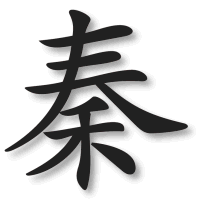
QIN22I - 206 B.C. |
|
In 246 BC at the age of 13 Qin Shihuang had come to the throne as King Chen of Qin. Once the King of Qin consolidated his power, he took the title Shi Huangdi (First Emperor), a formulation previously reserved for deities and the mythological sage-emperors, and imposed Qin's centralized, nonhereditary bureaucratic system on his new empire.
The advisor to the King of Wei put down his concerns in 221 BC:
"The King of Qin has a waspish nose, eyes like slits, a chicken breast and a voice like a jackal. He is merciless with a heart of a tiger or wolf. When in difficulties, he willingly humbles himself. When successful, he swallows men up without scruple [...] should he succeed in conquering the empire, we shall all become his captives."
In 221 B.C. the western frontier state of Qin, the most aggressive of the Warring States, subjugated the last of its rival states. Much of what came to constitute China Proper was now unified for the first time in history.
In subjugating the six other major states of Eastern Zhou, the Qin Kings had relied heavily on Legalist scholar-advisers. Centralization, achieved by ruthless methods, was focused on standardizing legal codes and bureaucratic procedures, the forms of writing and coinage, and the pattern of thought and scholarship. The standardized writing system throughout the empire helped unite ethnic groups whose spoken languages were incompatible.
To silence criticism of imperial rule, the Kings banished or put to death many dissenting Confucian scholars and confiscated and burned their books.
"No fewer than three hundred astrologers are watching the stars but these good men for fear of giving offence, merely flatter the emperor and dare not speak of his faults. It is he who decided all affairs of state great or small. He even has the documents weighed every morning and night, and will not rest until a certain weight has passed through his hands. How can we find the herbs of mortality for such a tyrant. And so they ran away.... Four hundred scholars were tried and found guilty of breaKing the law. They were buried alive in Xianying as a warning to the whole empire. "
Qin aggrandizement was aided by frequent military expeditions pushing forward the frontiers in the north and south.
The Great Wall
To fend off barbarian intrusion, the fortification walls built by the various warring states were connected to make a 5,000-kilometer-long great wall. What is commonly referred to as the Great Wall is actually four great walls rebuilt or extended during the Western Han, Sui, Jin, and Ming periods, rather than a single, continuous wall. At its extremities, the Great Wall reaches from northeastern Heilongjiang Province to northwestern Gansu.
A number of public works projects were also undertaken to consolidate and strengthen imperial rule. These activities required enormous levies of manpower and resources, not to mention repressive measures.
"He gave orders for two hundred and seventy palaces and pavilions within 200 li of Xianyang to be connected by causeways and covered walks and furnished with hangings, bells, drums and beautiful ladies each in the appointed place. Disclosure of his whereabouits became punishable by death."
Revolts broke out as soon as the first Qin emperor died in 210 B.C. His dynasty was extinguished less than twenty years after its triumph.
The imperial system initiated during the Qin dynasty, however, set a pattern that was developed over the next two millennia.
The text is based on, CHINA - a Country Study by Federal Research Division, Library of Congress, Edited by Robert L. Worden, Andrea Matles Savada and Ronald E. Dolan. Research Completed July 1987. This version and Webpage © Jan-Erik Nilsson, Gothenburg, Sweden, 2002