

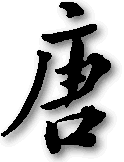
TANG618 - 907
|
|
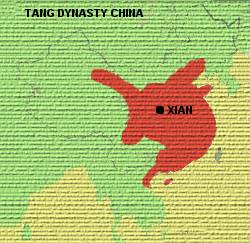 The territory during Tang,
Chinese civilization underwent a major transformation during the period spanning the turn of the third century (Late Han dynasty) to the mid-eighth century (High Tang dynasty) as a result of the massive immigration of people from Northern Asia into China and extensive trade contacts with all parts of Asia.
The Tang dynasty (A.D. 618-907), with its capital at Chang'an (Xi'an), is regarded by historians as a high point in Chinese civilization - equal, or even superior, to the Han period.
During the Tang dynasty China became an expansive, cosmopolitan empire. The capital city, Chang'an, became the world's largest city and attracted traders and pilgrims from all over the world. Foreign influences enriched Chinese art and culture.
Its territory, acquired through the military exploits of its early rulers, was greater than that of the Han. Stimulated by contact with India and the Middle East, the empire saw a flowering of creativity in many fields. Buddhism, originating in India around the time of Confucius, flourished during the Tang period, becoming thoroughly sinicized and a permanent part of Chinese traditional culture. Block printing was invented, making the written word available to vastly greater audiences.
The Tang Dynasty was the golden age of literature and art. No other period in history has enjoyed such a great number of poets and works of poetry on such scale and of such quality. Quantangshi, the large collection of Tang poetry, contains nearly 50,000 poems by 2,200 poets. Representative poets include Li Bai, Du Fu and Bai Juyi.
|
|
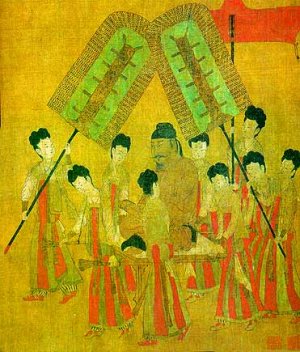
Emperor Taizong (627-649), the second emperor of the Tang Dynasty attended by court ladies.
The original painting at the Palace Museum, Beijing. |
A government system supported by a large class of Confucian literati selected through civil service examinations was perfected under Tang rule. Written examinations had been introduced during the previous Sui dynasty to identify true Confucians and test literary abilities. The Tang expanded this examination system, set up state schools, and issued authorized versions of the Confucian Classic texts. This competitive procedure was designed to draw the best talents into government. But perhaps an even greater consideration for the Tang rulers, aware that imperial dependence on powerful aristocratic families and warlords would have destabilizing consequences, was to create a body of career officials having no autonomous territorial or functional power base. As it turned out, these scholar-officials acquired status in their local communities, family ties, and shared values that connected them to the imperial court. From Tang times until the closing days of the Qing empire in 1911, scholar-officials functioned often as intermediaries between the grass-roots level and the government.
By the middle of the eighth century A.D., Tang power had ebbed. Domestic economic instability and military defeat in 751 by Arabs at Talas, in Central Asia, marked the beginning of five centuries of steady military decline for the Chinese empire. Misrule, court intrigues, economic exploitation, and popular rebellions weakened the empire, making it possible for northern invaders to terminate the dynasty in 907. The next half-century saw the fragmentation of China into five northern dynasties and ten southern kingdoms.
The text is based on, CHINA - a Country Study by Federal Research Division, Library of Congress, Edited by Robert L. Worden, Andrea Matles Savada and Ronald E. Dolan. Research Completed July 1987. This version and Webpage © Jan-Erik Nilsson, Gothenburg, Sweden, 2002