
By the mid-19th century, a very persistent rumor suggested that the ship still contained untold treasures, particularly a significant amount of valuable tin located deep within the hull's lowest parts. Throughout the century, this belief motivated several diving companies to explore the wreck. While it remains speculative, it is worth considering that among the merchant population of Gothenburg at that time were some of the most hardworking and sharpest businessmen and industrialists of their era. They were undoubtedly aware of international events such as the Napoleonic Wars (1803–1815), which stimulated the invention of preserved food in tin cans in general; the California Gold Rush (1848–1855), which generated a demand and significant wealth to pay for it; and the American Civil War (1861-1865), which marked a turning point for the acceptance of food in tin cans. Indeed, the import price of tin from England fluctuated widely, from £87 per ton in 1864, dropping to £52 in 1878, and then surging to £159 in 1892, as reported by the Ann Arbor Argus in 1892. These fluctuations would have offered any speculatively inclined individuals a wealth of interesting opportunities.
The first of them was Andrew Bourn, a wholesale merchant who also ran a professional salvaging company with his own ship. Andrew Bourn was born in London 1818, and died in Haga, Gothenburg, 1893. His business ranged from various products of which were building material and iron products, some were food and spirits. As a curiosity he seems to have exported large quantities of lingonberries preserved in water. He occurs in contemporary newspaper offering his diving service towards several maritime accidents and shipwrecks. In 1860 he owns a diving ship and was also importing three crates of diving equipment from England. [GHT September 2, 1860].
A. Bourn distinguished himself among the salvagers and optimistic divers by in 1862 using explosives to access the area where the tin was supposedly stored. This approach resulted in millions of pieces of broken porcelain being strewn over the remains of the ship from the blasts, and a massive disappointment, when the few pieces of metal that were found turned out to be zinc. Although the zinc was of good quality, it did not cover the costs of the salvage operation. It appears likely that this approach also caused the hull to break into three pieces of which two large enough to offer a problem for the navigations as when they slowly migrated downstream the Göta älv.
Andrew Bourn salvages with his diving equipment some porcelain in perfect condition, wood and iron from the Gotheborg "all of which will likely be donated to the Gothenburg Historical Museum". source: Göteborgs Handels- Och Sjöfartstidning 1862-10-10. Aftonbladet 1862-10-13 and a large number of other newspapers carries the same information a few days later.
One of the divers appears to have been Johan Kjellberg, that diving in the 1860s succeeded in taking up 77 dozen pieces (924 pcs) of porcelain.
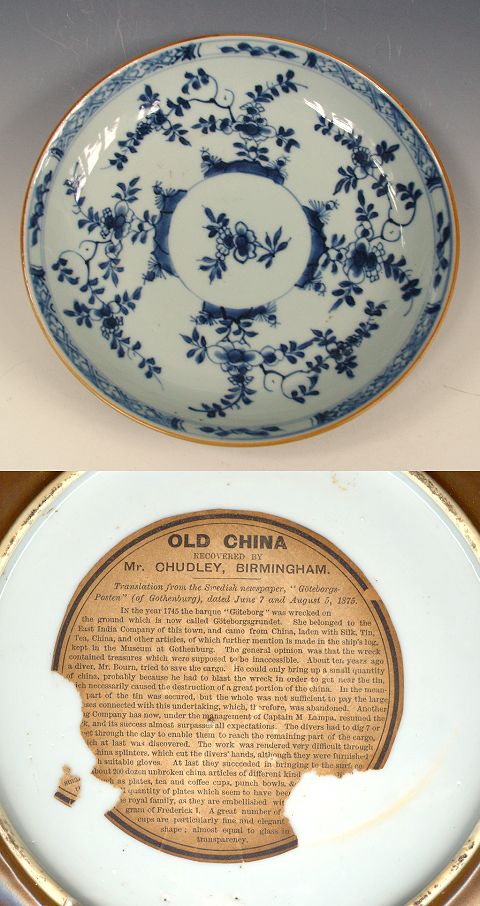
On the base of a shallow bowl a darkened paper label 'with a translation from Göteborgs-Posten' of 1875.
Reconstructing lost text can be challenging, but here's an attempt to fill in the gaps. This reconstruction is speculative and aims to create a coherent narrative based on the existing label on the 'Mr. Chudley dish' label fragment. It's important to consider that the actual content may have differed in a few words. (JE Nilsson, 20 November 2023)
Translation from Swedish newspaper, Göteborgs Posten (of Gothenburg) dated June 7 and Aug 5, 1875
In the year 1745, the barque 'Göteborg' was wrecked on the ground which is now called Göteborgsgrunded. She belonged to the East India Company of this town, and came from China, laden with Silk, Tin, Tea, China, and other articles, of which further mention is made in the ship's log, kept in the museum at Gothenburg. The general opinion was that the wreck contained treasures which were supposed to be inaccessible. About 10 years ago, a diver, called Mr. Bourn, tried to salvage the cargo. He could only bring up a small quantity of china, probably because he had to blast the wreck in order to get near the tin, which necessarily caused the destruction of a great portion of the china. In the meantime, part of the tin was secured but the whole was not sufficient to pay the large expenses connected with this undertaking which therefore was abandoned. Another diving company has now, under the management of Captain M Lampa, resumed the work, and its success almost surpasses all expectations. The divers had to dig 7 or more feet through the clay to enable them to reach the remaining part of the cargo, which at last was discovered. The work was rendered very difficult through numerous china splinters, which cut the divers' hands although they were furnished with suitable gloves. At last, they succeeded in bringing to the surface about 200 dozen unbroken china articles of different kinds and designs, such as plates, tea and coffee cups, punch bowls, and even a small quantity of plates which seem to have been intended for the royal family, as they are embellished with the monogram of Frederik I. A great number of porcelain cups are particularly fine; almost equal to glass in transparency.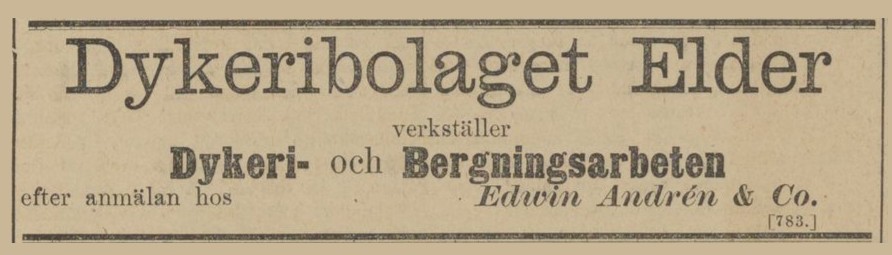
During the period 4th December, 1875 to June 8, 1876 the diving company advertised their services via the Wholesale Merchant Edwin Andrén & Co, in Göteborgs Handels- och Sjöfartstidning (GHT) all in all 9 times. GHT is often referred to as the source, in many contemporary local newspapers, reporting on the diving's on the Gotheborg. Edwin Andrén was together with the English Counsel Duff a long time friend of John Chudley, and were both called to appear at the court hearing after John Chudley's suicide Monday 29 May, 1876. John W Chudley seems to have been running a iron manufacturing company in Sheffield and considered very well off. In Gothenburg a company called John W Chudley & C:o, with office at Drottningatan 14, appears to have been active receiving imports until at least 1877. How he got to become involved in the salvaging of porcelain from the Gotheborg remains a mystery. I think we however can trust the information he gives at the base of a dish from the cargo, in 1875.
The Salvage Work at the Gothenburg Reef.
As previously mentioned, the local diving company 'Elder' began last year in May (1875) to use its divers to recover the remaining cargo from the large ship 'Gothenburg', which sank in 1745 near the Gothenburg Grounds, just off Elfsborg. This ship, belonging to the former East India Company, was on a journey from China, fully loaded with porcelain, tin, silk, and more.
The salvage work, which was led by Captain Mauritz Lampa (1828-1882), continued well into autumn with great speed. The divers managed, often after significant effort, to bring up a haul from the sea bed, located over 20 alnars deep (about 12 meters), which is of great value both economically and culturally.
Although several individual divers had searched the large wreck many times over the 130 years since its sinking, the new company found several rooms in the ship where the cargo was still in the same condition as when it was stowed.
According to the report recently submitted to the County Governor (Konungens befallningshavande, landshövdingen) by the company about the recovered goods, it consists of:
| Item | Quantity |
| Urns with lids | 130 |
| Larger and smaller bowls in various shapes | 2712 |
| Large and dessert plates | 636 |
| Large plates | 522 |
| Smaller plates | 384 |
| Various types of cups | 1158 |
| Diverse porcelain | 204 |
| Total | 5746 |
In light of the report received, the Royal Commander (kon. befh:de) has in his announcements "urged" unknown owners to come forward within a year and prove their ownership of the mentioned goods.
It is likely that after this period, the items will be sold at public auction.
Salvage Works at the Gothenburg Reef
As previously mentioned, the local diving company 'Elder', under the leadership of Captain Mauritz Lampa, has been actively continuing the salvage operations at the site of the 'Gothenburg' shipwreck. This ship, belonging to the East India Company, sank just off Elfsborg, in the year 1745. Since our last update on the discoveries made on the 'Gothenburg', a significant amount of various types of porcelain has been brought up, such as plates, tea and coffee cups, butter dishes, tureens, and some punch bowls, etc.
Among the plates found, a smaller quantity seems to have been intended for the court, as they bear the monogram of King Fredrik I. A large part of the porcelain, especially the coffee cups, is particularly fine and elegantly shaped, nearly transparent like glass.
It has been observed that the majority of the intact porcelain recovered was probably intended for smuggling. For example, divers found about 200 dozen porcelain items of all kinds loosely packed under the lining between the bottom oak beams in the hold. This might explain an old, widely accepted local tradition, which claims that the 'Gothenburg' was deliberately grounded to conceal a committed fraud.
Captain Lampa recently came to believe that the most significant part of the cargo had been salvaged after the shipwreck, while what he and his divers found mainly constituted the bottom ballast, except for some of the porcelain.
During the initial salvage, it might have been neither possible nor safe to attempt to save the hidden porcelain, forcing it to be abandoned. This has led to a rumor among the locals that there was also smuggled goods on board, which later evolved into the aforementioned tradition, persisting to this day.
Among other findings, ginger covered in bark has been noted. When peeled, the ginger was found to be perfectly fresh inside - a noteworthy fact considering it had been at the bottom of the sea for 130 years. The ginger has fared better than iron, as the contents of a found nail chest have turned into a single heavily oxidized mass.
Some tin and lead foil have also been found, suggesting where tea and possibly other items stored in such metal were located. As mentioned last time, some bars of fine tin were found, which were thought to yield a good profit if more were found. Indeed, a considerable number of such bars have been found, but they are not made of tin, but of the finest quality zinc.
It is likely that the divers have now retrieved most of what remained of the cargo in the ship; they are currently occupied with bringing up pieces of the ship's hull itself, which had a lining of lead, some of which has been melted down. Between the decking and the outer pine boards was a layer of cattle hair in undamaged condition still stuck onto the wood.
The main focus of the salvage is now on the oak planks. These planks, some of considerable size, are completely fresh and hard; likewise, some oak bottom beams, like the planks when brought up, are completely covered with porcelain shards. The diving company has transported these planks to Gamla Varvet for inspection by carpenters or others, as the oak would be excellently suited for furniture manufacturing, which would undoubtedly have its quaint appeal.
On a smaller dish similarly identified as the "Chudley" above a shorter version of the text is found, dated April 1876.
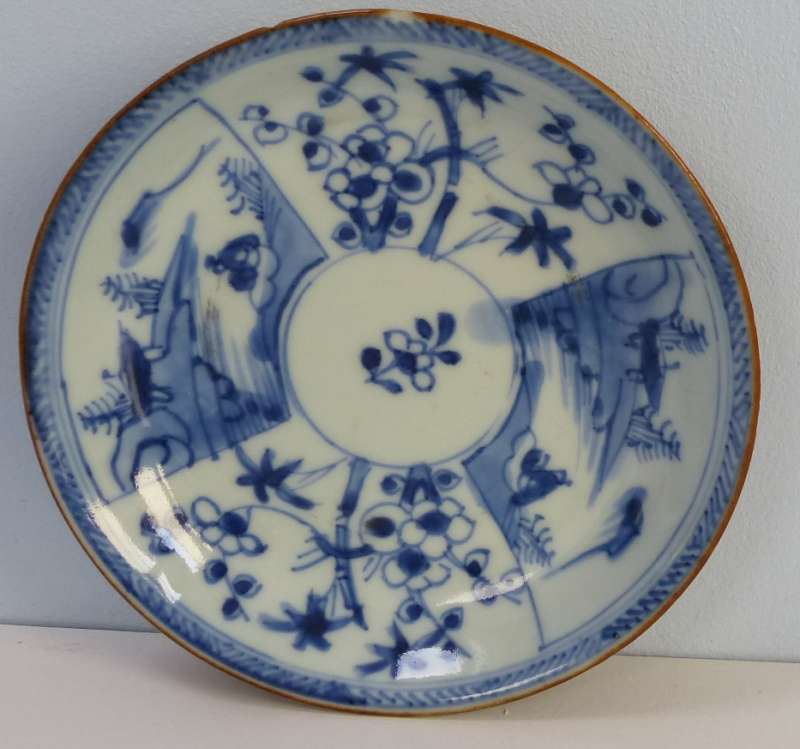
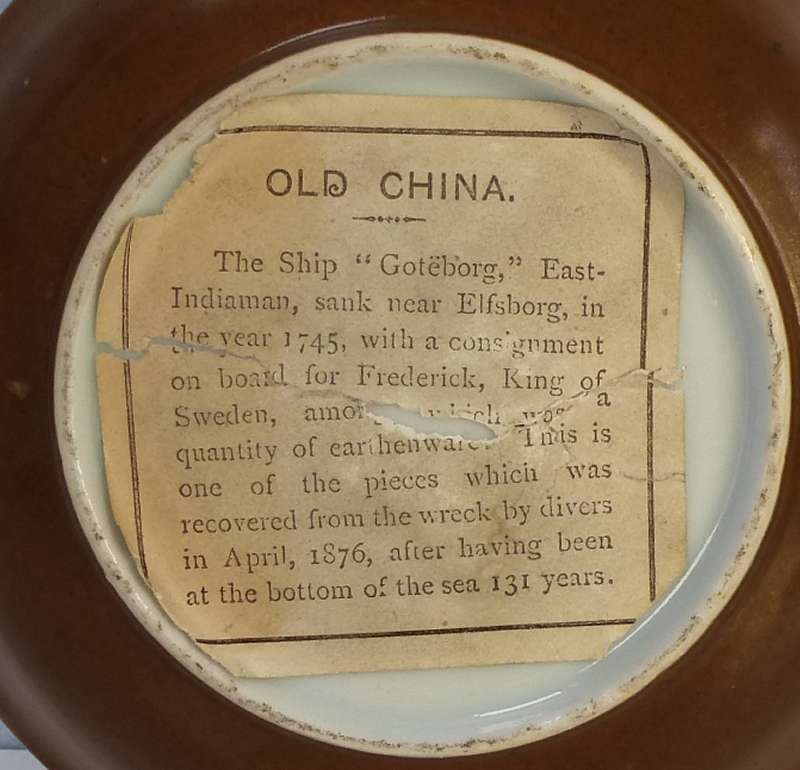
According to the Swedish Customs regulations, the items auctioned off in April 1876 must have been salvaged at least one year earlier, making it likely that it was salvaged up until the autumn of 1874. The same day as the first auction viewing Wholesale Merchant Mr. John W. Chudley from Birmingham arrives via Sheffield, two of Great Britain's most important industrial cities situated in the middle of England, and as per usual holes up at Hotel Göta Källare.
GÖTEBORGS-POSTEN, Friday, April 21, 1876.
Reported Travelers. ... Chudley fr. Sheffield …
Customs Auction.
On Tuesday, April 25th at 10 a.m., there will be an auction held in a warehouse on the property of Färjenäs near Gothenburg. The following batch of porcelain, etc., salvaged from the sea bed of the East Indiaman "Gothenburg," which sank near Elfsborg in 1745, will be sold: namely 98 1/2 dozen plates, 153 dozen spillkummar (a mid size bowl), 67 dozen cups, 77 dozen coffee cups, some with saucers; 10 dozen larger cups with lids, and a batch of metal ingots. The above-mentioned goods will be sold in smaller lots and are available for viewing at the location on Friday, April 21, and Saturday, April 22, from 10 a.m. to 4 p.m. Gothenburg Customs Confiscation Office, March 30, 1876.
| Item | Number |
| 98 1/2 dozen plates | 1 182 |
| 153 dozen 'spillkummar' (mid size bowls) | 1836 |
| 67 dozen cups | 804 |
| 77 dozen coffee cups, some with saucers | 924 |
| 10 dozen larger cups with lids | 120 |
| A batch of metal ingots | - |
| Total | 4 866 |
According to an English genealogy site J. Chudley & Co in Birmingham were only around for a relatively short period of time (from about 1871 to 1879'ish), as John Wonnacott Chudley took his own life in 1876 in Gothenburg, Sweden. The shop was located at 3 St Mary's Row in Moseley, a suburb of south Birmingham and might also have taken up numbers 4 and 5 as well. They made swords but might have been general iron mongers who made a wide variety of items (not just swords). His wife was Jessie Eliza Chudley.
Old East Indian Porcelain.
As known, the diving company 'Elder' has recovered various East Indian porcelain from a sunken ship belonging to the East India Company, the 'Gothenburg', which sank in 1745 near the Gothenburg ground, outside Elfsborg.
After this was sold at auction, the company continued its diving work and found a considerable amount of additional porcelain, consisting of tea and coffee cups with saucers, larger and smaller plates, jugs, etc.
This porcelain, which, according to experts, is partly of better quality than the previous find, will soon also be sold at public auction.
Since the company has even recovered the decking planks, which are made of oak and surprisingly still in good condition, there is nothing more to retrieve from the old East Indiaman."
In 1906-07 James Keiller the Younger made another more ambitious salvaging attempt. According to the accounts, the result of this effort was that not less than 4,300 pieces of porcelain were recovered, plus a large number of porcelain shards. Yet of the entire porcelain cargo, of between 500,000 - 700,000 pieces and hundreds of thousands of objects, only a limited number could possible have been recovered after the ship went down. The placement of the porcelain, along with the violence of the grounding where the rock struck right up to the foot of the foremast (Bagge, 1746), and not least Andrew Bourn's blasting of the wreck in the summer of 1862, which turned the majority of the remaining porcelain into millions of porcelain flakes that must have swirled around everywhere, must have contributed to the fact that very little porcelain could be left in any kind of intact condition in and around the wreck.
*) 1864-1885. Royal Governor: Count Albert Carl August Lars Ehrensvärd, born January 10, 1821, in Björkö parish, Jönköping County, died January 31, 1901, in Tosterup parish, Kristianstad County, was a Swedish count, civil servant, politician, Foreign Minister from 1885 to 1889, member of the Riksdag's first chamber from 1867 to 1874 and from 1877 to 1890, and Governor of Gothenburg and Bohus County from 1864 to 1885. He was also the governor from whom the 'Landshövdingehusen', characteristic of Gothenburg, got their name.
 Back to Gotheborg.com Home Page