
This page is only one of many thousands of Gotheborg.com Help and Information Pages, offering specialized knowledge on Chinese and Japanese Porcelain, including a Glossary, Q&A, Chinese and Japanese Porcelain Marks, Chinese Porcelain Exhibition and Excavation reports etc. For personal help and far more information, join our Discussion Board or use 'Ask a Question' for quick email consultations. For full text and better navigation, use a full-screen device rather than a mobile phone, that offers only limited content.
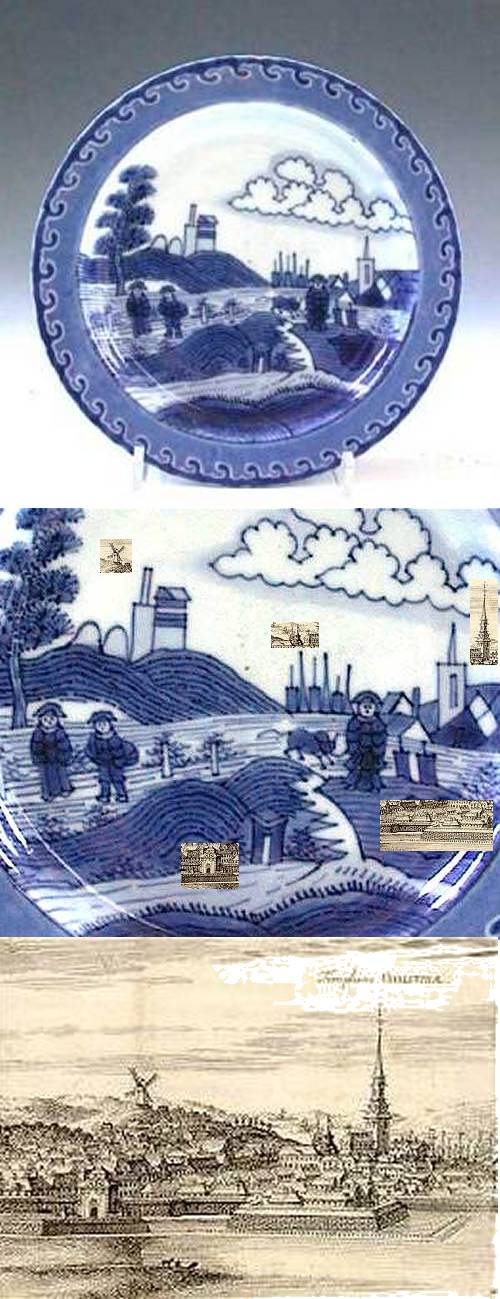
The above thickly potted dish is Chinese Export Porcelain plate and is found in the excavated cargo of a Chinese cargo ship found outside of Vietnam, near a village called Vung Tau. A large number of the porcelain found in this cargo carries a Yongzheng period (1723-1735) mark (Yongzheng Nian Zhi) and can because of this not be earlier than that. The cargo fits stylistically well with that period and the date have never been challenged.
It is generally said to be decorated in the style of the Dutch Delft Pottery decorator Frederik Van Frytom (1632 - 1702). Van Frytom is know to have decorated a series of small dishes made for the tea-ceremony in Japan, marked MB and dated 1684. (Frederik Van Frytom 1632 - 1702, Life And Work Of A Dutch Pottery-Decorator By A.Vecht Scheltema and Holkema NV, Amsterdam, 1968).
This decoration seems to appear both on contemporary Chinese and Japanese porcelain. It is widely published as being of the Deshima Island in the Nagaski harbour. Something that need to be wrong since the Nagasaki harbour has never looked even remotely like this. To mention just one thing - its inland was the Nagasaki city - not the wet and grassy pasture as on this dish.
It is highly likely though that the plate is made by Dutch order and even more likely is that a close previous pattern presented to the Japanese or Chinese might have been a Dutch tile.
For a background we need to remember that Japan was first visited by westerners in 1543 and in 1549 targeted by the Jesuit missionary Frans Xavier as the key to the Christening of the closed China. The small fishing village of Nagasaki soon grew to a city with 30 000 inhabitants thanks to the westerners activities.
During the course of time the Japanese well founded doubts in the intents of the smelly foreigners resulted in the Dutch traders being confined to a small man made island - Deshima Island - in the Nagasaki harbor. From this the profitable trade with Japan was continued by the Dutch despite a massive distrust.
Against this background it is understandable that the decoration of this plate have been supposed to be depicting this important trading station. Unfortunately this does not fit with the reality.
One place - also with strong Dutch connection - which DOES look like this is the city of Gothenburg on the Western coast of Sweden. Gothenburg was built as a trading station by the Dutch on much the same plan as "Batavia" or nowadays Jakarta and actually also "New Amsterdam" - today better known as New York.
Everybody familiar with Erik Dahlbergs important Swedish prints collection Suecia Antiqua et Houdierna depicting all cities and building of importance in Sweden by the end of the 17th century, will recognize the central part of the print of the city of GOTHEBORG, published in 1709.
Even the cow being lead on a leash by a farmer is present. The odd structure in the left top middle on the plate would then be the Kvarnberget wind mill and the gate in the middle match and explains the main city entrance - The Kings Gate - facing South to "Danska Vägen".
The curious and unexplained "half houses" on the dish appears exactly the same on the print by the simple reason that on the print, they have their lower part hidden behind the city walls.
This suggestion is published here for the first time, and based solely on my observation and familiarity with the city of Gothenburg. A detail of the original print of Gothenburg 1709, is shown above. The dish and this pattern is widely published in books on Chinese and Japanese export porcelain.
Jan-Erik Nilsson
 Back to Gotheborg.com Home Page