
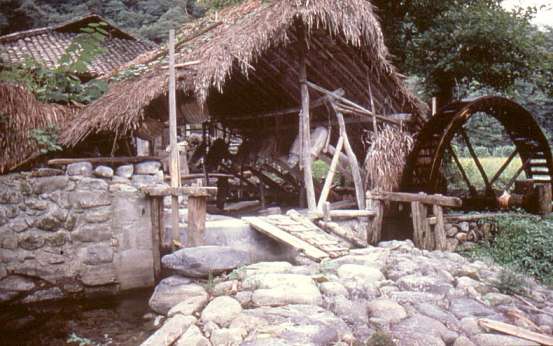
"The natives take advantage of the mountain torrents to erect wheels provided with crushers (trip hammers).
Having been finely pulverized, it is then purified by washing and levigation[1], and made up in the form of bricks, which are called pai-tun or white bricks (petuntse)"
Photo © Jan-Erik Nilsson, 1992
This section contains the full text of the "Twenty Illustrations of the Manufacture of Porcelain" written by Tang Ying, the celebrated superintendent of the porcelain manufacture in the province of Jiangxi during 1736-1753.
The first draft seems to date from 1735 and was on Imperial command added to a set of "twenty illustrations of the manufacture of porcelain" in 1743. The original document is one of the most important texts there is on how antiques Chinese Porcelain was actually made. Unfortunately the actual illustrations that this text were to explain have never been identified, but there are quite a number of export paintings on the manufacture of porcelain that appears to have been copied from or at least having been inspired by the original set.
This text is immediately based on the translation that was made by S.W. Bushell in 1899, and has carefully been edited here to simplify reading.
Almost all Chinese Porcelain was - and still are - made in the town of Jingdezhen on the banks of the Chang river in the southern Chinese province of Jiangxi. At the height of the China trade, thousands of kilns and workshops turned out millions of pieces of porcelain each year. All was done in an assembly line way where each worker performed a simple, yet specialized task. The Jesuit missionary to China, Père d'Entrecolles, took down that one piece of porcelain could pass through the hands of as many as seventy craftsmen. Even when decorating the porcelain each craftsman specialized in a specific element in the design "and human subjects was often treated the worst", he wrote.
Today, porcelain is still made in Jingdezhen using basically the same manufacturing processes as described by Tang Ying more than 250 years ago. In 1991 and 1992 I had the privilege of spending a few weeks in Jingdezhen together with Professor Bo Gyllensvärd and thus had the possibility to document both the processes involved in the porcelain making as well as a number of the places mentioned in the text, and of great importance to the history of Chinese porcelain. The pictures illustrating Tang Yings text here, is from this set, taken by me during these visits in 1991 and 1992.
Jan-Erik Nilsson
[1] Levigation is the process of grinding an insoluble substance to a fine powder, while wet. The material is introduced into the mill together with water, in which the powdered substance remains suspended, and flows from the mill as a turbid liquid or thin paste, according to the amount of water employed.
This page is based on an original translation from Chinese by S.W. Bushell, 1899, of a text written on Imperial command in 1743 by Tang Ying, the celebrated superintendent of the porcelain manufacture in the province of Jiangxi. It is widely reprinted. The version most likely to be authentic is the version found in the official annals of the province of Jianxi, Book XCIII, folio 19-23. The first draft seems to have been written in 1735. The version above was added to a set of 'twenty illustrations of the manufacture of porcelain' in 1743. The actual illustrations have never been identified. The text as it appears here is illustrated with photos taken on location by Jan-Erik Nilsson in 1991 and 1992.