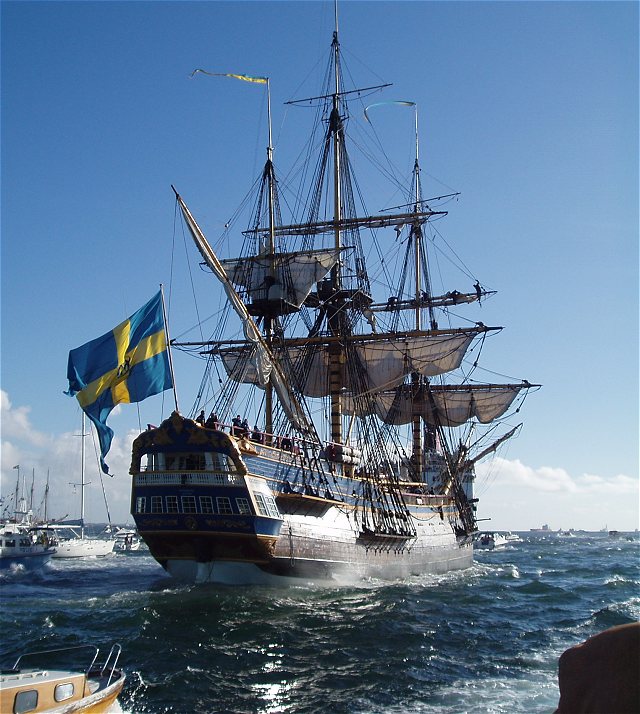
The 2nd of October 2005 our rebuilt replica of the East Indiaman Gotheborg is leaving Gothenburg for her voyage to China. In a few moments she will safely pass the exact location where the original foundered on homecoming in 1745. |
During 1992 Anders and Berit Wästfelt - two single persons, not hired by anyone but themselves - put together a core group of specialists that would be responsible - one for each group that made up the project - to reconstruct a wooden replica of the Swedish East Indiaman Gotheborg, and to sail with her to China and back. The financial security would be same as theirs, none. The obstacles innumerable, the chanse of success almost nil.
Needless to say, I jumped at the occasion. I mean, who wouldn't?
At this time Anders and Berit had just spent about ten years excavating the original Swedish East Indiaman Gotheborg (lost on homecoming in 1745) and in the process of doing this built up an enormous amount of goodwill and a large network of enthusiastic supporters that could be trusted upon helping in this next step. The loss of the Gotheborg in 1745 had been one of the most spectacular disasters in Gothenburg, evar. Now we wanted to turn this into one of the most spectacular marketing projects of the 20th century, and just hope we should not hit that stupid ground again once we got out on open water.
During the following six years to come we built this project from the ground up, asked by nobody except ourselves to do it and, paid by nobody. I worked with this as an amateur East India Trade specialist and as a professional marketing specialist - together with Anders Wästfelt trying to explain that China would become a most important trade partner in the future and that this project was the way to go if we wanted to connect Swedish trade and industries to this marker. In the early 1990s the Cultural Revolution was far from forgotten and very few could see what we cold see, that China was on the go.
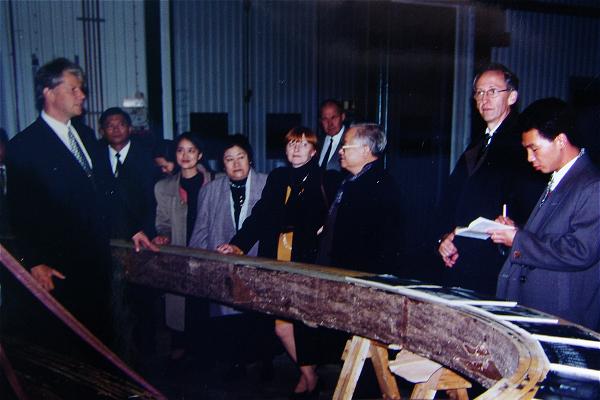
But the Chinese knew themselves what they were doing and Chinese delegation after delegation came, looked and eventually dragged their unwilling Swedish hosts to see what we were doing. Maybe the grandest friendship gesture ever made between one country to another. Only, this was not really Swedish government run,. It wasn't even City of Gothenburg run. It was private, run by Anders, Berit, me and a handful more private people who were literally carrying this whole project on our own shoulders.
Eventually the project got off the ground, the ship got built and eventually between 2005-2007 made a spectacular voyage to China and back. Here I have chosen to make a number of documents available on how this uniquely successful project came to be and some on how it was followed through. Every aspect except how and it was actually started has been covered by countless books, TV-programs and interviews, thousands of newspaper articles and I belive even a couple of full length movies.
The few thing we knew for sure when we started this in 1992 was that it would benefit Sweden immensely if we could swing it, and that we would call it the The Swedish East Indiaman Gotheborg III Adventure.
This is the story on how that worked out.
Jan-Erik Nilsson
PS An additional archive with the old outdated project web site and more documents (Swedish only) is available at http://www.ostindiefararen.com
More than 260 years ago, in March 1743 the first East Indiaman with the name of Gotheborg was resting safe and snug in a protected bay in the Western Swedish archipelago, right next to the islands of Styrso where I sit and write these words right now. It was early spring and she was waiting for winds that could carry her out on the North Sea. Soon Captain Moreen would give the order to cast loose and depart for what for her and many in her crew would be their last voyage, ever. The destination was Canton, in China.
Eventually she set sail and for two and a half year nobody heard anything from her. Then, in the morning of the 12th of September 1745 she appeared against the horizon outside the home harbor of Gothenburg. Joy and Glory - she's back! But suddenly, with a shattering crash she hit an underwater rock and sank within viewing distance from land. A loss and disaster beyond belief! Silk and tea for millions of $ was watersoaked and destroyed and deep down in the hull was the porcelain cargo of the Gotheborg, around 100 tons, or about 300,000 pieces shattered to pieces. Or were they? The salvaging of what could be salvaged from the immensely valuable cargo started immediately. On and off it actually continued for two centuries.
So far, the cause and even the full extent of the disaster remains a mystery. What actually happened is cast in clouds. Neither archive research nor recent excavations where eight years was spent sifting through tons of mud, soggy tea and porcelain shards - has given any proof of what actually happened. Despite achive finds of long lost documents, the rumor remains that there were something terrible wrong with the whole thing.
In a final attempt to solve the mystery, the 2nd of October in 2005, a rebuilt replica of the East Indiaman Gotheborg left Gothenburg to recreate the entire voyage to China and back. The whole project as well as the excavation was all started by a small group of enthusiastic professionals, each experts in their fields. With no public funding behind them whatsoever and with no other resourses except our own plans, knowledge and willpower. Since I was one of them, here is my story about how it all begun.
Jan-Erik Nilsson
It all started the 9th of December 1984 when Anders Wästfelt and a couple of friends made the first plunge in the cold and muddy water in the entrance of the Swedish Port of Gothenburg and found a large amount of porcelain shards 'spread out on an area the size of a foot ball field'.
Or maybe it all started in 1745 when the East Indiaman Gotheborg fully laden on homecoming from China after a two year long voyage ran into a rock in the Gothenburg port entrance and sank. And nobody seemed to be able to tell why.
Or, maybe it started already in 1718 when the Swedish King Charles XII was shot just outside the fortress of Frederikshald, and the Swedish era of Great Power screeched to a halt with the unfavorable peace treatises that followed?
However, to me it all started in early 1985, when I met up with Anders Wästfelt and his diver friends to take a look at what they had found. I could immediately tell that they had indeed rediscovered the Gotheborg. I also knew that I somehow wanted to be involved in this, were they to go down there again. They assured me, they would.
In early 1985 I was looking for ways to put dates on ordinarly 18th century Chinese export porcelain. One of the few firm reference points avalilable at that time was the porcelain cargo of the East Indiaman Gotheborg that so conveniently had foundered at the port entrance just outside of the City of Gothenburg. Quite a number of porcelain finds from this wreck were exhibited at the Gothenburg Historical Museum. The available information suggested that in 1906-09 a salvage operation run by James Keiller and Carl Lyon had cleaned out the whole site leaving nothing behind.
However, from Anders Wästfelts finds, it now appeared that this was not the case. So if that was wrong, what else was wrong? How much was actually left?
After about a year of research and preparations Anders and Berit Wästfelt were in 1986 redy to start a large scale marine archaeological excavation of the 1745 Gotheborg wreck site. Over the years to come, this would get the attention of the whole world and build up a massive good-will capital that would be drawn on for the continuation - the rebuilding of the Gotheborg - the Gotheborg III Project.
During the last few years of the excavation phase Anders Wästfelt had in 1990 begun to include the idea of building a full scale replica of the original ship Gotheborgin his presentations at the excavation base camp. In October 1992 the idea was worked out enough to be officially presented. During 1993 I joined the project Executive Management Committee as in charge of 'Research and Documentation' where the documentation part was related to the fact that my profession was marketing and that I as an arts historian was one of the foremost experts on the Swedish East India trade and history. I figured both, would be needed before this was over.
The site of the former Eriksberg shipyard, Göteborg, autumn of 1993. The project was still a vision and SOIC AB was not yet founded. We were firmly determined that on this muddy piece of industrial wasteland we would build a ship that would sail to China. But, first we needed to recreate the 18th century 'Terra Nova' shipyard. To the left Anders Wästfelt describing his plan. |
General Hull and Rigging plan. Hull reconstruction draft: Joakim Severinsson, Rigging: Olof Pipping. Fore and aft ship decoration drawing: Roland Rydén. |
The Executive Management Committee was the core group of the project. Ours was the task to set up a solid organsation that could get the project started, find a way to collect funds, interest sponsors, motivate the entire project, hire staff, find experts in all possibly fields necessary for something that had not been done for centuries, and and this with almost no funds whatsoever to work with. Such were the reality of starting something like this. It had no doubt been easier if someone had asked us to do it, then we would have had someone to complain to. As it were our options were to dig in and get going or, to give up and go home. So we dug in and very soon the Gotheborg III Project was moving, aimed at building a sailing replica of this ship, sailing it to China and back - hopefully without running into a rock on homecoming this time - as we put it to take a little bit of the edge of the intimidating scale of what we were attempting to do. I still have the highest regard for those who were the first to help, and all members of this first committee. It was fool heartedly, dead stubborn, fun and, we made it.
The 6th of June 2003 The Gotheborg III is launched from the Terra Nova shipyard.
Swept in the white smoke of gunpowder the salute is booming across the Gota Älv River again.
However wild, fun and fantasy enticing this project was, it was based on a solid and well thought out business plan. We also gave it a complex but solid organization, where the shipbuilding would be the mean to a much larger end and the synergies would be so many that the ship could not help being built in the process.
Also going for this project was that it was based on a genuine feeling of friendship between the people of Sweden towards our old trade partners, the people of China and all countries along the sailing route. It was basically a public project but it was not asked for, started by or - in particular - not funded by the government or any local authorities. It was just us. A small group of professionals who happened to think this felt like a very important thing to do. In this we had the support of thousands of ordinary citizens, members of the friends organization plus hundreds of small companies from the local industry. The one basic thought was that old friends should be fine doing business with each other again. The ship would also be a perfect focal point for many efforts in that direction. We also decided to be a little bit "Chinese" in that we would not bother worrying about the time factor. Even if it took many years to make this work, we needed to start 'now', and it would still be a good thing whenever it was done.
The 2nd of October 2005 The Gotheborg III departs from the inner harbour pier in Gothenbourg followed by the cheers of tens of thousands of spectators.
The white smoke of gunpowder and the thunder claps of the salute is booming across the Göta Älv River once again.
The grand Gotheborg III project is now into the last of the three phases; excavation - rebuilding - voyage. The ship is now well on its way to China. Since I belive many might find it interesting with some of the background information to this project, I have made a chronology and some of the information the project brought to life available on-line. Even if everything did not turn out exactly the way we planned it, I think that nobody today feel anything but pride about their part in that the ship was actually built.
Currently my big heroes are the people who now actually are sailing the ship to China.
More information and pictures will be added as time permits.
Jan-Erik Nilsson
Gothenburg, October 2005