
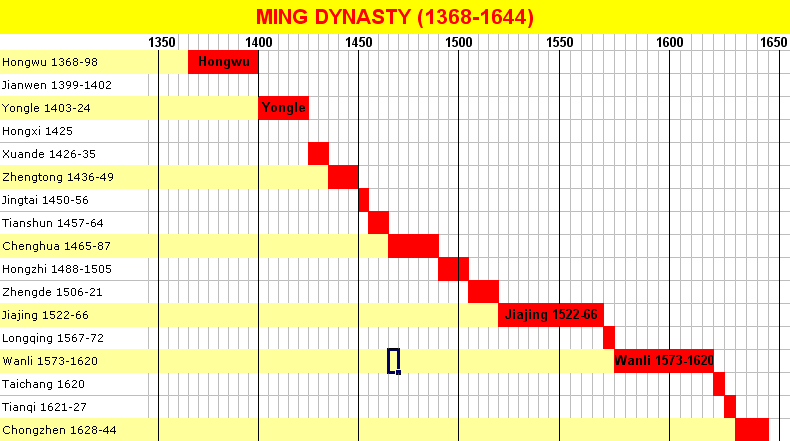
This chart shows the relative length and sequence of the various period during the Ming dynasty (1368-1644). This chart has been copied and in my view, quite improved, and submitted to Wikipedia. Since plagiarism is the most honest kind of flattery, I am very pleased. They even kept my color scheme, which is my case was inspired by "Imperial yellow".
What makes things difficult is that the Ming dynasty was actually quite a long time ago, it's actually called Medieval times in most of the world, and mankind was actually trying things out, that they were about to do for the very first time. So, there were no set rules to a lot of things.
Like what requirement you need to have on porcelain that was about to be considered "Imperial" about half a millennia later. This said, what I am aiming at is that some of the porcelain that was delivered to the Imperial court in Beijing, in particular by the end of the dynasty, was most probably just commissioned from the better of the private kilns. This means that at this time there are no complete agreement among scholars about what was imperial and not. We can guess, but most likely we can never know for sure what was made for the court or not.
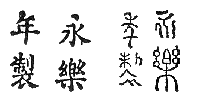
Marks are helpful but as a general rule the last thing you should trust while trying to establishing a date on a particular piece of Chinese porcelain. By a careful study of all technical and artistically features - including the mark - the authenticity of most Chinese porcelain is possible to establish. We should however be aware of that the best copies are those still not detected.
| Hongwu 1368-1398 洪武 | |
|---|---|
 |
Alternate titles: Gaodi; Hung-wu; Taizu; Zhu Chongba; Zhu Yuanzhang 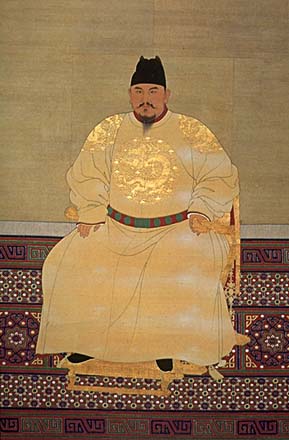
The Hongwu emperor; in the National Palace Museum, Taipei. The Ming dynasty's founder, the Hongwu emperor, is one of the strongest and most colorful personalities of Chinese history. His long reign established the governmental structure, policies, and tone that characterized the whole dynasty. His reign as emperor With the south pacified, Zhu sent his generals Xu Da and Chang Yuchun to lead troops against the north. At the beginning of 1368 Zhu finally proclaimed himself emperor of the Ming dynasty, establishing his capital at Nanjing. Hongwu ("Vastly Martial") was adopted as his reign title, and he is usually referred to as the Hongwu emperor, though Taizu is more strictly correct. The troops sent to conquer the north were highly successful. Shandong and Henan provinces submitted to Ming authority. By August 1368, Ming troops had entered the Yuan capital of Dadu (later renamed Beijing). The Mongol emperor Shundi fled to Inner Mongolia, and, although Mongol power was not immediately destroyed, historically the Yuan dynasty now came to an end. The rest of the country fell easily as Ming troops subdued first the northwest, then the southwest (Sichuan and Yunnan). Unification was completed by 1382. The Hongwu emperor was cruel, suspicious, and irrational, especially as he grew older. Instead of eliminating Mongol influence, he made his court resemble the Mongol court, and the despotic power of the emperor was institutionalized for the rest of the dynasty. One of his political acts was to grant principalities to all his sons, ostensibly from fear of another Mongol invasion, so that the imperial princes could be given military powers to aid the regular armies. A contributing factor was his interest in maintaining personal control over the empire through his sons' principalities. Despotic tendencies The trend toward political despotism can be seen in the Hongwu emperor's various other actions. In 1380 the prime minister Hu Weiyong was implicated in a widespread plot to overthrow the throne and was executed along with 30,000 members of his clique. The emperor consequently abolished the prime ministership in perpetuity as well as the central chancellery. Thus, the next highest level of administration, the six ministries, became merely advisory to the emperor himself, who now exercised direct control. This change had serious defects, the most important being the inability of even the most vigorous emperor to attend to all the affairs of state. In an attempt to overcome this difficulty, the emperor made use of six or more grand secretaries, who were responsible for routine administration. The institution of the grand secretaries evolved from that of the Hanlin Academy, the original function of which was to assist in the education of the heir designate. Although superior in practice to the six ministries, the grand secretaries (later institutionalized as the grand secretariat) were mere servants of the despotic emperor. The Song emperors, learning from the Tang dynasty's experience, had felt that the militarists were the most dangerous group in the country and had purposely encouraged the scholar class, but the Hongwu emperor felt that, after the Mongol expulsion, the scholars formed the most dangerous group. Nevertheless, his interest in restoring traditional Chinese values involved rehabilitating the Confucian scholar class, and from experience he knew that effective government depended upon the scholars. He therefore encouraged education and purposely trained scholars for the bureaucracy. At the same time he used methods to deprive them of power and position and introduced the use of heavy bamboo as a punishment at court, often beating to death scholar-officials for the slightest offense. He felt that scholars should be mere servants of the state, working on behalf of the emperor. Because of the emperor's attitude, a great many members of the gentry were discouraged from embarking on official careers. Administration To train scholars for the bureaucracy, the Hongwu emperor in 1369 ordered the establishment of schools at each local level. Students were subsidized and were privileged to apply for admission to the Hanlin Academy, which presumably formulated policy and supervised the local schools. As a result of this edict, more schools developed during the Ming than in previous periods of Chinese history, and education became inseparable from civil-service recruitment by examination, the realization of which had been an ideal during the Tang and Song dynasties. Imperial authorities controlled the system of examination as far down as the provincial examinations that provided candidates for the metropolitan and palace examinations at the capital. The examination system made it possible to recruit the best minds for governmental service, though examinations stressed only the Song Neo-Confucian interpretation of the Classics and forced candidates to write in an artificial literary style, discouraging the development of originality. The Hongwu emperor's military system, the weiso ("guard-post") system, was of earlier origin. The practice of granting land to soldiers for cultivation in peace realized his ideal of having the troops support themselves so as not to burden the people. Foreign affairs In foreign relations the Hongwu emperor extended the Ming empire's prestige to outlying regions: southern Manchuria was brought into the empire; outlying states, such as Korea, the Liuqiu (i.e., Ryukyu) Islands, Annam, and other states, sent tribute missions to acknowledge the suzerainty of the Ming emperor; and, not satisfied with the expulsion of the Mongols, he sent two military expeditions into Mongolia, reaching the Mongol capital of Karakorum itself. Ming forces even penetrated Central Asia, taking Hami (in the Gobi) and accepting the submission of several states in the Chinese Turkistan region. When Ming emissaries traversed the mountains to Samarkand, however, they were met with a different reception. Timur (one of history's greatest conquerors) was building a new Mongol empire in that region, and the Chinese envoys were imprisoned. Eventually, they were released, and Timur and the Ming exchanged several embassies, which the Chinese regarded as tributary missions. Timur was preparing an invasion of China when he died in 1405. The Hongwu emperor was less successful with Japan, the buccaneers of which ravaged the Chinese coast. Three missions went to Japan, armed with inducements and threats, but were unable to curb piracy, because the Japanese authorities were themselves helpless. The succession A great problem for the Hongwu emperor was the succession. His first choice, made when he was prince of Wu, was Biao, his eldest son, later known as the heir designate Yiwen. As the Hongwu emperor's reign progressed there were indications that he favored his fourth son, Di, the prince of Yan, whose principality was at Beijing and whose personal qualities and military ability were more impressive. In 1392, when the heir designate Yiwen died, the Hongwu emperor was persuaded to appoint Yiwen's eldest son as his successor, rather than the prince of Yan, who was angered by this decision. After the Hongwu emperor's death in June 1398, he was succeeded by his grandson Yunwen, known in history as Huidi, or the Jianwen emperor, who reigned until 1402, when the throne was usurped by the prince of Yan (the Yongle emperor). Conclusion In his progress from a mendicant monastery to the imperial palace, the Hongwu emperor illustrates the chaos into which China had fallen under the preceding late Yuan dynasty. The Yuan rulers were alien Mongol conquerors who had nevertheless absorbed many Chinese features during their reign. Their administration was faltering by the Hongwu emperor's time, and his achievement, first as rebel leader and then as emperor, was to focus national resentment against the foreign rulers and to resuscitate a more truly Chinese way of government. This he did so forcefully that his reign has been seen as a culmination of the despotic trends that had been in evidence since the Song dynasty (960–1279). He considered certain groups (for instance, maternal relatives; court eunuchs, who were often entrusted with power; and the military) as having been peculiarly prone to intrigue in the past, and vigorously stamped out such tendencies. He prohibited eunuchs, for instance, from participating in government, forbade the empress to meddle with court politics, and appointed civilian officials to control military affairs. Of lowly peasant origins, he always was aware of the popular misery that administrative corruption could engender, and he savagely punished malpractices Main source: Hongwu. 2015. Encyclopædia Britannica Online. Retrieved 24 June, 2015, from http://global.britannica.com/biography/Hongwu |
| Jianwen 1399-1402 建文 | |
| Jianwen 1399-1402 建文
After the Hongwu emperors death in 1398 his grandson and successor, the Jianwen 建文 emperor, trying to assert control over his powerful uncles, provoked a rebellion on the part of the Prince of Yan and was overwhelmed in 1402. |
|
| Yongle 1403-1424 永樂年製 | |
 |
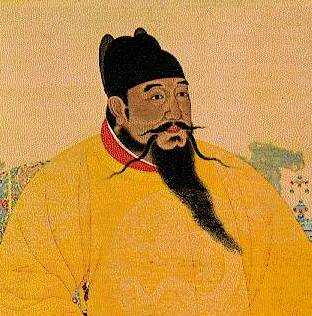
The Yongle emperor, detail of a portrait; in the National Palace Museum, Taipei. Wade-Giles romanization Yung-lo, temple name (miaohao) (Ming) Chengzu or (Ming) Taizong, posthumous name (shi) Wendi, personal name Zhu Di. Born May 2, 1360, in Yingtian, now Nanjing, Jiangsu province, China - August 5, 1424, Yumuchuan (now in Inner Mongolia), en route to Beijing). In 1403 the Prince of Yan took the throne as the Yongle emperor (reigned 1402–24) and proved to be vigorous and aggressive. Third emperor (1402–24) of China's Ming dynasty (1368–1644), which he raised to its greatest power. Returned the empire's capital from Nanjing to Beijing (Northern City), which was rebuilt with the Forbidden City and giving that city its present-day name. Subjugated Nam Viet, campaigned personally against the reorganizing Mongols in the north and sent large naval expeditions overseas, chiefly under the eunuch admiral Zheng He, to demand tribute from rulers as far away as Africa. Youth and early career Zhu Di's father, the Hongwu emperor, had rapidly risen from a poor orphan of peasant origin through stages as a mendicant Buddhist monk and then a subaltern in a popular rebellion against the Mongol rulers of the Yuan dynasty to become a virtually independent satrap in part of the rich eastern Yangtze River (Chang Jiang) valley, with his headquarters at Yingtian (Nanjing). There Zhu Di was born fourth in a brood that ultimately numbered 26 princes. Modern scholarship has suggested that Zhu Di was probably borne by a secondary consort of Korean origin, although in traditional Chinese fashion he always treated his father's principal consort, the revered and influential empress Ma, as his "legal" mother. In 1360 Hongwu was struggling with other contenders for supremacy in the Yangtze valley, while the Yuan government at Dadu (Beijing) was all but immobilized by court factionalism. In the next seven years the Hongwu emperor's armies swept central and eastern China clear of opposition, and in 1368 he inaugurated the new Ming dynasty, with its capital at Nanjing. He drove the last Mongol emperor out of Beijing and then beyond the Great Wall and the Gobi. At the age of 10, in 1370, Zhu Di was designated prince of Yan (an ancient name for the Beijing region). As he grew to manhood during the next decade, the new Ming empire was stabilized, an elaborate governmental apparatus was erected, and a new socioeconomic order characterized by authoritarian reconstruction in many fields was instituted. The boy grew up in the mold of his remarkable father—robust, vigorous, and temperamental—and he became his father's favourite. His natural leadership qualities clearly outshone those of his many brothers. In 1380, at the age of 20, the prince of Yan took up residence at Beijing. The early Ming governmental system provided that the imperial princes other than the eldest son, who remained at Nanjing as heir apparent, be enfeoffed in strategic areas as regional viceroys. Through the 1380s the prince of Yan gained experience in patrolling and skirmishing along the northern frontier under the tutelage of the greatest generals of the age. In 1390 he and his older half brother the prince of Jin (enfeoffed in adjacent Shanxi province to the west) were given joint command of a patrolling expedition beyond the Great Wall, and in 1393 they assumed full supervisory control over defense forces of the whole central sector of the northern frontier. Thereafter, the prince of Yan campaigned almost annually to keep the fragmented and disorganized Mongols off balance and on the defensive. Meanwhile, in 1392, the heir apparent died. Some historians believe that the aging Hongwu emperor seriously considered naming the prince of Yan his new heir, in violation of tradition and the household rules he had himself promulgated. The emperor did hesitate for almost half a year before designating his successor, but then he complied with tradition by investing the dead crown prince's son Zhu Yunwen, then only 15 years old. From this time forward, and especially after the deaths of his two remaining seniors in 1395 and in 1398, respectively, the prince of Yan became increasingly arrogant and imperious; when the old emperor died in the summer of 1398 the prince of Yan, in full vigour at the age of 38, considered himself the de facto head of the imperial clan and expected to be treated deferentially by his nephew. The young new emperor Zhu Yunwen (the Jianwen emperor) had other intentions. Influenced by Confucian scholar-officials, he instituted a series of reforms unsettling to the newly stabilized government. One of his major goals was to take regional power away from the princes, and in 1398–99 one prince after another was imprisoned, exiled, or driven to suicide. Thus the prince of Yan found himself steadily more isolated and endangered, and in August 1399 he rose in rebellion, declaring it his avuncular duty to rescue the inexperienced emperor from his malicious advisers. The rebellion lasted from 1399 into 1402 and devastated much of western Shandong province and the northern part of the Huai River basin. The central government at Nanjing seems to have underestimated the prince of Yan's strength and failed to muster its manpower and matériel effectively; the war was a long stalemate. In early 1402 the prince of Yan's forces broke through the imperial armies in the north, sped almost unopposed southward along the Grand Canal, accepted surrender of the imperial fleet on the Yangtze River, and were admitted into the walled capital by court defectors in July 1402. Four days after the fall of Nanjing, the prince of Yan took the throne himself, although he did not formally begin his rule until 1403; he took the reign name Yongle ("Perpetual Happiness"). The Jianwen emperor had disappeared. Whether he died in a palace fire (as was officially announced) or escaped in disguise to live many more years as a recluse is a puzzle that troubled Zhu Di until his own death and has been a subject of conjecture by Chinese historians ever since. Accession to the throne The accession brought terrible retribution to those who had most closely advised Jianwen. They and all their relatives were put to death. Before the purge ended, thousands had perished. The new emperor also revoked the institutional and policy changes of his nephew-predecessor and even ordered history rewritten so that the founding emperor's era name was extended through 1402, as if the Jianwen emperor had never reigned at all. The one reform policy that remained in effect was that princely powers must be curtailed. Hence, the surviving frontier princes were successively transferred from their strategically located fiefs into central and south China and were deprived of all governmental authority. From the Yongle period on, imperial princes were no more than salaried idlers who socially and ceremonially adorned the cities to which they were assigned and in which they were effectively confined. No subsequent Ming emperor was seriously threatened by a princely uprising. As the Yongle emperor, Zhu Di was domineering, jealous of his authority, and inclined toward self-aggrandizement. He staffed the central government with young men dependent on himself and relied to an unprecedented extent on eunuchs for service outside their traditionally prescribed palace spheres—as foreign envoys, as supervisors of special projects such as the requisitioning of construction supplies, and as regional overseers of military garrisons. In 1420 he established a special eunuch agency called the Eastern Depot (Dongchang) charged with ferreting out treasonable activities. Although it did not become notorious in his own reign, it came to be a hated and feared secret police in collaboration with the imperial bodyguard in later decades and centuries.The Yongle emperor also relied heavily on a secretarial group of young scholar-officials assigned to palace duty from the traditional compiling and editing agency, the Hanlin Academy, and by the end of his reign they became a Grand Secretariat, a powerful buffer between the emperor and the administrative agencies of government. Although the emperor, like his father, was quick to anger and sometimes abused officials cruelly, he built a strong and effective administration, and during his reign China settled into the generally stable political and socioeconomic patterns that were to characterize the remainder of the dynasty. Like his father, Yongle had little personal respect for the higher forms of Chinese culture. In the fashion of the Mongol khans, he summoned to China and highly honoured a Tibetan lama, and the strongest intellectual influence on him may have been that of a monk named Daoyan, a long-favoured personal adviser. Along more orthodox lines, his government sponsored the compilation and publication of Confucian and Neo-Confucian Classics, and it most notably sponsored the preparation in manuscript form of a monumental compendium of literature called Yongle dadian ("The Great Canon of the Yongle Era") in more than 11,000 volumes, which preserved many works that would otherwise have been lost. But the emperor himself must have considered such activities a kind of busywork for litterateurs who enjoyed public esteem but not his personal trust. A military man of action, the Yongle emperor had little enough patience with unavoidable administrative business, much less with intellectual exercises. Foreign policy In the early years of his reign, he seems to have been fascinated by the regions beyond China's southern borders, perhaps in part because of rumours that the Jianwen emperor had escaped overseas. In 1403 the Yongle emperor sent out three fleets under eunuch commanders to proclaim his accession throughout Southeast Asia as far as Java and southern India. More vigorously than any other ruler in Chinese history, he sought recognition from faraway potentates in these regions. Throughout his reign "tributary" missions regularly traveled to China from overseas, including local kings of Malacca and Brunei. Most renowned of the Yongle emperor's many ocean admirals was the Muslim eunuch Zheng He, who led grand armadas on seven great voyages between 1405 and 1433. Zheng He visited no fewer than 37 countries, some as far away as the Persian Gulf, the Red Sea, and the east coast of Africa almost as far south as Zanzibar, and from all the states that he visited Zheng He brought home envoys bearing tribute to acknowledge the Yongle emperor's overlordship. The emperor similarly sent a eunuch emissary on repeated tribute-seeking missions to Tibet and Nepal and a civil servant across Central Asia to Afghanistan and Russian Turkistan. The Yongle emperor became the only ruler in Chinese history to be acknowledged suzerain by the Japanese, under the Ashikaga shogun Yoshimitsu. For a short time the Japanese were so docile as to send their own subjects to the Chinese court for punishment as piratical plunderers of the Korean and Chinese coasts. But the succession of a new shogun brought about a less submissive attitude in Japan; from 1411 on, no tribute missions arrived from Japan despite the Yongle emperor's inquiries, and Japanese raiders became active again on China's coast. The emperor then threatened to send a punitive expedition against Japan if it would not reform. But in 1419, when the shogunate brusquely denied responsibility for any piratical activities and refused to resume the former tributary relationship, the Yongle emperor was too preoccupied with other matters to do more than grumble. The Yongle emperor's expansionist inclinations led China into an ultimately disastrous military adventure against China's southern neighbour, Dai Viet (Vietnam, called Annam by the Chinese). In 1400 the young Tran dynasty, heir to the Dai Viet throne, had been deposed and a new dynasty proclaimed. From the beginning of Yongle's reign Tran loyalist refugees urged him to intervene and restore legitimate rule, and, when his own envoys to Annam were murdered, in 1406, the emperor authorized a punitive campaign. Chinese forces rapidly occupied and pacified Annam. Because no Tran heir seemed available, the Yongle emperor in 1407 transformed Dai Viet from a tributary state into the new Chinese province of Annam. Local resistance broke out almost immediately and continued irrepressibly. Especially after 1418, guerrilla warfare against the Ming authorities made the Chinese position in Annam increasingly precarious. By that time the emperor had lost most of his early interest in the southern regions, and the situation was allowed to deteriorate until his grandson, the Xuande emperor, realistically, albeit with some humiliation, abandoned direct Ming rule of Annam in 1428. During the early years of the Yongle emperor's reign, the northern frontier, traditionally the zone of greatest danger to any Chinese regime, was relatively quiescent. At the outset of his Beijing-based insurrection in 1402, the Yongle emperor had sought and won the support of the Mongol tribes directly to his rear, in northeastern China. In later payment for this support, he in effect gave these Urianghad Mongols virtual autonomy by withdrawing China's command posts south of the Great Wall, and he regularly sent the Urianghad chiefs substantial gifts. Other tribes beyond the northern frontier—the Eastern Mongols, or Tatars, and the Western Mongols, or Oyrats—were too disorganized to do more than struggle among themselves. In the far west, the Turko-Mongol empire builder Timur (Tamerlane) had already invaded and pillaged both India and Syria when the Yongle emperor came to the Chinese throne, and in 1404 Timur prepared to launch an expedition against China. Vaguely aware of this, the Yongle emperor alerted his commanders in the west to prepare for trouble; but Timur died in 1405, and the expedition was canceled. Thereafter, the emperor maintained amicable relations with Timur's heirs at Samarkand and Herat, keeping the Central Asian trade routes open. After his early years on the throne, the Yongle emperor's attention was diverted from the south back to the northern frontier by the emergence of an effective new Tatar leader named Aruqtai. In 1410 the Yongle emperor resumed the aggressive extramural patrolling in the north that had preoccupied him as a prince in the 1380s and '90s. Between 1410 and 1424 the emperor five times personally led grand armies northward into the Gobi, primarily against Aruqtai but occasionally against Oyrats or restless Urianghad groups. The campaigns culminated in only a few battles, in which the Chinese forces won indecisive victories, but they had the effect of forestalling the development of a new large-scale Mongol confederation that might have seriously threatened China. Astute diplomacy was also relied on during these years to keep the Mongols fragmented and to establish at least nominal Chinese authority over the Juchen (Chinese: Nüzchen, or Ruzhen) peoples in the far northeast, as distant as the Amur River (Chinese: Heilong Jiang). Transfer of the capital to Beijing The most notable domestic event of the Yongle emperor's reign was the transfer of the national capital and the central government from Nanjing to Beijing. This reflected and symbolized the emperor's and the country's shift of attention from the southern oceans to the northern land frontiers. Beijing was perhaps not the ideal site for the national capital: it historically had been associated primarily with "barbarian" dynasties such as the Yuan, it was far removed from China's economic and cultural heartland, and it was dangerously close and exposed to the northern frontier. But it was the Yongle emperor's personal power base, and it was a site from which the northern defenses could be kept under effective surveillance. In 1407 the emperor authorized transfer of the capital there, and from 1409 on he spent most of his time in the north. In 1417 large-scale work began on the reconstruction of Beijing, and thereafter the Yongle emperor never returned to Nanjing. The new Beijing palace was completed in 1420, and on New Year's Day of 1421 Beijing formally became the national capital. Before this transfer of the capital could be accomplished and before the northern defenses could be made satisfactorily secure, the Yongle emperor had to provide for the reliable transport of grain supplies from the affluent Yangtze valley to the north. Since the old Grand Canal linking the Yangtze and Huang He (Yellow River) valleys had been neglected for centuries and was largely unusable, coastal transport service around the Shandong peninsula was reorganized, and it proved spectacularly successful in the early years of the Yongle emperor's reign under the naval commander Chen Xuan. Rehabilitation and extension of old waterways in the north proceeded simultaneously, so that in 1411 sea transport vessels could enter the Huang He mouth south of Shandong and thus avoid the most perilous part of the coastal route; then Chen Xuan by 1415 successfully rehabilitated the southern segments of the Grand Canal, and sea transport was abandoned. With Chen Xuan serving as supreme commander of the Grand Canal system until his death in 1433, the new army-operated waterways complex, extending from Hangzhou in the south to outside Beijing, was able to deliver grain supplies in quantities adequate for the northern needs. In 1421, when Beijing became the national capital, deliveries began to exceed 3,000,000 piculs (200,000 tons) annually. The Yongle emperor's overseas expeditions, the ill-fated occupation of Annam, the northern campaigns, the rebuilding of Beijing, and the rehabilitation of the Grand Canal all required enormous expenditures of supplies and human effort. That China was able to undertake such projects during his reign gives evidence of the Yongle emperor's strong leadership, but they seem to have left the country exhausted and ready for an era of recovery under his successors. The emperor fell ill while returning from his campaign of 1424 into Mongolia and died at the age of 64 in August, when the army was still en route to Beijing. He was succeeded by his eldest son, Zhu Gaozhi, who had served ably as regent during his father's frequent long absences from the capital; he is known to history by the posthumous designation Renzong ("Benevolent Forebear"). The Yongle emperor fathered three other sons and five daughters. His principal consort was the empress Xu, daughter of the great early Ming marshal Xu Da; she died early in his reign, in 1407. The Yongle emperor was originally given the posthumous temple designation Taizong ("Grand Forebear"), a designation traditionally given to the second emperor of a dynasty. In 1538, long after that designation had come to be considered an unjustifiable insult to the memory of the Jianwen emperor, it was changed to the equally flattering Chengzu ("Completing Ancestor"), in acknowledgement that it was indeed Zhu Di who consolidated the new dynasty. Main source: Yongle. 2015. Encyclopædia Britannica Online. Retrieved 24 June, 2015, from http://global.britannica.com/biography/Yongle |
| Xuande 1426-1435 大明宣德年製 | |
The Xuande mark is said to have been written by the famous calligrapher Shendu, since the official mark of Xuande is following his hand writing. |
|
| Zhengtong emperor 正統 1435-49, 1457-1464 | |
For a century after the Yongle emperor, the empire enjoyed stability, tranquillity, and prosperity. But state administration began to suffer when weak emperors were exploited by favored eunuchs: Wang Zhen in the 1440s, Wang Zhi in the 1470s and '80s, and Liu Jin from 1505 to 1510. The only serious disruption of the peace occurred in 1449 when the eunuch Wang Zhen led the Zhengtong emperor (first reign 1435–49) into a disastrous military campaign against the Oirat (western Mongols). The Oirat leader Esen Taiji ambushed the imperial army, captured the emperor, and besieged Beijing. The Ming defense minister, Yu Qian, forced Esen to withdraw unsatisfied and for eight years dominated the government with emergency powers. When the interim Jingtai emperor (reigned 1449–57) fell ill in 1457, the Zhengtong emperor, having been released by the Mongols in 1450, resumed the throne as the Tianshun emperor (1457–64). Yu Qian was then executed as a traitor. |
|
| Jingtai 1449-1457 景泰 | |
After the Yongle emperor the empire enjoyed stability for a century. As weak emperors were exploited by favored eunuchs state administration began to suffer. The following period is known as the Interregnum despite several emperors did occupy the throne. The Jingtai Emperor, born Zhu Qiyu, was the seventh Emperor of the Ming dynasty, reigned from 1449 to 1457. The second son of the Xuande Emperor, he was selected in 1449 to succeed his elder brother Emperor Yingzong, when the latter was captured by Mongols following the Tumu Crisis. When the interim Jingtai emperor (reigned 1449–57) fell ill in 1457, the Zhengtong emperor, having been released by the Mongols in 1450, resumed the throne as the Tianshun emperor (1457–64). |
|
| Tianshun 1457-1464 天順 | |
| When the interim Jingtai emperor (reigned 1449–57) fell ill in 1457, the Zhengtong emperor, having been released by the Mongols in 1450, resumed the throne as the Tianshun emperor (1457–64). | |
| Chenghua 1465-1487 大明成化年製 | |
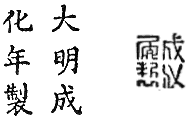
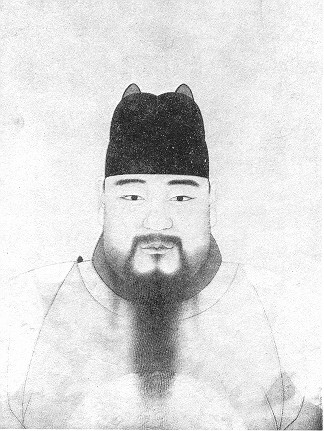
It is thought that during the Chenghua period there were only one calligrapher writing all marks on all official porcelains. I am not sure we can assume that, regardless of what the mark looks like. In the early 1990's I discussed this with Liu Xinyuan head of the excavations in Jingdezhen at this time, while spending some time studying their finds. He told the reason why the Chenghua mark looks like it does - in his opinion - was because the original mark was written by the emperor while he was quite young, and his handwriting was not so good. Whatever the case is, the Chenghua mark is inelegant, thick, often unbalanced and immature. Some common characteristics of the Chenghua porcelain mark by whatever hand but true to the period: |
|
| Hongzhi 1488-1505 大明弘治年製 | |
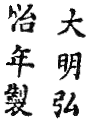 |
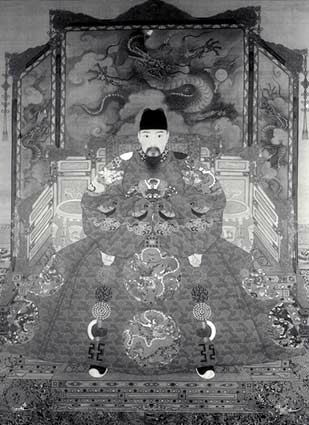 The Hongxi (reigned 1424–25), Xuande (1425–35), and Hongzhi (1487–1505) emperors were able and conscientious rulers in the Confucian mode.
|
| Zhengde 1506-1521 大明正德年製 | |
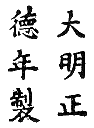 |
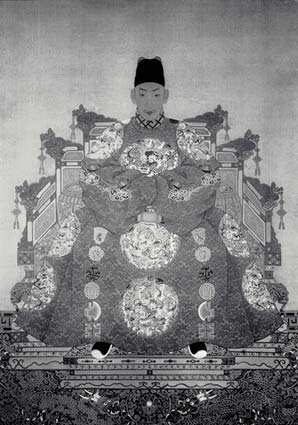 The Zhengde (reigned 1505–21) and Jiajing (1521–1566/67) emperors were among the less-esteemed Ming rulers. The former was an adventure-loving carouser, the latter a lavish patron of Daoist alchemists. Both emperors cruelly humiliated and punished hundreds of officials for their temerity in remonstrating.
|
| Jiajing 1522-1566 大明嘉靖年製 | |
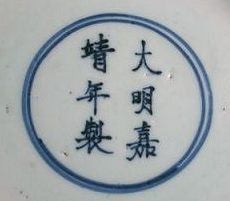 |
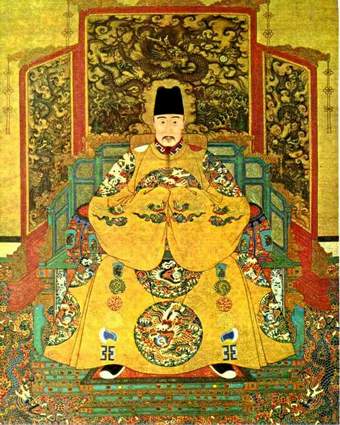
Wade-Giles romanization Chia-ching, personal name (xingming) Zhu Houcong, posthumous name (shi) Sudi, temple name (miaohao) (Ming) Shizong. Born 1507, China — died 1566/67, China. The 11th emperor of the Ming dynasty (1368–1644), whose long reign (1521–66/67) added a degree of stability to the government but whose neglect of official duties ushered in an era of misrule. For one period of 20 years, during the regime of an unpopular grand secretary named Yan Song, the Jiajing emperor withdrew almost entirely from governmental cares. China's long peace ended during the Jiajiang emperor's reign. The Oirat, under the vigorous new leadership of Altan Khan, were a constant nuisance on the northern frontier from 1542 on; in 1550 Altan Khan raided the suburbs of Beijing itself. "Japanese pirates" During the same era, Japan-based sea raiders repeatedly plundered China's southeastern coast. Such sea raiders, a problem in Yuan times and from the earliest Ming years, had been suppressed during the reign of the Yongle emperor, when Japan's Ashikaga shogunate offered nominal submission to China in exchange for generous trading privileges. However, changes in the official trade system eventually provoked new discontent along the coast, and during the 1550s corsair fleets looted the Shanghai-Ningbo region almost annually, sometimes sending raiding parties far inland to terrorize cities and villages throughout the whole Yangtze delta. Although coastal raiding was not totally suppressed, it was brought under control in the 1560s. Also in the 1560s Altan Khan was repeatedly defeated, so that he made peace in 1571. Notoriously cruel, Jiajing caused hundreds of officials who had the temerity to disagree with him to be tortured, demoted, or killed. He spent much of his time and money, especially in his later years, patronizing Daoist alchemists in the hopes of finding an elixir to prolong his life. The government was left in the hands of a few favourites who allowed the situation on China’s borders to deteriorate. Mongol tribesmen under the leadership of Altan Khan (died 1583) raided the northwest frontier and several times even besieged the Chinese capital at Beijing. Japanese pirates harassed trade along the coast, and rebellions in the southern provinces were frequent. Jiajing’s successors, however, were able to revive Ming power temporarily. |
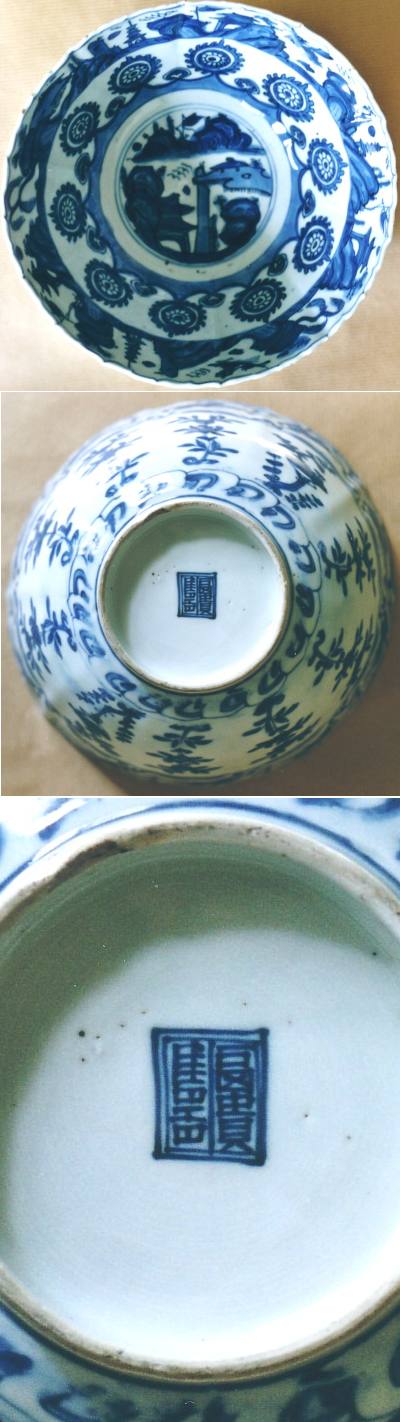
|
736. Fu Gui Jia Qi - 'Excellent Wares for the Wealthy Nobility' or 'Beautiful Vessel for the Rich and Honorable'. An auspicious inscription on folk wares, mostly seen on blue-and-white porcelain made in Jingdezhen in the Jiajing and Wanli reigns of the Ming dynasty and also seen on wares with gilt designs produced in the Jiajing reign. Chakra or, the flaming wheel-design on the inside. Estimated date C. 1600 according to some sources but probably Jiajing. Coll: Musée Antoine Lécuyer of Saint-Quentin (Aisne), France. |
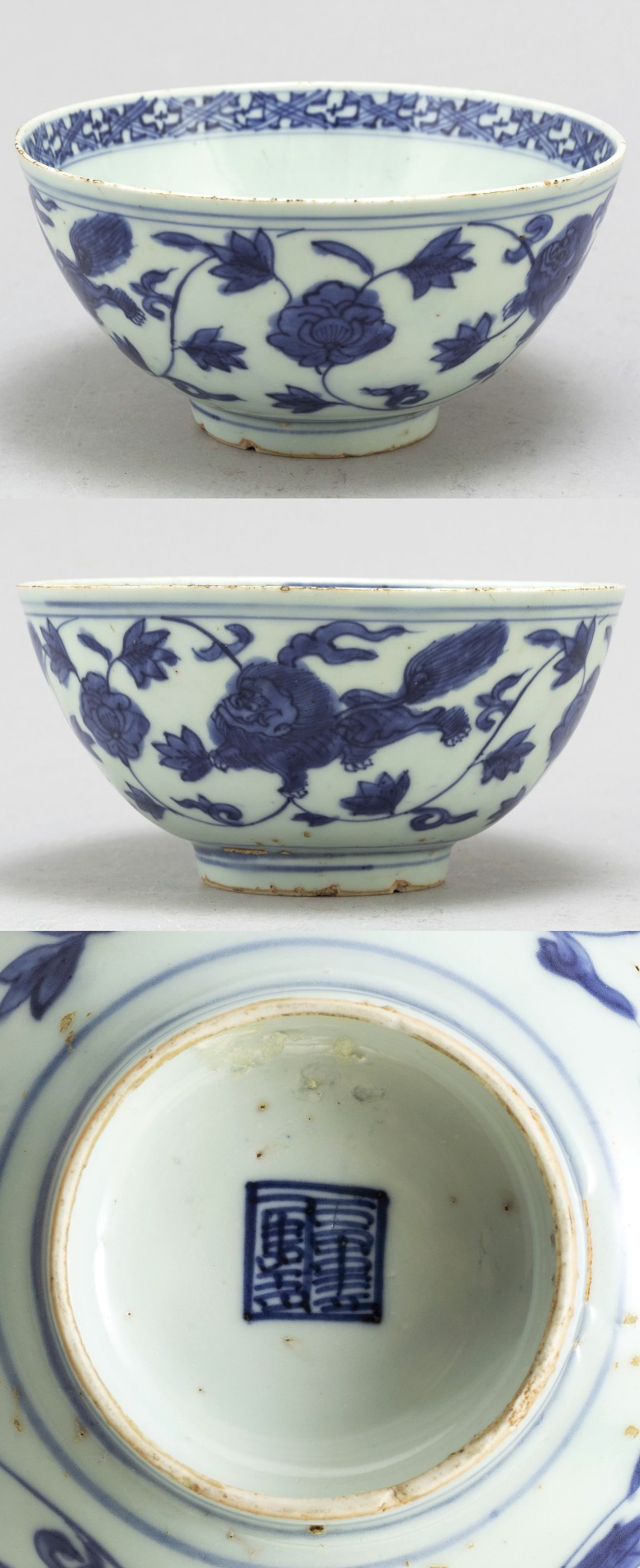
|
1577. Fu Gui Jia Qi - 'Excellent Wares for the Wealthy Nobility' or 'Beautiful Vessel for the Rich and Honorable'. An auspicious inscription on folk wares, mostly seen on blue-and-white porcelain made in Jingdezhen in the Jiajing and Wanli reigns of the Ming dynasty and also seen on wares with gilt designs produced in the Jiajing reign. Decoration on the outside of a Qilin or, a mythical lion-deer. Estimated date C. 1600 according to some sources but probably Jiajing. See: a bowl with similar mark at Musée Antoine Lécuyer of Saint-Quentin (Aisne), France. Gotheborg.com mark #736. |
| Longqing 1567-1572 大明隆慶年製 | |
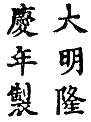 |
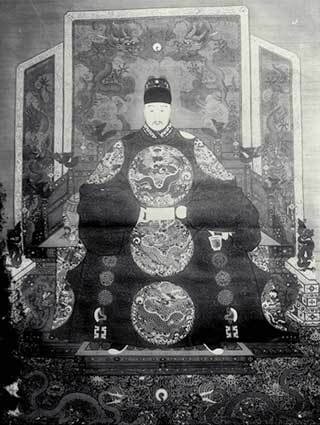
Wade-Giles romanization Lung-ch’ing, temple name (miaohao) Muzong, posthumous name (shi) Zhuangdi, original name Zhu Zaihou. Born 1537, China - died 1572, China. The 12th emperor (reigned 1566/67-72) of the Ming dynasty (1368–1644). In this short reign the famous minister Zhang Juzheng first came to power and the country entered a period of stability and prosperity. During the Longqing emperor’s reign the Mongol leader Altan (died 1583), who had been harassing China’s northern borders and had attacked the capital at Beijing, was repulsed and a peace treaty was signed. Government expenditures were limited and an attempt was made to wipe out corruption. For the next decade, during the last years of the Longqing emperor (reigned 1566/67–1572) and the early years of the Wanli emperor (1572–1620), the government was highly stable. The court was dominated by the outstanding grand secretary of Ming history, Zhang Juzheng, and capable generals such as Qi Jiguang restored and maintained effective military defenses. |
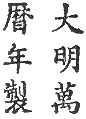
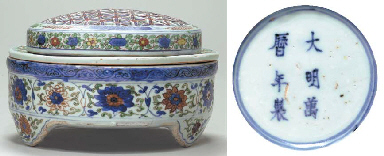
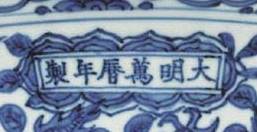
| Wanli 1573-1620 大明萬曆年製 | |
|
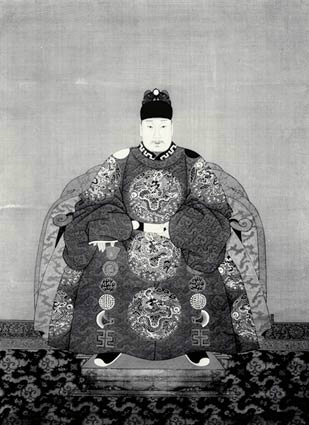
Wade-Giles romanization Wan-li, personal name (xingming) Zhu Yijun, posthumous name (shi) Xiandi, temple name (miaohao) (Ming) Shenzong. Born Sept. 4, 1563, China — Aug. 18, 1620, Beijing). In 1592, when Japanese forces under Toyotomi Hideyoshi invaded Korea, Ming China was still strong and responsive enough to campaign effectively in support of its tributary neighbor. But the Korean war dragged on indecisively until 1598, when Hideyoshi died and the Japanese withdrew. It made heavy demands on Ming resources and apparently precipitated a military decline in China. The Wanli emperor was a recluse whose apparent inattention to government affairs contributed to the abuses of power by provincial officials and other political figures that came to dominate that era of Chinese history. The violence and corruption among leaders of the northern provinces led to much dissatisfaction and unrest, preparing the way for the invasion from the north by the Manchu, who subsequently conquered all of China and established the Qing dynasty (1644–1911/12). Wanli’s reign also witnessed some of the earliest Western inroads into China, among them by the Italian priest Matteo Ricci. The reign of the Wanli emperor was a turning point of Ming history in other regards as well. Partisan wrangling among civil officials had flared up in the 1450s in reaction to Yu Qian's dominance and again in the 1520s during a prolonged "rites controversy" provoked by the Jiajing emperor on his accession; after Zhang Juzheng's death in 1582, it became the normal condition of court life. Through the remainder of the Wanli emperor's long reign, a series of increasingly vicious partisan controversies absorbed the energies of officialdom, while the harassed emperor abandoned more and more of his responsibilities to eunuchs. |
| Taichang 1620 大明泰昌年製 | |
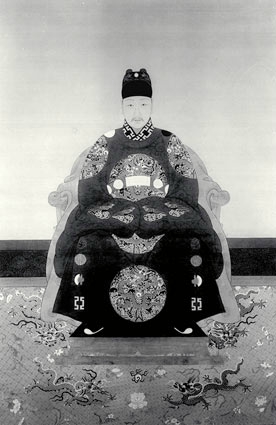
Born 28 August 1582 – 26 September 1620, age 38. The Taichang Emperor was the fourteenth emperor of the Ming Dynasty. He was born Zhu Changluo, the eldest son of the Wanli Emperor and succeeded his father as emperor in 1620. However his reign came to an abrupt end less than one month after his coronation when he was found dead one morning in the palace following a bout of diarrhea. The Wanli Emperor died on 18 August 1620 and Zhu Chanluo officially ascended the throne on 28 August 1620, taking the era name "Taichang" meaning "Magnificent Prosperity". The first few days of his reign started promisingly enough as recorded in official Ming court history. Two million taels of silver was entailed as a gift to the troops guarding the border, important bureaucratic posts left vacant during Wanli's long periods of administrative inactivity were finally starting to be filled, and many of the deeply unpopular extraordinary taxes and duties imposed by the late emperor were also revoked at this time. However ten days after his coronation, Taichang was taken ill. So grave was the new emperor's physical condition his birthday celebration originally planned for the next day was cancelled. According to some non-official primary sources, Taichang's illness was brought about by excessive sexual indulgence after he was presented with eight beautiful serving girls by his nemesis Lady Zheng as a coronation gift. The emperor's already serious condition was further compounded by severe diarrhea after taking a dose of laxative, recommended by an attending eunuch Cui Wensheng on 10 September. Finally on 25 September, to counter the effects of the laxative, he asked for and took a red pill presented by a minor court official named Li Kezhuo, who dabbled in apothecary. It was recorded in the official Ming court history that Taichang felt much better after taking the pill, regained his appetite and repeatedly praised Li Kezhuo as a "loyal subject" . That same afternoon the emperor took a second pill and was found dead the next morning. The death of a second emperor who was seemingly in good health within the span of a month sent shock waves through the empire and started rumours flying. The much talked about mystery surrounding the emperor's death became known as the infamous "Case of the Red Pills", one of three notorious 'mysteries' of the late Ming Dynasty. The fate of Li Kezhuo, whose pills were at the center of this controversy, became a hotly contested subject between competing power factions of officials and eunuchs vying for influence at the Ming court. Opinions ranged from awarding him money for the emperor's initial recovery to executing his entire family for murdering the emperor. The question was finally settled in 1625 when Li was exiled to the border regions on the order of the powerful eunuch Wei Zhongxian, signaling the total dominance of eunuchs during the reign of Taichang's son Zhu Youxiao, who became the Tianqi Emperor. |
|
| Tianqi 1621-1627 大明天啓年製 | |
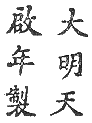 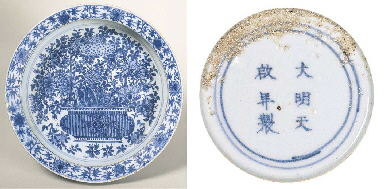
|
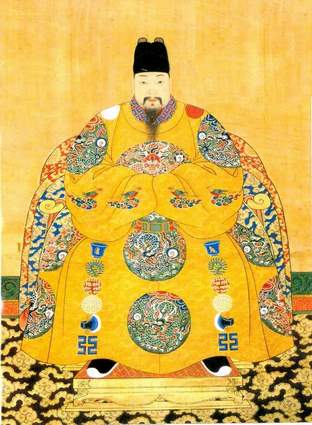
Wade-Giles romanization T’ien-ch’i, personal name (xingming) Zhu Youjiao, posthumous name (shi) Zhedi, temple name (miaohao) (Ming) Xizong. Born 1605, China - died 1627, at age 22. The Tianqi emperor was the 16th and penultimate emperor (reigned 1620–27) of the Ming dynasty. He was too young and indecisive to provide needed leadership. In 1624 he finally gave almost totalitarian powers to his favorite, Wei Zhongxian (1568–1627), the most notorious eunuch of Chinese history. Wei brutally purged hundreds of officials, chiefly those associated with a reformist clique called the Donglin party, and staffed the government with sycophants while the dynasty disintegrated. A new threat had in the meantime appeared on the northern frontier. The Manchu, quiet occupants of far eastern Manchuria from the beginning of the dynasty, were aroused in 1583 by an ambitious young leader named Nurhachi. During the Wanli emperor's latter years, they steadily encroached on central Manchuria. In 1616 Nurhachi proclaimed a new dynasty, and overwhelming victories over Ming forces in 1619 and 1621 gave him control of the whole northeastern segment of the Ming empire, south to the Great Wall at Shanhaiguan. Ascending the throne at the age of 15, the Tianqi emperor preferred carpentry to governmental affairs. He handed the powers of government to Wei, a former butler in the empress dowagers service and a friend of the young emperors nurse. Wei became the most powerful eunuch in Chinese history, replacing hundreds of officials and creating a network of spies. He even had temples erected in his honor throughout the country. During this time several foreign invasions took place. The Dutch attacked and occupied the island of Taiwan, a Chinese protectorate; and the Manchu tribes, who 20 years later were to conquer all of China, were virtually unopposed in their conquest of the northeastern part of the Ming empire around the Liao River valley. Conditions deteriorated in every part of the empire. In the northern and southwestern provinces, rebellions became endemic, and the imperial treasury was too depleted to repair the dikes when the Huang He (Yellow River) burst its banks. By the end of the Tianqi emperors reign the dynasty had lost control of the country, and his brother and successor, the Chongzhen emperor, was powerless to reverse the decline. |
| Chongzhen 1628-1644 大明崇禎年製 | |
 |
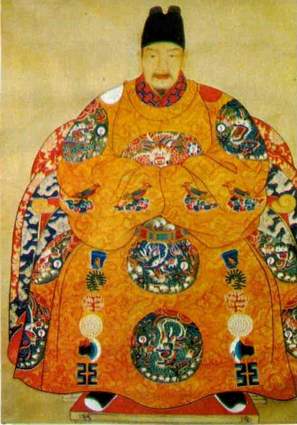
Wade-Giles romanization Ch’ung-chen, personal name (xingming) Zhu Youjian, posthumous name (shi) Zhuangliemindi, temple name (miaohao) (Ming) Sizong or (Ming) Yizong. Born Feb. 6, 1611, Beijing, China — April 25, 1644, Beijing. 16th (or 17th) and last emperor (reigned 1627–44) of the Ming dynasty (1368–1644). The Chongzhen emperor (reigned 1627–44) ascended the throne at the age of 16 on the death of his brother, the Tianqi emperor (reigned 1620–27), and tried to revive the deteriorating Ming government. He banished Wei Zhongxian, the powerful eunuch who had dominated his brother’s reign, and he eliminated some of the more corrupt officials. He could not, however, quell partisan strife within the bureaucracy and the army. The imperial generals were frequently more interested in quarreling with one another than in putting down rebellions or halting the incursions of the Manchu tribes on the northeast border of the empire. The Chongzhen emperor tried to revitalize the deteriorating Ming government. He banished Wei Zhongxian but could not quell the partisan strife that was paralyzing the bureaucracy. The Manchu repeatedly raided within the Great Wall, even threatening Beijing in 1629 and 1638. Taxes and conscriptions became increasingly oppressive to the Chinese population, and banditry and rebellions spread in the interior. The Ming government became completely demoralized. Finally, a domestic rebel named Li Zicheng captured the capital in April 1644, and the Chongzhen emperor committed suicide. The Ming commander at Shanhaiguan accepted Manchu help in an effort to punish Li Zicheng and restore the dynasty, only to have the Manchu seize the throne for themselves. The corruption of previous reigns had so depleted the imperial treasuries that Chongzhen was unable to supply his armies, and his troops frequently joined enemy forces. In desperation, Chongzhen demanded more taxes and conscripts from the already overly oppressed population. Unable to bear this extra burden, the people joined the rebel bands in increasing numbers. Finally, in 1644 several of Chongzhen’s eunuch generals betrayed him, and Li Zicheng, one of the rebel leaders, captured the capital city, Beijing. As Li’s forces approached the city, the emperor struck a bell, signaling his ministers to appear for a conference. When no one came, he climbed to the top of Meishan (Coal Hill), next to his palace, and hanged himself. His posthumous name, Zhuangliemindi, was bestowed during the succeeding Qing dynasty. |
| Southern (Nan) Ming 1645-1683 | |
| Hongguang to Koxinga 1645-1683 During a period of close to forty years the southern part of China was ruled by seven emperors claiming their eight to tenth generation of kinship back to the first emperor of the Ming dynasty. They mostly enjoyed a very short life after that. I mention this here despite their limited importance for the imperial porcelain industry which during this time mostly focused on export. This was however also the highly artistic period of the Transitional period (defined by Soames Jenyns to 1620-1683) as well as that of the very interesting export porcelain developed for the Japanese as well as the Dutch market and the Middle eastern market. Ming loyalists ineffectively resisted the Qing (Manchu) dynasty from various refuges in the south for a generation. Their Nan (Southern) Ming dynasty included the prince of Fu (Zhu Yousong, reign name Hongguang 弘光 1644-45), the prince of Tang (Zhu Yujian, reign name Longwu 隆武 1645-46), the Prince of Lu (Zhu Yihai, no reign name but called 魯王), and the prince of Gui (Zhu Youlang, reign name Yongli 永历 1646-1662) and Dingwu (定武), 1647-1663. The loyalist coastal raider Zheng Chenggong (Koxinga) and his heirs held out on Taiwan until 1683 after which the Qing dynasty could effectively be considered to have begun. Some confusion about reign marks and auspicious symbols on porcelain, prevailed well into the 18th century. The most popular mark was that of Chenghua 大明 or just 成化年製 which, referring to the quality of the porcelain of the period can look innocent enough, but if it was only that, is anyone's guess. |
|
The marks section of Gotheborg.com was initially established in May 2000 thanks to a generous donation of approximately one hundred images of Japanese porcelain marks, by Karl-Hans Schneider from Euskirchen, Germany. This contribution provided a modest yet substantial beginning of the Marks Section. It was a kind gesture that I really appreciated.
Of the many later contributors, I would especially want to mention Albert Becker, Somerset, UK, who was the first to help with some translations and comments on the Japanese marks. His work was then greatly extended by Ms. Gloria S. Garaventa, after which Mr. John Avery looked into and corrected some of the dates. Most of the Satsuma marks were originally submitted by Ms. Michaela Russell, Brisbane, Australia. A section which was then greatly extended by Ian & Mary Heriot, a large amount of information from which still awaits publication.
A warm thank you also goes to John R. Skeens, Florida, U.S.A., and Toru Yoshikawa for the Kitagawa Togei section, and to Susan Eades for her help and encouragement towards the creation of the Moriyama section. For the last full overhaul of the Satsuma and Kutani sections, thank you to Howard Reed, Australia. The most recent larger contribution was made by Lisa M. Surowiec, New Jersey, USA.
In 2004 and from then on, my warm thank you goes to John Wocher and Howard Reed, whose knowledge and interest have sparked new life into this section and given reason for a new overhaul. Thank you again and thank you to all I have not mentioned here, for all help and interest in and contributions to our knowledge of 20th-century Japanese porcelain.
The Chinese marks section would not have been possible without the dedicated help of Mr. Simon Ng, City University of Hong Kong, whose translations and personal efforts in researching the origin and dates of the different marks have been an invaluable resource. It has since been greatly extended by several contributors such as Cordelia Bay, USA, Walt Brygier, USA, Bonnie Hoffmann, Harmen Lensink, 'Tony' Yalin Zhang, Beijing, 'ScottLoar', Shanghai, Mike Harty, and many more expert members of the Gotheborg Discussion Board.
A number of reference pieces have also been donated by Simon Ng, N K Koh, Singapore, Hans Mueller, USA, Hans Slager, Belgium, William Turnbull, Canada, and Tony Jalin Zhang, Beijing.
All images and text submitted by visitors and published anywhere on this site are and remain the copyrighted property of the submitter and appears here by permission of the owners which can be revoked at any time. All information on this site, that are not specifically referenced to peer reviewed sources, are the personal opinions given in good faith by me, my friends and fellow experts, based on photos and the owners' submitted descriptions. They are not to be used for any financial or commercial decisions, but for educational and personal interest only, and can and will be changed as further information merits.
For further studies, Encyclopedia Britannica is to be recommended in preference to Wikipedia, which, not being peer-reviewed, might contain misleading information.
Web design and content as it appears here © Jan-Erik Nilsson 1996-.