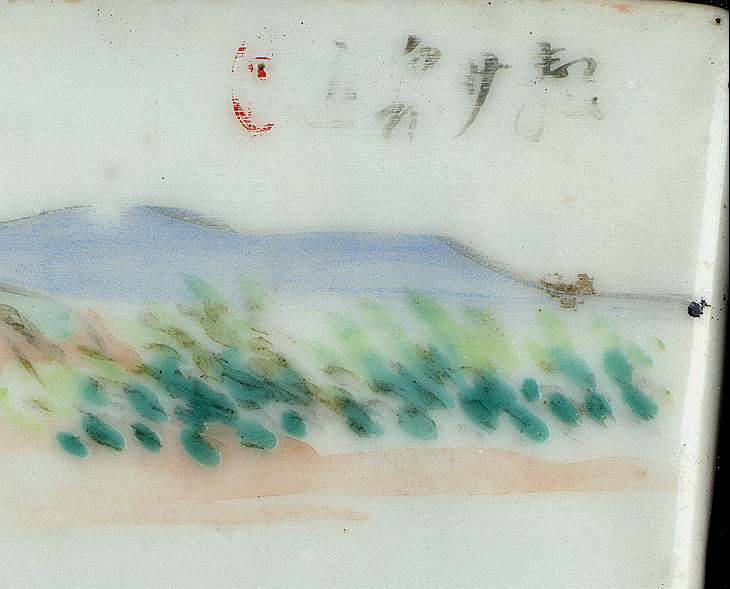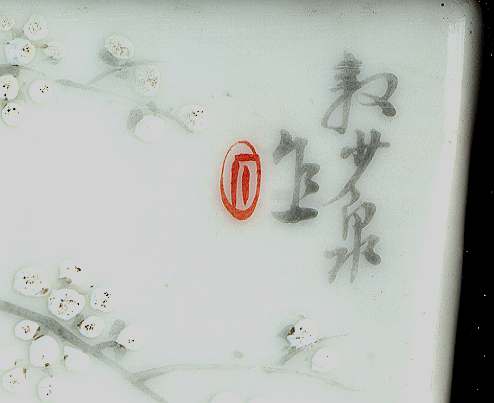
This is a work in progress attempting to chart Chinese porcelain artists of the late Qing dynasty and also an attempt to chart porcelain pieces with dates in their inscription. This page is a source table that includes both all dated items we have so far. For those particularly interest in specific interest, please see the Gallery which lists only the artists. For the moment the numbers is the rightmost column is a unique item number for this table only. For a detailed discussion of the different artists, please support our efforts by becoming a member of our Discussion Board, and see in particular 'Late Qing Enameled pieces', 'Dated porcelain' and the 'Porcelain Plaques' topic.
Main sources for this page besides this, is the exhibition catalog Innovations and Creations, A Retrospect of 20th Century Porcelain from Jingdezhen, 2004 and Simon Kwan, Brush and Clay, Hong Kong 1990. Both are indicated in the entries followed by the relevant page and illustration numbers. Please submit any additions or corrections you might have at the discussion board.
ll marks and artists names here are given in western characters and romanized according to the hanyu pinyin system, which is the system that succeeded Wade Giles. The name of Chinese person would usually be written with three characters. The first character would is the family name or 'surname' (xìng), while the two following characters represents the given name (míng). The given name should be written together as one word. In older books names are often romanized by the older Wade-Giles system which is no longer in use.
Besides the family and given names, two more kinds of names occurs.
Zi (字) - this is a given adult courtesy name. When grown up, the family name was used only by himself and his parents. Other people of the same age would address him by the zi. A zi was often based on the birth order in the family as the 'second son' in the family. The characters commonly used are bò for the first, zhóng for the second, shu for the third, and jì typically for the youngest, if the family had more then three sons. For clarity, the Chinese character 字 will be used in the table below when the zi of an artists is known.
Hao (号) - is a self selected pseudonym, also called Bi Ming, literally pen name, usually three or four characters long. Since you choose this yourself, it was possible to have as many pseudonyms as you liked. It often contained a rare character as might befit an educated literatus, or could be the name of one's residence as "Resident of Dongpo".
Other characters that often occurs in signatures are 'hua', meaning painting, or here, painted by. It is one of a number of verbs used to indicate the involvement of the person signing the work. You will see the same character on paintings; where you might alternatively see 'xie' meaning to write, as in the Chinese literati world, paintings are 'written', showing the close relationship in the Chinese mind between calligraphy and painting - both being executed with the same instrument. Another word sometimes seen is 'zuo' meaning done by.
| Icon | Artist | Hanyu pinyin | Comments | Date in inscription | Marks section number | Shape | Mark | Index |
|---|---|---|---|---|---|---|---|---|
| X You Fang | 1893 | hatstand | Guangxu Nian Zhi | 2 | ||||
| X You Mao | 1892 | Bowl | Guan Yao Nei Zao | 3 | ||||
| X X Tai | 1891 | Tea caddy | 4 | |||||
| Ao Shaoquan (Zi: Nianzhou) | 敖少泉 (字南洲) |
1904 | hatstand | Shen De Tang Zhi | 5 | |||
 Signed by: Bao Wen |
Bao Wen | 宝文 | 1119. Teapot. Signed by: Bao Wen and dated in the inscription to the jia wu year (1894). | 1894 | 1119 | Tea pot | 7 | |
| Bi Botao (1885-1961) | 毕伯涛 | Second generation of the literati school of porcelain painting. Famous for his birds and flowers. Significant but peripheral to the Eight Friends. (Simon Kwan, Brush and Clay, 1990 p.42). Exhibit number 61 (Innovations and Creations, 2004).
Bi Botao (1886-1962), was a scholar at end of Qing Dynasty, was mentored by the famous painter Zhang Yunshan, and then travel and stay to Jingdezhen and study powdered colour, good at painting animals & flowers, and was on top of Jingdezhen Ceramic Arts by his seals, poems, handwritings and paintings. |
8 | |||||
| Bi Yuanming (1907-1990) | 毕渊明 | Exhibit number 80 (Innovations and Creations, 2004). Bi Yuanming (1907-1990) was a native of She county, Anhui province. His father Bi Botao was accomplished in inscription, calligraphy, poem and painting, so Bi Yuanming was taught and trained by his father since childhood. He came to Jingdezhen to learn craftsmanship at the age of fourteen, he specialized in painting on porcelain and also took up inscription, and he was adept at painting animals and calligraphy. He had already revealed his artistic talent in inscription, calligraphy, poem and painting when he was only nineteen. He held personal inscription, calligraphy and painting exhibits, and was highly praised by older artists in the circle of ceramic art. He was good in painting tigers and the tigers he painted appeared powerful and bold and each had different features. His painting inherited the excellent traditions of traditional Chinese painting in composition of a picture, wielding the brush, color and composition, etc. He had the same styles with Zhang Zishan in painting with orderly style of drawing and his paintings are also full of the special ability or talent of Gao Qifeng's Lingnan painting school, there is traditional Chinese realistic painting, as well as freehand brushwork in traditional Chinese painting among his works, so he was called Bi Laohu. He also specialized in painting figure, landscape, flowers and birds and was good at inscription and calligraphy, so his works was incorporated with poem, inscription and calligraphy and he had formed the unique artistic style of his own. In addition to works whose subject matter were tigers, his main works also included Hundreds of Monkey in Playing and Golden Monkey, etc. |
9 | |||||
 Signed by: Bin Mao |
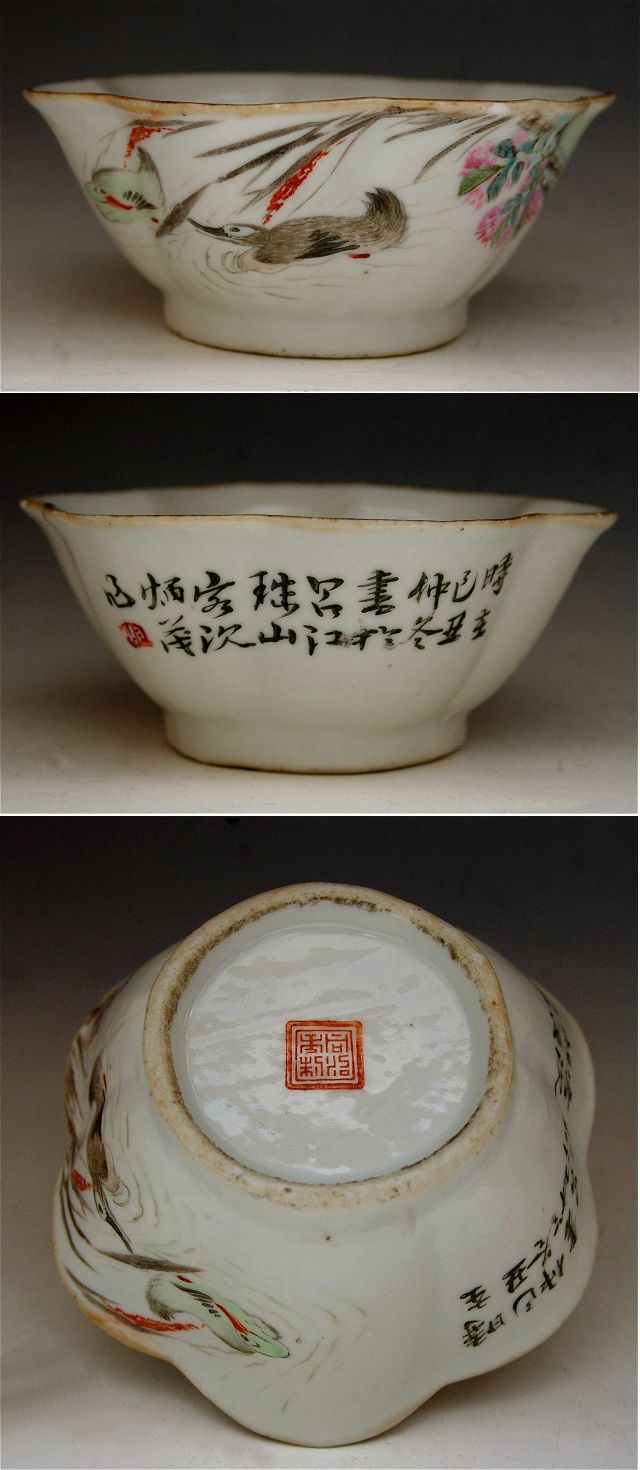
Bin Mao | 1187. Bowl with lobed sides, dated ji chou in the inscription matching 1889. Red stamped mark Tongzhi Nian Zhi on the base. Text in general translation by David Lane: shi zai, ji chou, zhongdong, shu yu, Lu Jiang, Zhu Shan, (X) ci, Bin Mao, ti [red seal] At the time of the ji chou year (1899) |
1889 | 1187 | Lobed bowl | Tongzhi Nian Zhi | 10 | |
| Binghui | 炳辉 | 11 | ||||||
| Cai Jingbiao | 蔡敬标 | 12 | ||||||
| Cai Shousheng | 蔡寿生 | 13 | ||||||
| Cai Songnian | 蔡松年 | Qianjiang artist (Koh). | 14 | |||||
| Cai Xinren | 蔡新仁 | 15 | ||||||
| Cai Xinshun | 蔡新顺 | 16 | ||||||
| Cai Yusheng | 蔡雨生 | 17 | ||||||
| Cao Yichang | 1926 | Kamcheng | 18 | |||||
| Chaikin Taiwan | 蔡金台 | 19 | ||||||
| Chan Kwok | 陈国治 | 20 | ||||||
| Chan Yucheng | 1919 | Dinner set | Chang Jiang Cui Yun Xuan Hua | 21 | ||||
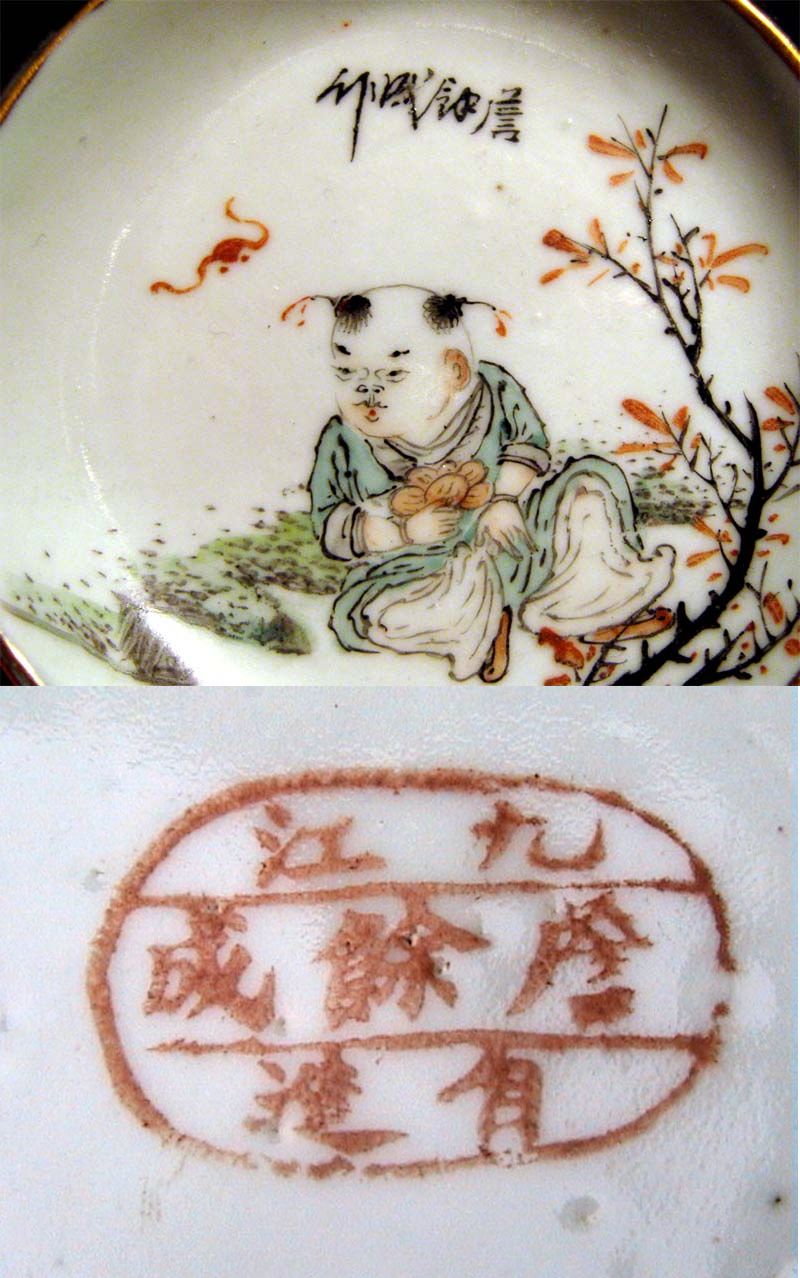 |
Chan Yucheng | 1431. Mark: Jiujiang Chan Yucheng You Zao ("You" short for "youxian gongsi" meaning ltd. or inc.) Date: Style of decoration consistent with a date around 1912. | Jiujiang Chan Yucheng You Zao | 554 | ||||
| Chang Tai | 昌太 | 22 | ||||||
| Chen Deming () | 陈德明 | Exhibit number 74 (Innovations and Creations, 2004). | 23 | |||||
 |
Chen Guang Di | 647. "1921 Winter month, For Sir Run Mao's pleasure. From your humble friend Chen Guang Di respectfully presented".
|
1921 | 647 | Bowl | 24 | ||
| Chen Guang Hui | 1907 | Plaque | 25 | |||||
| Chen Menglong | 陈孟龙 | 26 | ||||||
| Chen Shan-mode | 陈善模 | 27 | ||||||
| Chen Wei Yan | 陈渭岩 | 28 | ||||||
| Chen Xianshui (1923-?) | 陈先水 | Exhibit number 127 (Innovations and Creations, 2004). | 30 | |||||
| Chen Yan | 程言 (次笠) |
Qianjiang artist (Koh). | 31 | |||||
| Chen Yaoxing (1923-1998) | Exhibit number 97 (Innovations and Creations, 2004). | 32 | ||||||
 Signature and mark: Chen Yung Tai (name) Zao Made |
Chen Yungtai Zao (Make) | 1153. Tea pot. Dated in the inscription to the yi mao year (1915). Mark and signature in inscription: Chen Yung Tai (name) Zao Made. The decoration is of a boat in the river, "(Boat) Guest tour thousand mountains and miles with the Spring wind".
|
1915 | 1153 | Teapot | Cheng Yungtai Zao | 33 | |
 Signature: Chen Zichang (name) Zao Made |
Chen Zichang | 陈子常 | 1443. Bowl. Dated in the inscription to the bing shen year (1896). Inscription reads:
古玩 (guwan) 如此 (ruci) 局局生新 / 丙申之冬 / 陈子常作 "Antiques/curious like this make one feel alive and new." followed by "Winter, bingshen (year, 1896); made by Chen Zichang." N.K. Koh's lists three items 1882, 1893, and 1894 of which a hatstand vase dated Jia Wu 1894 has a similar decoration to this.
|
1896 | 1443; | Bowl | Da Qing Tongzhi Nian Zhi | 34 |
| Chen Zichun | 1915 | hatstand | Jing Zhen Shin Fa Zao | 35 | ||||
| Cheng Bingfang | 程炳芳 | 36 | ||||||
| Cheng Dayou | 程大有 | 37 | ||||||
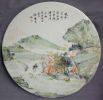 Plaque signed by: Cheng Huanwen, 1880 |
Cheng Huanwen | 程焕文 | Circular plaque signed by Cheng Huanwen. | 1880 | Plaque | 38 | ||
| Cheng Men (1833-before 1908), Zi: Xueli (Snow Cap) | 程门 (字雪笠) |
One of the most famous qianjiang painters on porcelain in the Tongzhi and Guangxu periods. Excelled in landscapes but few of them have survived. Treated the porcelain medium as if it were paper. Was a pioneer of the literati school. (Simon Kwan, Brush and Clay, 1990 p.40). Biography (Simon Kwan, Brush and Clay, 1990 p.85). Exhibit number 8-9 (Innovations and Creations, 2004). Cheng Men was the Pioneer of qianjiang painting on porcelain and was active during the Xianfeng (1851-61) to Guangxu period (1875-1908). Extant pieces included a teapot with landscape drawing dated 1855. It was drawn by him and his second son Cheng Rong. He is an all round artist, great in all aspects of Chinese painting, ie. landscape, human figures and birds/flower. So far no work of his dated after 1889 has been found. Recent findings also indicated that he had work for the imperial kiln. (Koh) | 39 | |||||
 Signed by: Li Daoren Zuo (Sheng Men) |
Cheng Men (Li Daoren Zuo) | 757. Narcissus bowl. Inscription "Finding pleasure while sailing among the red trees and the green hills" Wu Ji Qiu Rou - "wi ji (1888) Autumn Months". Signed: Li Daoren Zuo (Cheng Men). Red mark seal: Song Sheng. |
1888 | 757 | Lobed low bowl | Song Sheng | 40 | |
| Cheng Rong | Second son of Cheng Meng | 41 | ||||||
| Cheng Yan (cili - Second Cap) | 程言 (次笠) |
42 | ||||||
| Cheng Yiting (1895-1948) / Peigu Zhai | 程 意亭 | Birds-and-flowers in gongbi. Independent painter of the 1930s with his own studio in which he worked on orders they had received. Second generation of the literati school of porcelain painting. Member of the Yueyuan Hua, later called Eight Friends of Zhushan from 1928. Studio name: Peigu Zhai (Simon Kwan, Brush and Clay, 1990 p.42, fig. 42-49). Was artistically much under the influence of the Zhe School artist Cheng Zhang (1869-1938) in Shanghai to which he was a pupil. (Simon Kwan, Brush and Clay, 1990 p. 91). Exhibit number 48-49 (Innovations and Creations, 2004). Cheng Yiting, whose alias was Pu, was also known as Bo Shan Shan Ming. He was born in Leping, Jiangxi province in 1897 and died in 1948. He was one of Eight Friends Zhushan and especially accomplished in painting flowers and birds. (Source: jdz.gov.cn 2011) Cheng Yiting (1895-1948), was mentored by Zhang Xiaogeng and Pan Taoyu, and then went to Shanghai to learn painting of flowers & birds from famous painter Cheng Yaosheng. His painted flowers & birds are super precious and natural. |
43 | |||||
| Cheng Yunnong (active 1940s) | Third generation of the literati school of porcelain painting. (Simon Kwan, Brush and Clay, 1990 p.42, fig 122) | 44 | ||||||
| Cheng Zhenyuan | 程镇元 | 45 | ||||||
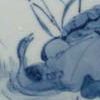 Plaque signed by: Chun Jun, 1911 |
Chun Jun | Porcelain plaque signed by Chun Jun. | 1911 | Plaque | 46 | |||
| Cui Xiangyan (1922-1997) | Exhibit number 142 (Innovations and Creations, 2004). | 47 | ||||||
| Dai Huanzhao | 戴焕昭 | 48 | ||||||
| Dai Shousan | 1915 | hatstand | DAI Shou San Zhi | 49 | ||||
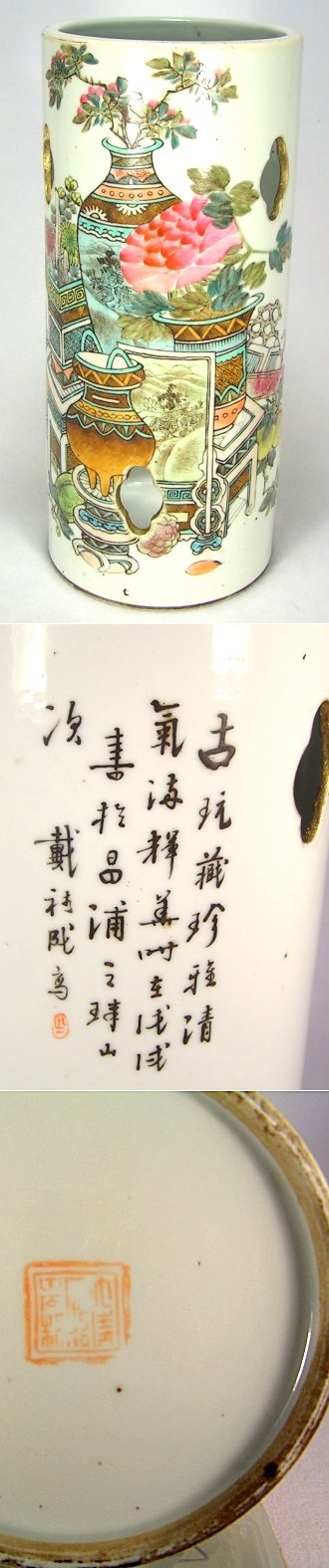 Signed by: Dai Yu Cheng |
Dai Yucheng | 戴裕成 | 1113. Hatstand, dated wu xu year, in the calligraphy, matching western date is 1898. Red base mark Da Qing Tongzhi Nian Zhi. The text is a rather sloppy cursive that starts off talking about the pure and elegant etc pleasures of collecting antiques. following the date it gives a place of manufacture that is not quite clear to me--something mountain something in Changpu? Last is the name of the artist Dai Yu Cheng.
|
1898 | 1113 | Hatstand | Da Qing Tongzhi Nian Zhi | 50 |
| Deng Bishan (1874-1930) / Qingchuang Dushu Lo | 鄧 碧珊 | Excelled in fish paintings in ink monochrome style. Second generation of the literati school of porcelain painting. Member of the Eight Friends of Zhushan from 1928. (Simon Kwan, Brush and Clay, 1990 p. 42, fig. 78-82). Studio name: Qingchuang Dushu Lou (Simon Kwan, Brush and Clay, 1990 p. 53). Executed when Fang Zhimin's army marched into Jingdezhen in 1930. Biography Kwan, Brush and Clay, 1990, p. 93. Exhibit number 51 (Innovations and Creations, 2004). Deng Bishan, whose hometown was Yujing county, Jiangxi province, was one of the Eight Friends of Zhushan. He was a famous artist in painting on ceramics in Jingdezhen, and expert at painting fishes and sea weed. (Source: jdz.cn 2011) Deng Bishan (1874-1930), was a scholar at end of Qing Dynasty, he was living on painting porcelain portraits at his early age, the Porcelain Portrait Painting was invented by him. He was then focusing on painting powdered colour fishes & sea weed, and flowers & birds. He was named as “The King Of Fishes†then. He absorbed the techniques of Japan Painting Art and the China Paintings in Song Dynasty, and at his early age he was also influence by China Lingnan Painting Group (the famous painting group then), so his skill and techniques were quite superior and unique. |
51 | |||||
| Deng Bisun | 邓碧孙 | 52 | ||||||
| Deng Xiaoyu | 邓肖禹 | 53 | ||||||
| Dong Shaopu | 董少莆 | 54 | ||||||
| Duan Maofa | 段茂发 | 55 | ||||||
| Duan Qingshun () | Exhibit number 140-142 (Innovations and Creations, 2004). | 56 | ||||||
| Duan Shi-Lin | 段世林 | 57 | ||||||
| Duan zichun junan | 段子安 | 58 | ||||||
| Fa Taisi | 1908 | Teapot | Da Qing Guangxu Nian Zhi | 59 | ||||
| fake? | 1914 | Teapot | 60 | |||||
| Fang Jiaxi (Fong Jiazhen) | 1894 | Vase | 61 | |||||
 |
Fang Jiazhen | 方家珍 | 844. Vase with Qianjiang style decoration. Landscape; main colors in pale red, lake green and blue; direct applications of enamels. The Painter's calligraphy acknowledging his painting style and inspiration from Ni Zan, Huang Gongwang's Qianjiang painting friend. | 1882 | 844 | Vase | 62 | |
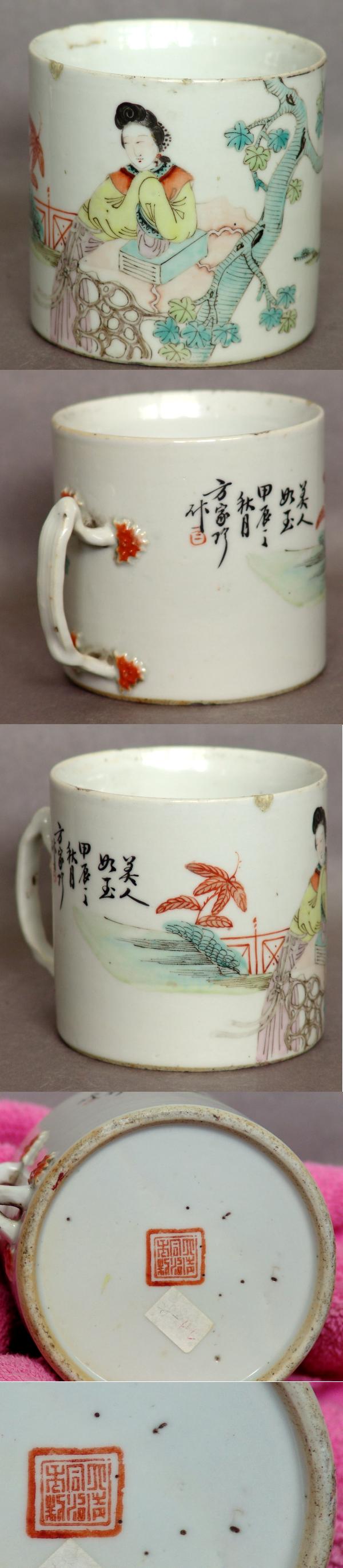 Signed by: Fang Jiazhen |
Fang Jiazhen | 方家珍 | 1024. Mug with handle. Height 10 cm, diameter 10 cm. Base mark: Da Qing Tongzhi Nian Zhi, Dated to the jia chen year (1904). | 1904 | 1024 | Mug with handle | Da Qing Tongzhi Nian Zhi | 63 |
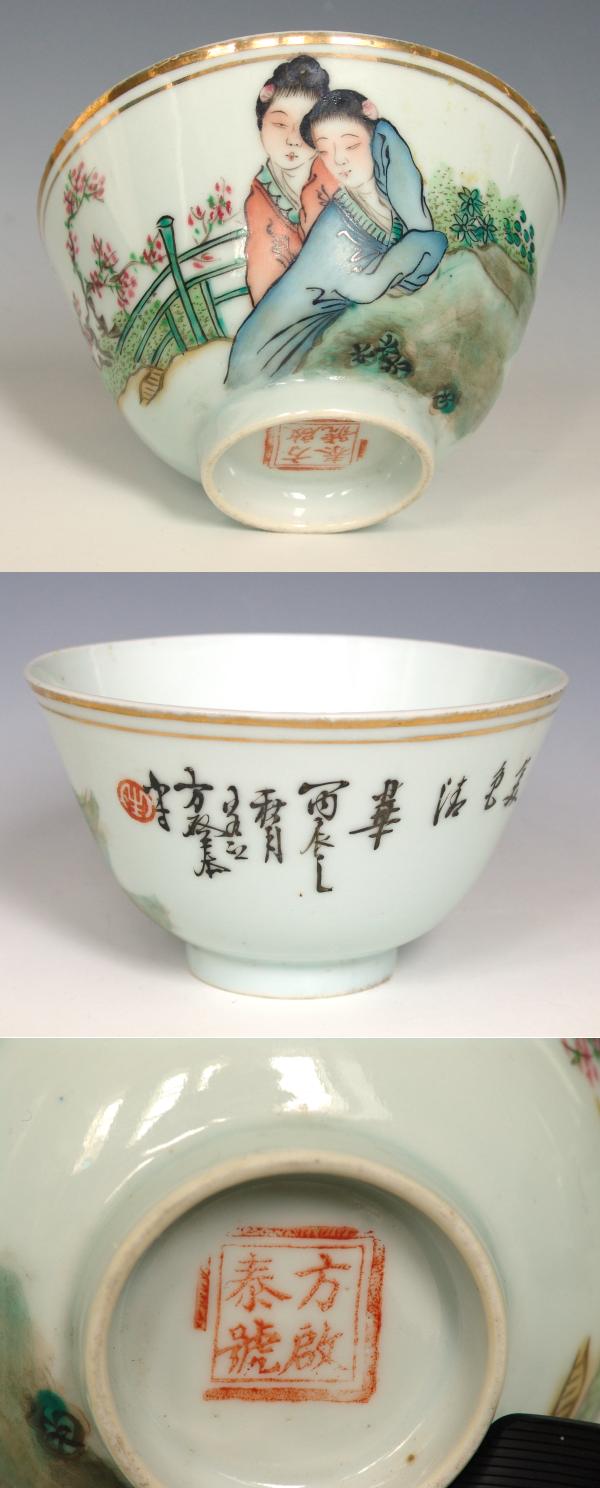 |
Fang Pingtai | 1016. Small soup bowl. Dated in the inscription as of "1916". Poem signed with the same name as the factory or studio; Fang Pingtai painted, and base mark Fang Pingtai Hao. | 1916 | 1016 | Cup | Fang Pingtai Hao | 64 | |
| Fang Tinghui | 方廷辉 | Qianjiang artist. | 1893 | Tray | 65 | |||
| Fang Tinghui | 方廷辉 | Qianjiang artist (Koh). | 66 | |||||
 Plaque signed by: Fang Yunfeng |
Fang Yunfeng (1897-1957) | 方云峰 | Third generation of the literati school of porcelain painting. (Simon Kwan, Brush and Clay, 1990 p.42, fig 119-120). Exhibit number 68-70 (Innovations and Creations, 2004). | 67 | ||||
| Feng Datuo () | 冯大陀 | Exhibit number 95 (Innovations and Creations, 2004). | 68 | |||||
| Fu Yaosheng (1941-2003) | Exhibit number 116 (Innovations and Creations, 2004). | 69 | ||||||
| Fu Yuntang (Lucky cloud hall) | 福云堂 | 70 | ||||||
| Gao Hengsheng | 高恒生 | 1900 | Teapot | 71 | ||||
 Signed and seal of: Gao Hengsheng |
Gao Hengsheng | 高恒生 | 1009. hatstand, dated to the xin chou year in the calligraphy, matching western date is 1901. Red stamped four character base mark Gao Hengsheng. The name also appears as the last line of the poem. | 1901 | 1009 | hatstand | Gao Hengsheng | 72 |
 Signed and seal: Gao Hengsheng |
Gao Hengsheng | 高恒生 | 1111. Covered jar. Iron red seal mark on the base: Gao Hengsheng Zhi. Height 9.5 cm. Decorated in enamels. Dated in the decoration as ren yin, representing '1902'. The red seal mark on the base says "Gao" (high/tall), "Heng" (constant, enduring, everlasting), "hua?" (painted). "Hua". Signature in the inscription "Gao Hengsheng Zuo" (made). | 1902 | 1111 | Dome lidded jar | Gao Hengsheng Hua | 73 |
| Gao Hengsheng | 高恒生 | 1902 | Cup | 74 | ||||
 Signed and seal: Gao Meisheng |
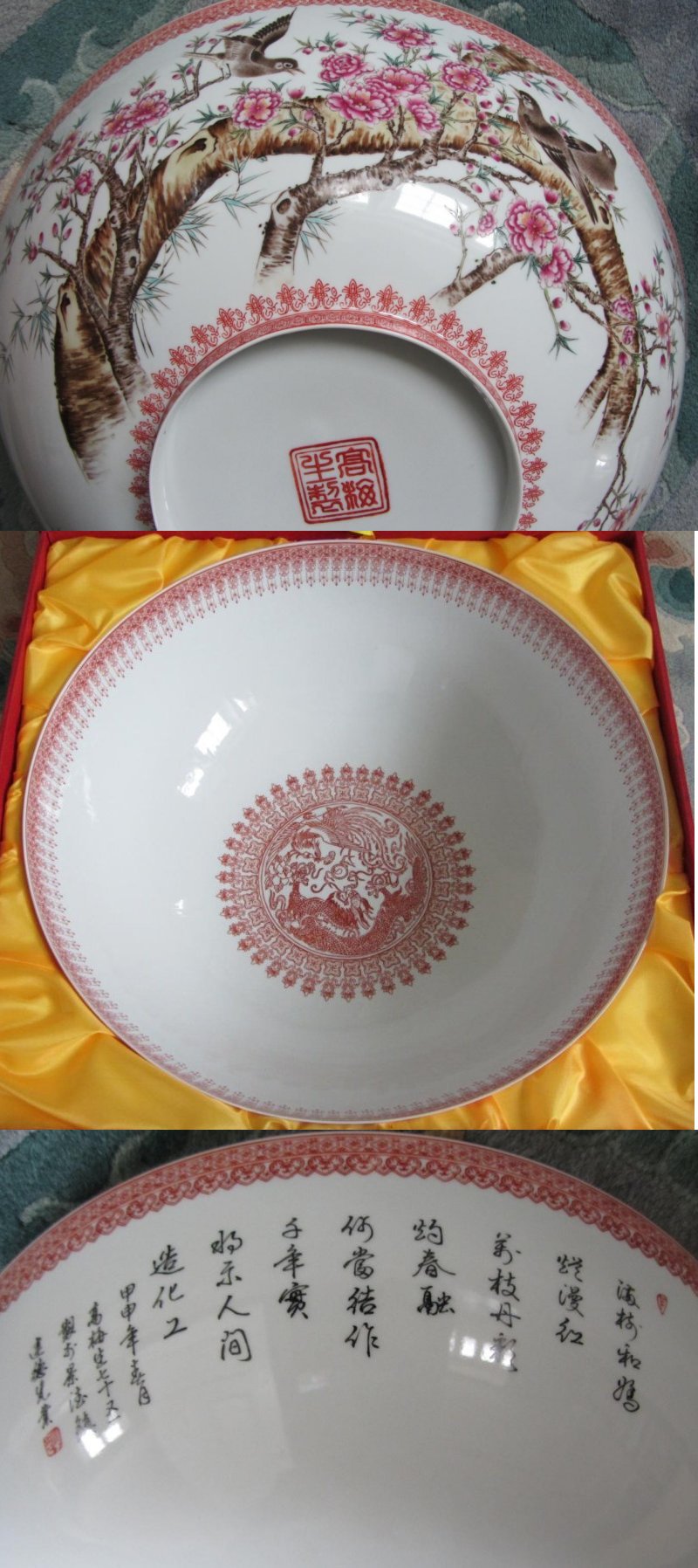
Gao Meisheng | 高 梅生 | 2004 | Bowl | 560 | |||
 Signed by: Gao Xintian |
Gao Xintian (Good intention) | 高心田 | 1013. Square brush holder. height 8.5 cm. Dated in the inscription to the xin mao year, matching the western year of 1891. On the base a reversed stamped Guangxu Nian Zhi seal mark in iron red. Decoration in Wang Yeting style, but signed by Gao Xintian. | 1891 | 1013 | Square brush holder | Guangxu Nian Zhi | 75 |
| Gao Xintian (Good intention) | 高心田 | 76 | ||||||
| Gong Yaoting (1910-1975) | 龚耀庭 | Exhibit number 104-105 (Innovations and Creations, 2004). Gong Yaoting was a artist of ceramic fine arts and was a native of Nanchang, Jiangxi Province. At the age of 10 he learned skill at Jingdezhen hededa ceramic shop. He dived into ceramic crafts skills. In his young ages, he became known for his landscape paintings. After the establishment of the People's Republic of China in 1949, he made further progress in technique. He was good at landscape paintings, whatever green or greenish, pale brown, snow scene and so on, especially pale brown landscape. He was skilled in grass and tree, stone and fine or scenic landscape views painting. After he sketched in Huang mountain in 1964, his paintings were stiff, exquisite, bright and elegant in colour, lively in composition and natural. He is free from vulgarity of red and green in landscape paintings. His paintings give the impression of deep artistic conception. His works are elegant and unique. He is one of the influential Fencai realistic landscape painters. His main works are the plum vase with Fencai decoration. (Source: jdz.gov.cn 2011) |
77 | |||||
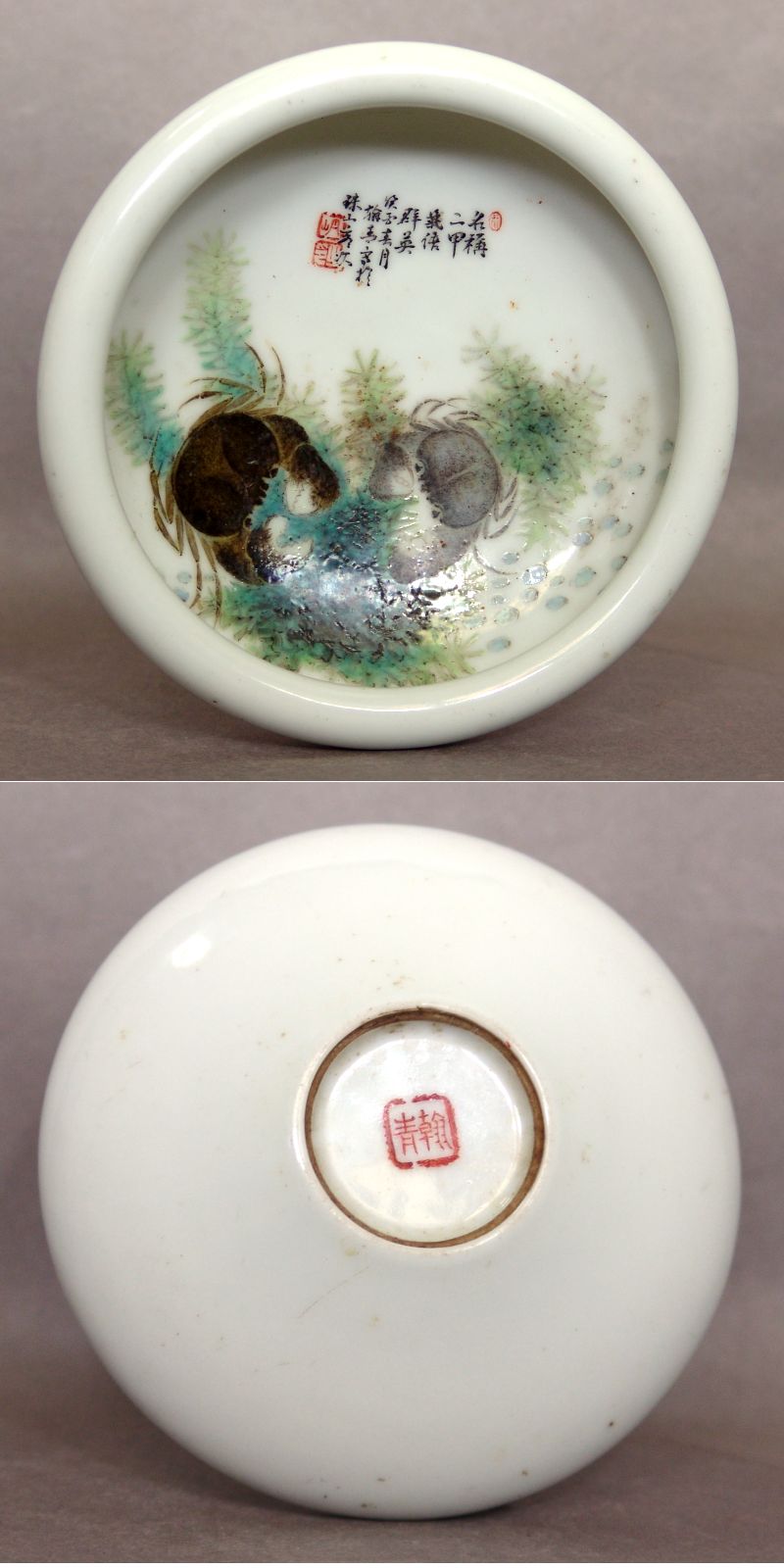 |
Han Qing | 999. Brush washer dish, dated in the inscription as the year gui you, meaning "1933". Red base mark of Han qing. | 999 | Brush washer | Han Qing | 78 | ||
| Hankou Ganxin Congsi | 1922 | Jar | 79 | |||||
| Hankou Ganxin Congsi | 1922 | Jar | 80 | |||||
| He Fang (Ming Gu) | 何肪 (明谷) |
Qianjiang artist. | 81 | |||||
| He Xuren (1882-1941) / Xuren Chupin | 何 許人 | Famous Qianjiang artist of which not that many extant pieces are known. See artist database. One of the Eight Friends of Zhushan.
He Xuren(1882-1940), was superior on archaizing on Jingdezhen porcelain art world, he also opened a artshop to sell his own artwork and teach persons the painting skills, the famous 'The King Of Flowers and Birds' painter Deng Xiaoyu (the grandson of Deng Bishan) and 'The King of Snow Landscape' Yu Wenxiang was mentored by him. He was the master of landscape, especially of snow landscape. |
1934 | Plaque | Red 4 characters | 82 | ||
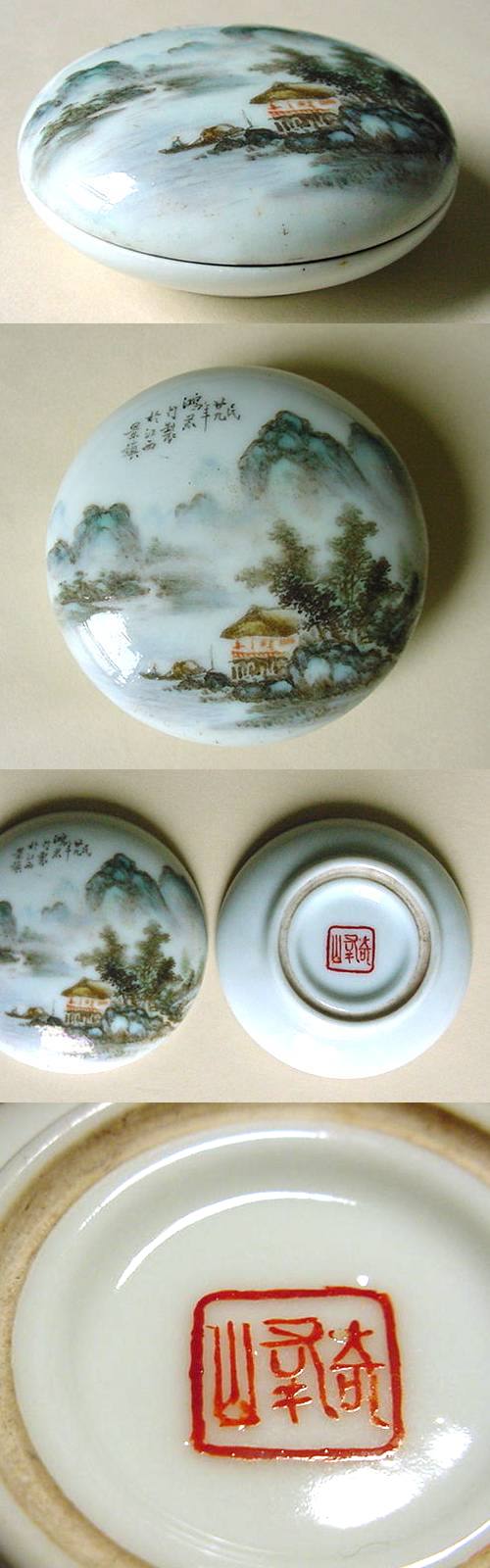 |
Hong Jun (Ji Feng) | 645. Dated in the inscription to the 29th year of the Republic (1940). "Hong Jun ( Artist name ) self made in Jingzhen (Zingdezhen)". Base Mark: "Ji Feng" (Artist's second name). | 1940 | 645 | Seal paste box | Ji Feng | 83 | |
| Hu Lu (1903-1976) | Exhibit number 96 (Innovations and Creations, 2004). | 84 | ||||||
| Hu Shikan | 胡诗看 | 85 | ||||||
| Hu Xianya (1902-1996) | Exhibit number 160 (Innovations and Creations, 2004). | 86 | ||||||
| Hu Yanbiao (beard face) | 胡颜标 | 87 | ||||||
| Hu Younong | 胡友农 | Qianjiang artist. | 88 | |||||
| Huang Mingguang | 黄铭光 | Qianjiang artist. | 89 | |||||
| Huang Xiaocun (98-99) | Exhibit number 98-99 (Innovations and Creations, 2004). | 90 | ||||||
| Jia Rui | 家瑞 | Qianjiang artist. | 91 | |||||
| Jiang Xi Wu (River Wu Dvelling) | 江栖梧 | Qianjiang artist. | 92 | |||||
| Jiang Xichen | 蒋錫臣 | Qianjiang artist (Koh). | 93 | |||||
| Jiang Yong ? | 1917 | Vase | Jiang Yong X X | 94 | ||||
 Signed by: Jiang Yongsheng |
Jiang Yongsheng | 755. 'Peace and riches' vase. Ti kai, er shu hua, ji you xia yue shu yu jiang you, Jiang yong sheng zuo. The bird's call make the flowers bloom. Drawn beside the river Jiang, in the summer months of the 'Ji You' year (1909), by 'Jiang Yongsheng'. | 1909 | 755 | Six sided vase | 95 | ||
| Jiang Yuqing (Zi: Shouchun) | 蒋玉卿 (字寿春) |
Qianjiang artist. | 96 | |||||
| Jiangxi Chen | 蒋錫臣 | 97 | ||||||
 Jiangxi Guang Ya (name) Company |
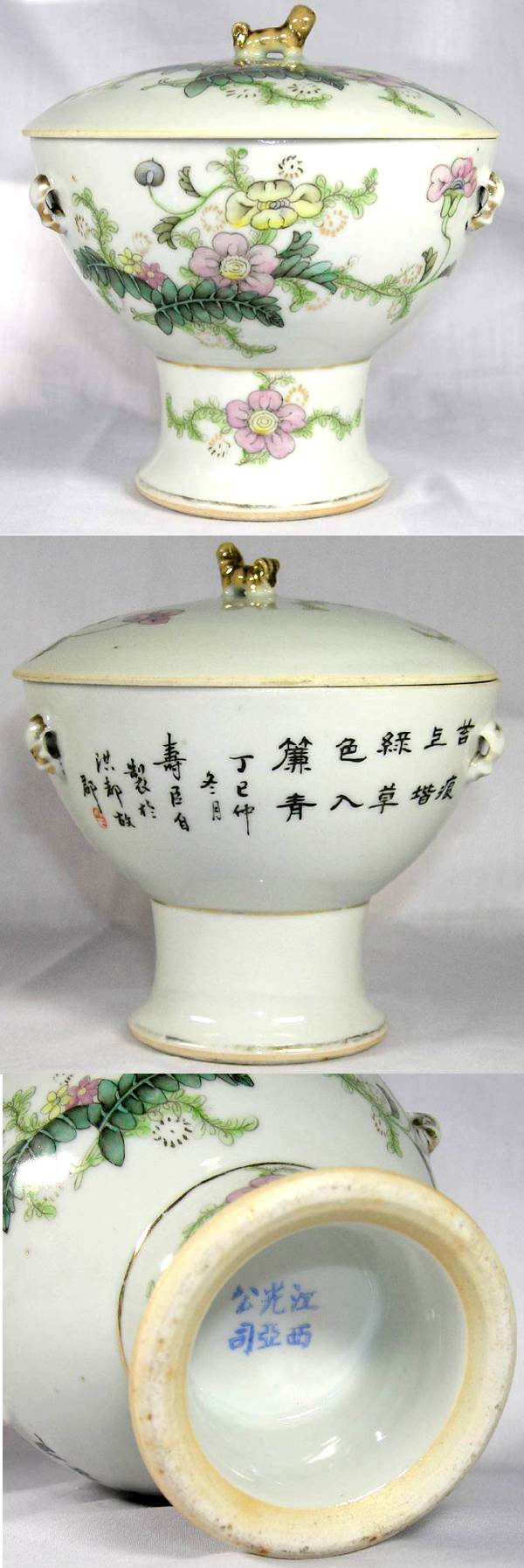
Jiangxi Guang Ya Gongsi | 1121. Lidded bowl. Dated in the inscription to the ding si year (1917). Base mark in blue enamel: Jiangxi Guang Ya Gongsi "Jiangxi Guang Ya (name) Company".
I P Collection |
1917 | 1121 | Lidded stem bowl | Jiangxi Guang Ya Gongsi | 98 | |
| Jiao Peilan (Banana orchid ornament) | 蕉佩兰 | Qianjiang artist. | 99 | |||||
| Jin Pinqing (Ho), active 1862-1908 | 金品卿 (字浩) |
One of the most famous qianjiang painters on porcelain in the Tongzhi and Guangxu periods. His reputation rested on landscapes, also birds-and-flowers. Treated the porcelain medium as if it were paper. Pioneered qianjiang painting together with Wang Tingzhou and Cheng Men. Was a pioneer of the literati school. (Simon Kwan, Brush and Clay, 1990 p.40, fig. 1.) Pioneered the art of porcelain painting in the late Qing (Simon Kwan, Brush and Clay, 1990 p. 82). Employed as decorator in the Imperial Porcelain Factory in Jingdezhen. Biography (Simon Kwan, Brush and Clay, 1990 p.86). Good calligrapher. Signed pieces as from Huancui Pavilion, at the top of the Zhushan hill. (Simon Kwan, Brush and Clay, 1990 p.87). Exhibit number 10 (Innovations and Creations, 2004).  So far no work of his dated after 1901 has been found. (Koh) | 100 | |||||
 Signed by: Jin Shaozhai |
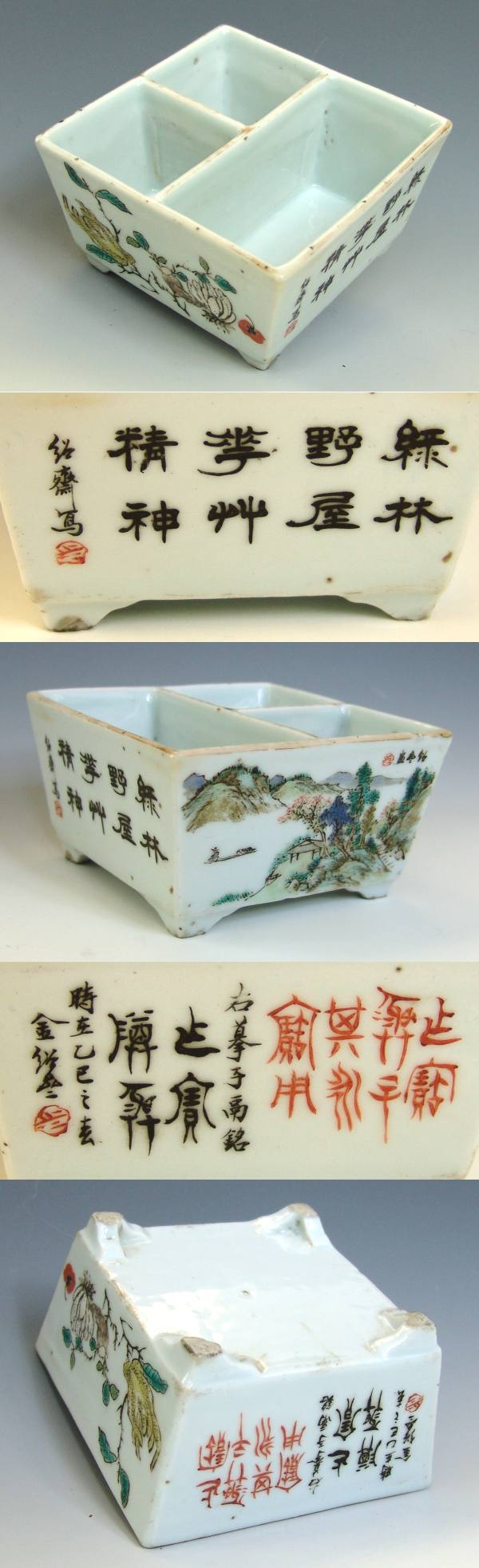
Jin Shaozhai | 金绍斋 | 832. Brush pot for Chinese painting, 1905. The verses saying something in the line of: Dreaming of a country house, in the green forest. Signed by the artist: Jin Shaozhai. Dated in the calligraphy to the yi si year, 1905.
|
1905 | 832 | Brush pot with three compartments | 101 | |
| Kang Jiazhong (1933— ) | Kang Jiazhong was born in Yibing county, Sichuan province in 1933. He graduated from the department of sculpture of South-west Fine Art College in Chongqin in 1955 and came to work in the fine art section of Jingdezhen Ceramic Research Institute in Jiangxi province, taking up ceramic sculpture. He learned the technologies of porcelain manufacturing and traditional ceramic art modestly from many ceramic craftsmen and other famous masters of art and craft in the institute, and get extra instruction from the predecessors, such as Zeng Longsheng, Yang Haisheng and so on. Later, he was also enlightened by professor Zhou Qingding from Zhejing Fine Art Institute, taking up the creation of animal sculpture. He also explored the use of colored glaze to sculpture works and made the colored glaze get extensive use on sculpture works. His style of animal sculpture had far-reaching influence on the development of ceramic sculpture in Jingdezhen. His works were chosen to take part in the national fine art exhibit and foreign ceramic exhibit for many times. The artist's main works included colored glaze decoration hanging plate, groups of ceramic sculpture of ancient Chinese inventor and Jinggangshan ceramic relief mural painting, which was made through the cooperation with Wang Xiliang, etc. (Source: jdz.gov.cn 2011 | 558 | ||||||
 Mark: Guan yao nei zao (Imperial Kiln for Inner Palace) |
Lei Guangheng | 雷光亨 | 997. Vase. Dated in the inscription to the jia wu year (1894). Red base mark Guan yao nei zao (Imperial Kiln for Inner Palace). Qianjiang decoration. Height 29.5 cm (11 5/8 inch.)
|
1894 | 997 | Vase | Guan Yao Nei Zao | 102 |
| Lei Guiquan | 雷桂泉 | Qianjiang artist. | 103 | |||||
| Lei Huolian | 雷火莲 | 104 | ||||||
| Li Mengdan (Ziqiao) | 李梦丹 (字子乔) |
Qianjiang artist. | 105 | |||||
| Li Mianting (Li Mian Pavillion) | 黎勉亭 | 106 | ||||||
| Li Nanyu | 1933 | Pot | Nan Cang Cheng Xin Sheng Zhua | 107 | ||||
| Li Shengchun (1903- ) | 李盛春 | Porcelain painter or sculptor of Jingdezhen in the first half of the twentieth century. (Simon Kwan, Brush and Clay, 1990 p. 43) Li Shengchun, who was also known as Sanlian, was born in Nanchang county, Jiangxi province in 1903. He came to Jingdezhen to learn painting at the age of eighteen. Already as an apprentice he had already reached a very high level in painting on porcelain and was valued by several porcelain manufacturers, such as Gongheke, etc. When he was painting on porcelain for exhibit in Nanchang municipal ceramic research institute in 1933, he was highly appraised by many experts in this field. After 1949 the artist's art was full of vigor. His works was chosen to taken part in the ceramic exhibit in Soviet Union in 1953 and he himself participated in the creation activities of ceramics for export and cooperation between Germany and China, etc. In 1956 he took up research work at Jingdezhen Ceramic Research Institute. He was good at traditional antique color techniques and explored much in the innovation of antique color decoration. The artistic porcelains he gave an archaic appearance reached the degree of mixing the false with the genuine, and became precious artistic works. The artist also did very well in expressing new substance of realistic life by means of excellent traditional techniques. Take his Flourishing On the Farm antique color fish jar as an example, the artist formed new patterns using the lines of peony branches which were entwined together, and blooming peonies and their healthy and strong branches and leaves matched naturally, vividly and vigorously. And the patterns were painted in bright green color and vigorous and unrestricted lines, giving people the feeling of youthful emotions and character. His other main works included antique fish jar and antique color water lily vase, etc. (Source: from jdz.gov.cn 2011) |
108 | |||||
| Li Shunxing | 1917 | Vase | 109 | |||||
| Li Weihan | 李维翰 | Qianjiang artist (Koh). | 110 | |||||
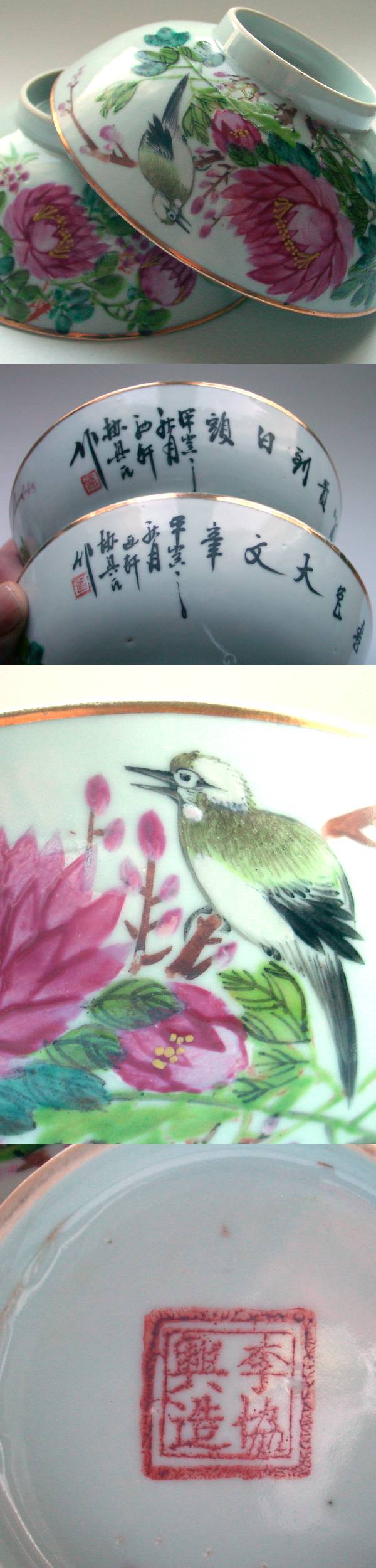 |
Li Xiexing Zao (Made) | 102. Mark: Li Xiexing Zao (Li Xiexing Factory Made). Dated 1914.
The second part of the text contains the words Jia Yin Nian - matching year 1914. The birds common Chinese name is "White head Granny" and the flower is of course Peony, which stands for prosperity. Caption is: "Prosperity to the old age". Unmistakably Jiangxi quality, either Jingdezhen or Nanchang. Set of several bowls: Bird: "White head Granny" (Prosperity till eternity). Bowl 2: Yellow bird - "The Great Spring Scholar", Caption refers to the fantastic singing of this yellow bird. In the quiet Chinese villages, after a long snowy winter, her rapid singing signaling the arrival of Spring is sheer joy. Bowl 3 - The flaming/glorious blossom. Peony is here a metaphor for family success and wealth. The date carries all the characteristic of the period : Two years into the republic period, the warlords are still fighting but the bright enamels, the hue of the white glaze and the hasty fluent painting reflects the desire of the potters of a better daily life.
|
1914 | 102 | Bowl | Li Xiexing Zao | 111 | |
| Li Xinyuan | 1915 | Pot | 112 | |||||
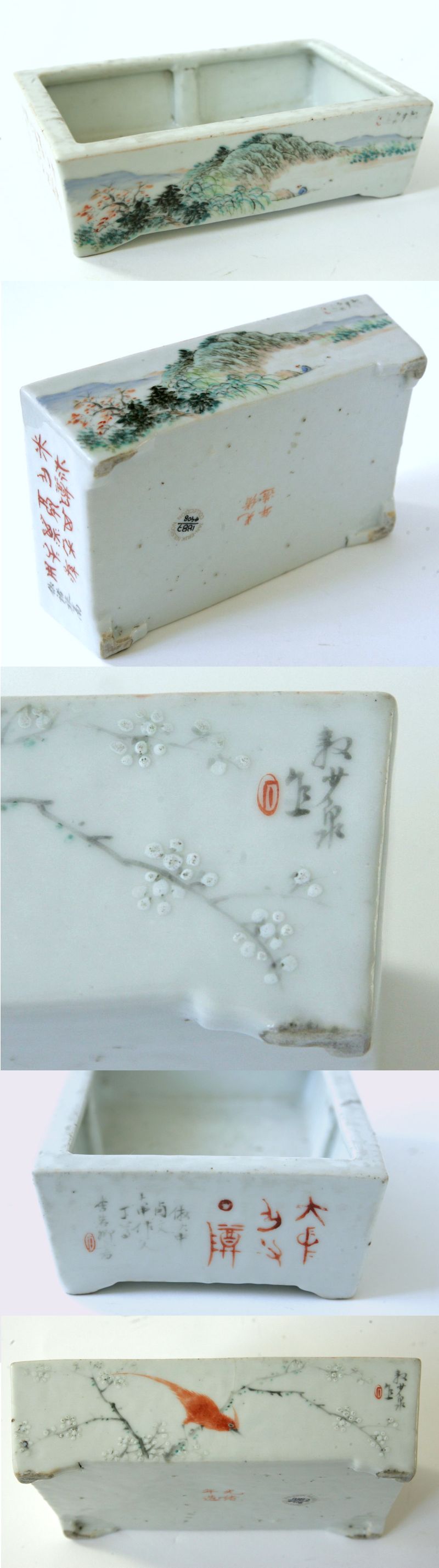 Signed by: Li Yanqing |
Li Yanqing | 408. Narcissus pot. The four character mark on the base reads Guangxu Nian Zao (1875-1908). Calligraphy on the sides reads Painted by Li Yanqing (in the) ding hai year (1887).
|
1887 | 408 | Square bowl | Guangxu Nian Zhi | 113 | |
| Li Youmei | 李友梅 | Qianjiang artist. | 114 | |||||
| Li Yunhui | 李蕴辉 | 115 | ||||||
| LI Yuyuan | 李裕元 | 116 | ||||||
| Li Zhensheng | 李镇生 | 117 | ||||||
| Li Zhiheng () | Porcelain painter or sculptor of Jingdezhen in the first half of the twentieth century. (Simon Kwan, Brush and Clay, 1990 p. 43) | 118 | ||||||
| Liang Duishi (active 1920-1937) / Lize Xuan / Shilu | (Simon Kwan, Brush and Clay, 1990 p. 43) Studio mark: Lize Xuan (Simon Kwan, Brush and Clay, 1990 p.53), Shilu (Simon Kwan, Brush and Clay, 1990 p.53). Exhibit number 52 (Innovations and Creations, 2004). | 119 | ||||||
| Lin Dachun | 林大椿 | 120 | ||||||
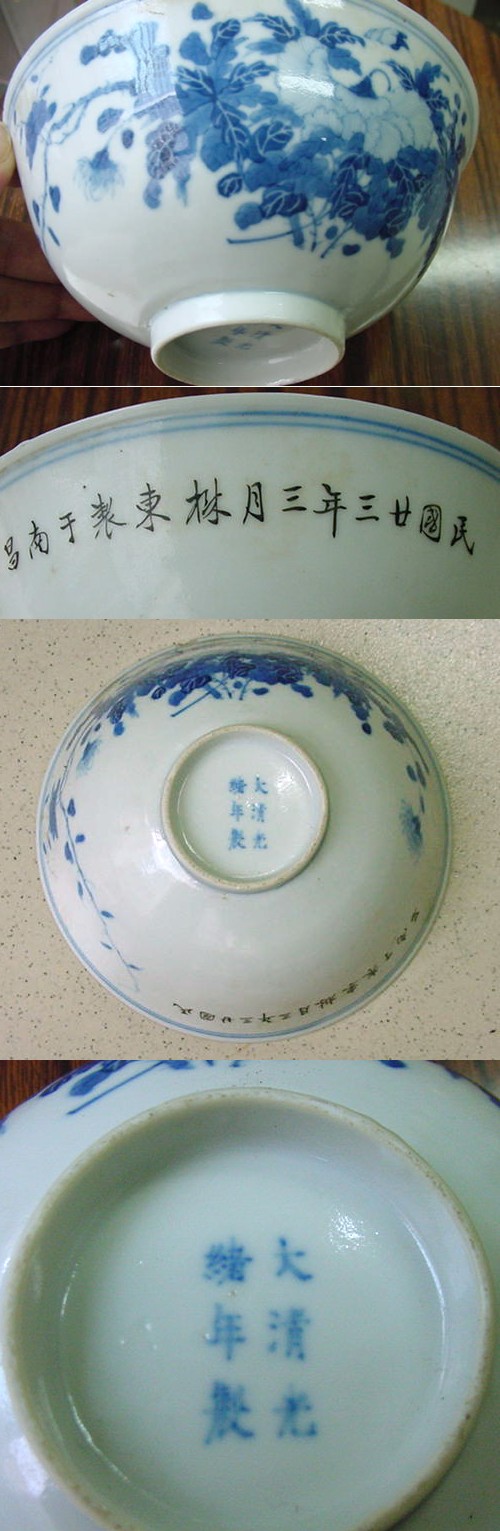 |
Lin Dong | 630. Dated in the inscription Republic 23rd year March Lin Dong made in Nanchong, Since 1912 was counted as year 1, the 23rd year is 1912-23=1935. Mark: Da Qing Guangxu Nian Zhi - "Guangxu period (1875-1908) made". | 1935 | 630 | Bowl | Da Qing Guangxu Nian Zhi | 121 | |
| Lin Haiqing | 1927 | Jar | Red 4 characters | 122 | ||||
| Ling Xiang | 1888 | Bowl | Tongzhi Nian Zhi | 123 | ||||
| Little Mountain | 1887 | Bowl | 124 | |||||
| Liu Baoren (108)Â | Exhibit number 108 (Innovations and Creations, 2004). | 125 | ||||||
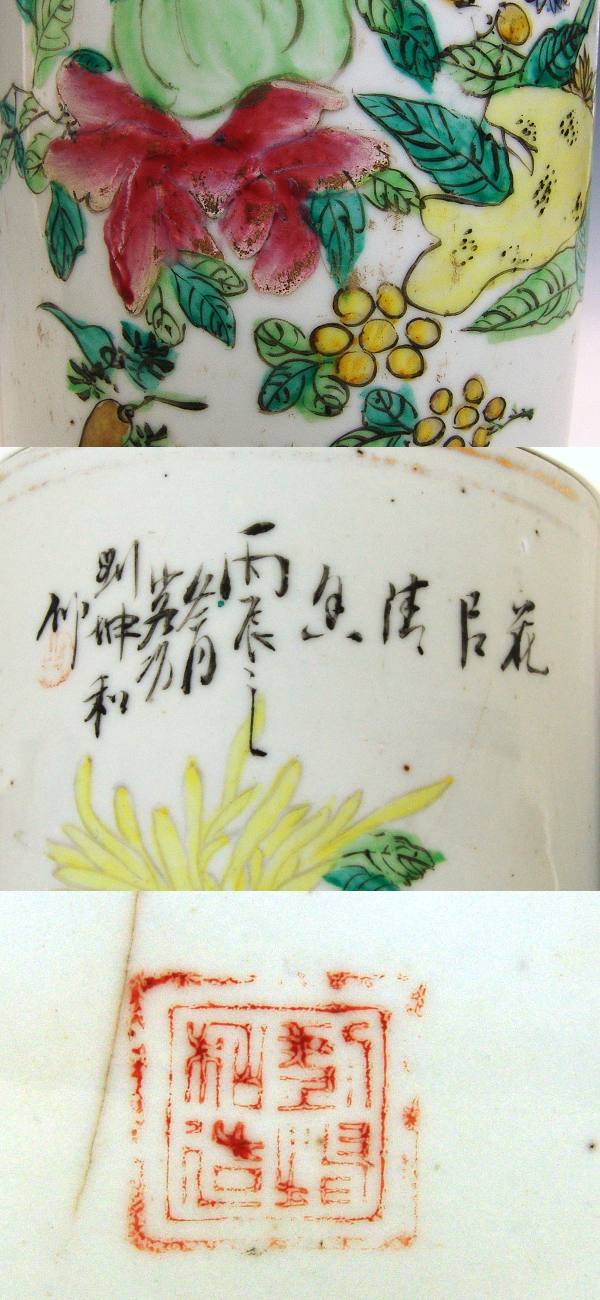 |
Liu Junhe | 833. Porcelain vase. The two first upright characters gives the year bing chen (1916). Mark: Liu Junhe Zao meaning: 'Liu Junhe' Made.
|
1916 | 833 | Vase | Liu Junhe Zao | 126 | |
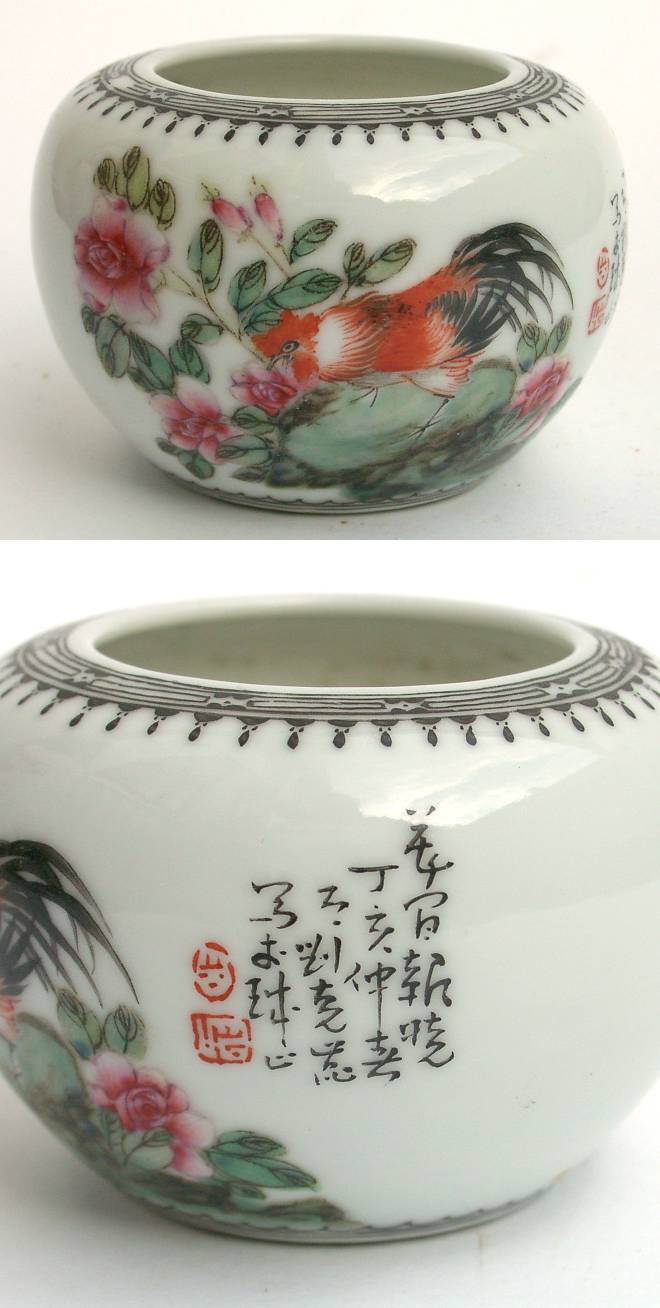 |
Liu Kerui | 646. Dated "Spring 1947, Liu Ke Rui painted at Zhu Shan". (Zhu Shan or Pearl Hill is the area of the former Imperial porcelain factory in Jingdezhen.)
Donated to the gotheborg.com reference collection. |
1947 | 646 | Globular bowl | 127 | ||
| Liu Linggu | 柳灵谷 | 128 | ||||||
| Liu Xiren (1906-1967) / Yonghua Tang / Zaisi Xuan | Third generation of the literati school of porcelain painting. (Simon Kwan, Brush and Clay, 1990 p.42, fig 109-112). Studio mark: Yonghua Tang (Simon Kwan, Brush and Clay, 1990 p.53) , and Zaisi Xuan (Simon Kwan, Brush and Clay, 1990 p.53). Exhibit number 71-72 (Innovations and Creations, 2004). | 129 | ||||||
| Liu Yucen (1904-1969) / Yinbing Zhai / Jue'an | 刘雨岑 | Specialized in birds-and-flowers. Independent painter of the 1930s with his own studio in which he worked on orders they had received. Second generation of the
literati school of porcelain painting. Member of the Yueyuan Hua, later called Eight Friends of Zhushan from 1928. Studio name, early period: Yinbing Zhai; later period: Jue'an (Simon Kwan, Brush and Clay, 1990 p.42, fig. 69-77). Exhibit number 65-69 (Innovations and Creations, 2004).
Liu Yucen, also called Yucheng, was a native of Taiping county of Anhui province, was a ceramic artist. At the age of 15 he entered the Boyang porcelain school and took national painter Pan Taoyu as his teacher to learn traditional painting. At the age of eighteen, he came to Jingdezhen to make a living on porcelain and gained the help and praise of the famous expert Wangqi. He was an expert at the Chinese flower and bird painting with realistic and abstract technique. He combined well in composition, colours, elegancy and shaping. He made the porcelain decoration reach an artistic effect of harmony and unity. He created firstly ink painting Fencai decoration technique and designed the famous peach flower with water drop. His works are fresh, elegant and bright. He forms his own style in ceramic field. He created many skillful Fencai flower and bird works in his life, which were collected by the fans of the porcelain at home and abroad. Because of his remarked artistic achievements, he has acted as associate chairman of Jiangxi branch of China art association, chairman of Jingdezhen artistic staff association, associate chairman of Jingdezhen political and according session and so on. (Source: jdz.gov.cn 2011) Liu Yucen (1904-1969), was mentored by Pan Taoyu, came to Jingdezhen in 1922, good at powdered colour flowers & birds, and acknowledged painting souls of Ren Bonian and Xinrong Shanren (the two famous painter then). |
130 | |||||
| Liu Zhongqing (1889-1968) | 刘仲卿 | Third generation of the literati school of porcelain painting. (Simon Kwan, Brush and Clay, 1990 p.42). Exhibit number 81-84 (Innovations and Creations, 2004).
Liu Zhongqing(1898-1969) Liu Zhongqing a ceramic artist, with a name of Xizu, is a native of Nanchang of Jiangxi province. He began to learn the skill when nine years old. He has engaged in ceramic art for 67 years. In his young ages, he copied many famous porcelains and silk scroll collected by the ancient palace which played a great role in improving his realistic technique. His paintings stress the Fencai technique decoration. He was an expert in painting, filling color and engraving seals. His works obtained high praise in his young ages. In his middle year, he specialized in painting bird, herbs and insects especially butterflies which was unique in style. He combined cloissonne, embroidery, silk paintings and other artistic refinements into a whole body. He created a unique skill of point and line. The whole painting regards the line as the framework, the point as brightness and darkness. The lines are smooth and fine and show strength in softness which have a typical the artistic character of Qing dynasty Yongzheng fencai. He works obtained high praise at home and abroad. The collectors and the antiques such as "Gong Hean","Qibaozhai", "Min Zexuan" at that time praised his works greatly who bought and sold all his works. His masterpieces are the vase and phoenix and peony, feather light with hundreds of butterflies, eggshell bowl with opium and magnolia Fencai tea set, Fencai porcelain plate with butterflies in flowers etc. (Source: jdz.gov.cn 2011) |
131 | |||||
 Signed and seal: Lou Chunmao |
Lou Chunmao | 1079. Hatstand, Calligraphy: "Admiring the old for benefit in the future, Mr Luo Chunmao made, (plus his seal), Winter of the yi si year (1905). In 1894 Mei Chunmao occurs on a pieces with a Guan yao nei zao mark, see 1894
|
1905 | 1079 | Hatstand | 132 | ||
| Lou Yongfa/Lou Youngxian | 1917 | Kamcheng | LOU Yong Fa/Lou Young Xian | 133 | ||||
| LU Shangwen | 1904 | hatstand | Da Qing Guangxu Nian Zhi | 134 | ||||
| Lu Yunshan | 陆云山 | 135 | ||||||
| Luo Zhonglin | 羅仲林 | Qianjiang painter. | 136 | |||||
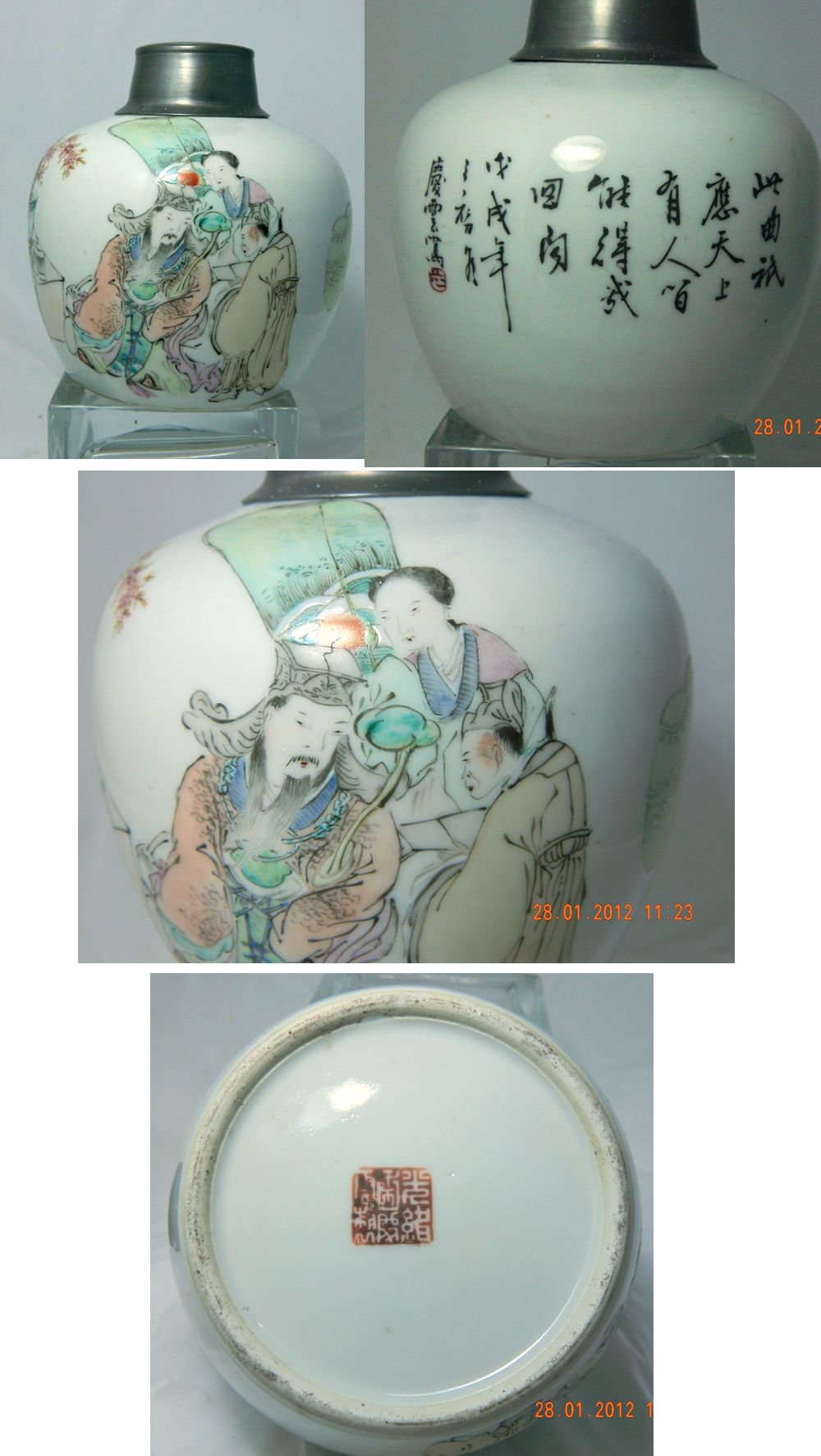 Signed by: Ma Qingyun (1898) |
Ma Qingyun | 马庆云 | 1428. Ginger Jar, dated wu xu year in the calligraphy (1898). Mark on the base an unusual combination of period and artist/studio: Guangxu Nian Qingyun Zhi. Signed by: Ma Qingyun (1898). | 1898 | Ginger jar | Guangxu Nian Qingyun Zhi | 137 | |
 |
Man of thirty great mountain peaks | 1414. Square tea pot. Dated in the calligraphy to 1871. Hand written base mark in iron red with chafered corners Da Qing Tongzhi Nian Zhi "Great Qing Dynasty Tongzhi Period Make". The second line reads "Tongzhi Xin Wei (1871) Mid Autumn (I) made this by the side of the Jingdezhen River... (could be read as, Made at the Changjiang Official Works). Chang jiang is the river that runs through the city but also a district of Jingdezhen. The artist call himself the man of the thirty great mountain peaks and say he have painted the decoration in the style of Ni Yunlin which refers to the Yuan painter Ni Zan. As usual in these wares that refer to famous painters, the style of the decoration bears no connection to Ni Zan, who painted almost exclusively in ink and never painted bird/flower subjects, only an occasional bamboo. | 1871 | 1414 | Teapot | Da Qing Tongzhi Nian Zhi | 138 | |
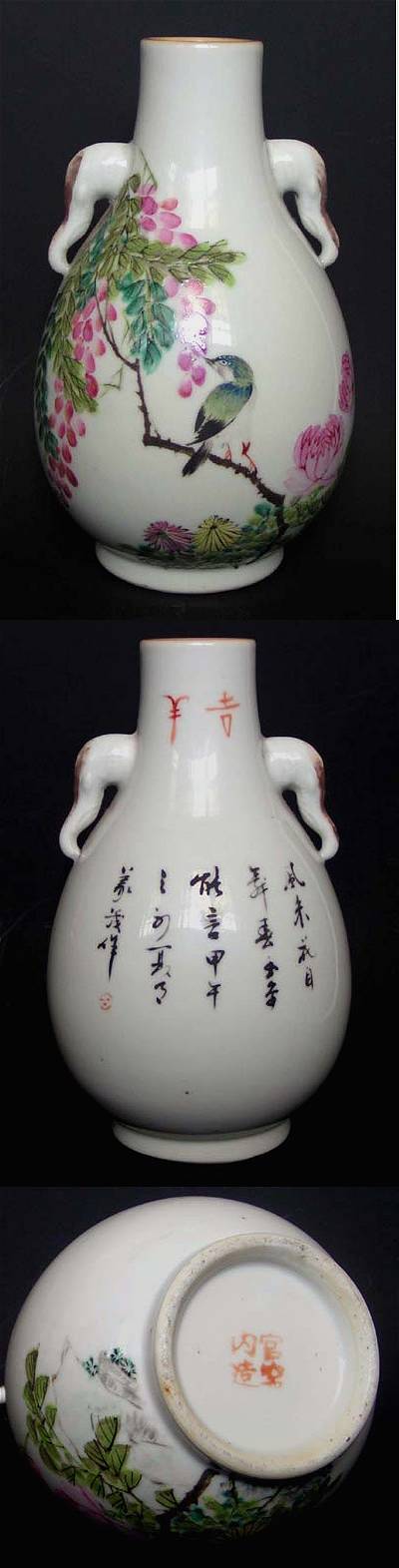 Signed by: Mei Chunmao |
Mei Chunmao | 梅春茂 | 1125. Vase with elephant's trunk handles. Dated in the inscription to the jia wu year (1894). Red base mark Guan yao nei zao (Imperial Kiln for Inner Palace). In 1905 Mei Chunmao occurs on a pieces with a stamped Tongzhi Nian Zhi mark. | 1894 | 1125 | Vase with elephant handles | Guan Yao Nei Zao | 139 |
| Mei Feng-chiao | 梅峰樵 | Qianjiang artist. | 140 | |||||
| Meng Yuantai | 1899 | Vase | 141 | |||||
| Mo Qiuxia () | Exhibit number 64 (Innovations and Creations, 2004). | 142 | ||||||
 Set of Plaques signed by: Mo Zheng |
Mo Zheng | 553 | ||||||
| Nie Xingsheng | 聂杏生 | 143 | ||||||
| Pan Taoyu (1887-1926) (Pan Pottery House) / Guhuan Zhai | 潘陶宇 (潘匋宇) |
One of the two most famous porcelain painters of Jingdezhen in the early years of the Republic. Painted in fencai enamels, totally different from the of the Qianjiang school. Painted figures and birds-and-flowers, inscribed with verses and signed with a seal as if painting on silk or paper. Pan was a all-rounder who was good in human figures, landscape and bird/flower. Few works have survived. Had a strong influence on Jingdezhen porcelain painters. Among Pan Taoyu's students are Wang Yeting, Liu Yucen and Cheng Yiting, all members of the famous Eight Friends of Zhushan. The Eight Friends of Zhushan were among the best Fencai master artists of the Republican period. Studio mark: Guhuan Zhai (Simon Kwan, Brush and Clay, 1990 p.41) Outstanding fencai (enamels) artist of the 1910s and 1920s. (Simon Kwan, Brush and Clay, 1990 p. 82). Employed by the warlord Cao Kun in 1923. Usually small formats. Biography (Simon Kwan, Brush and Clay, 1990 p.90). Exhibit number 25-28 (Innovations and Creations, 2004). | 144 | |||||
| Pan Yongbing (1900-1961) | 潘庸秉 | Pan Yongbing was a artist of ceramic fine arts and was a native of Boyang county, Jiangxi Province. He was born into an old and famous ceramic family. As a child he was taught to paint by his uncle, a famous master of ceramic crafts of Jiangxi province. At the age of 14, he entered into the First Industry school of Jiangxi Province to specialize in ceramic crafts. After graduation, he worked as a teacher in the Porcelain School of Jiangxi Province. In 1925 he worked as the painting master in Beijing Ceramic Company. During this period he visited famous masters and often sketched and copied at places of historic interest and scenic beauty. He seriously researched the works of the ancient famous painters. Because of his diligence his accomplishment was improved and his paintings of landscape, figure, flowers and birds, animals and so on were elegant and unique. The picture appearance of the ceramic shape he designed was fresh and elegant. He was capable of being well skilled at using all kinds of techniques of fine arts. Earlier in the 1930s his ceramic works had influence at home and abroad. His works were exhibited in China, America, Belgium, Panama and so on and won many prizes. After the establishment of the People's Republic of China in 1949, he was once the associate superintendent of the Ceramic Research Institute of China Light Industry Ministry, the director of China Artist Association, the associate president of Artist Association of Jiangxi Province, the president of Jingdezhen Artist Association and the general editor of Ceramic Arts and so on. His main works are gold oval platter with underglaze red, embossed and carved chicken hanging plate with blue glaze, new crane tea set with sky blue glaze, embossed pot with celadon, landscape vitrolite painting and so on. |
145 | |||||
| Pan Yushu | 潘玉书 | 146 | ||||||
| Pan Zhaotang ? | 1912 | Vases | 147 | |||||
| Pan Zhinan | 潘植南 | Qianjiang artist. | 148 | |||||
| Peng Youxian | 彭友贤 | 149 | ||||||
| Phase Ren Ren | 任相仁 | 150 | ||||||
| Qi Ming (Enlightened) | 启明 | Qianjiang artist (Koh). | 151 | |||||
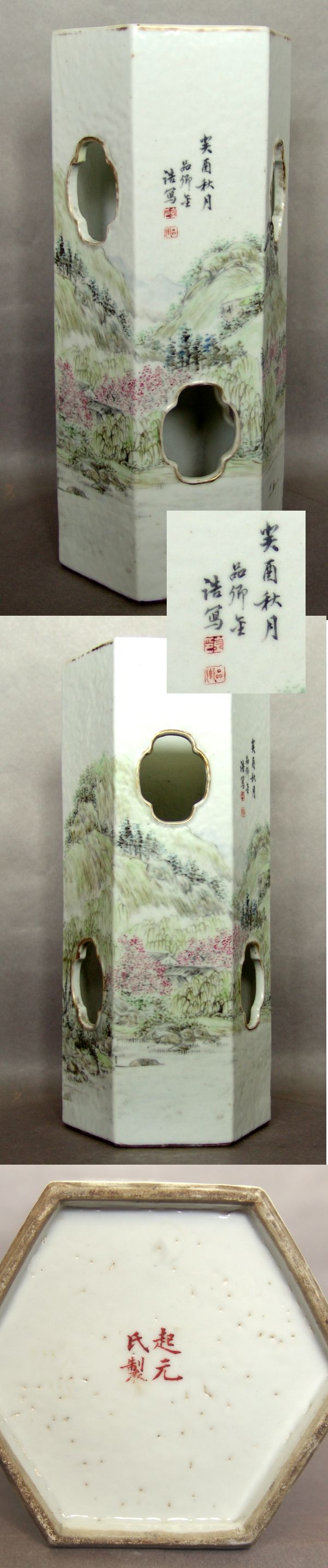 |
Qi Yuanshi | 998. hatstand with pierced walls. Dated in the calligraphic inscription to the gui you year, i.e. 1873. Hand written base mark in iron red Qi Yuanshi zhi meaning "Qi Yuanshi made". | 1873 | 998 | hatstand | Qi Yuanshi Zhi | 152 | |
| Qing Yun (Ma Qing Yun) | 1912 | Teapot | 153 | |||||
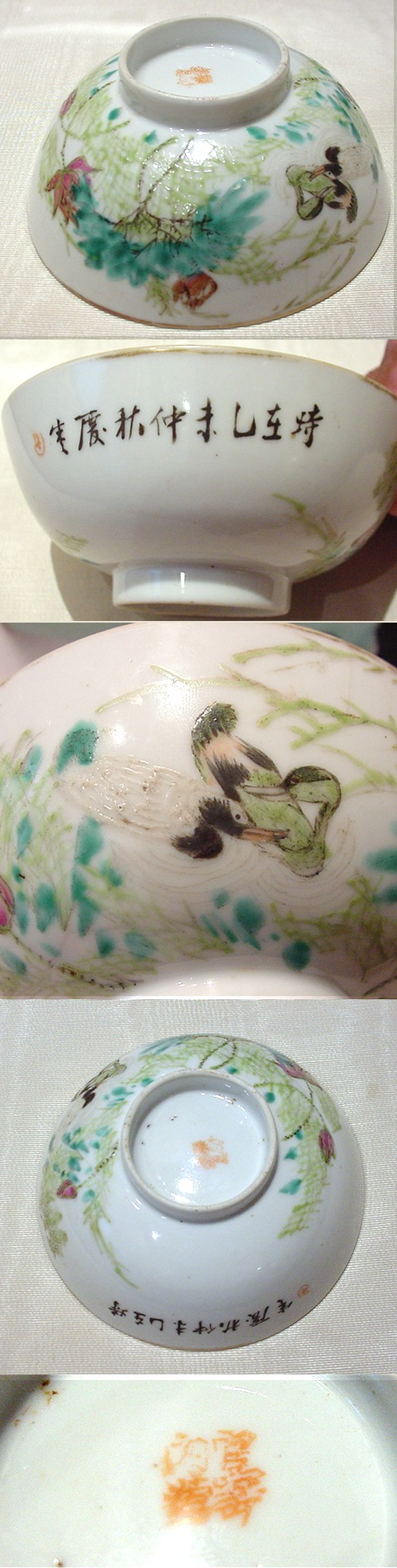 Signed by: Qing Shu |
Qing Zhu | 686. Bowl. Red base mark Guan yao nei zao (Imperial Kiln for Inner Palace). Dated mid summer 1895. Inscription reads Shi Zai (at the time of) yi wei (matching year 1895) Zhong Qiu (mid summer) Qing Shu (Artist name). | 1895 | 686 | Bowl | Guan Yao Nei Zao | 154 | |
| Rao Hua Jie | 饶华阶 | 155 | ||||||
| Ren Huantang | 1882 | 156 | ||||||
| Ren Huanzhang (Zi: Weishan) | 任焕章 (字巍山) |
1882 | Teapot | 157 | ||||
| Ren Huanzhang (Zi: Weishan) | 任焕章 (字巍山) |
1891 | Jar | 158 | ||||
| Ren Huanzhang (Zi: Weishan) | 任焕章 (字巍山) |
Qianjiang artist. | 159 | |||||
| Shan Min ? Ting | 1905 | Vase | 160 | |||||
| Shao Qiao | 少樵 | Qianjiang artist (Koh). | 161 | |||||
| Shao Quan | 1887 | Bowl | Guangxu Nian Zhi | 162 | ||||
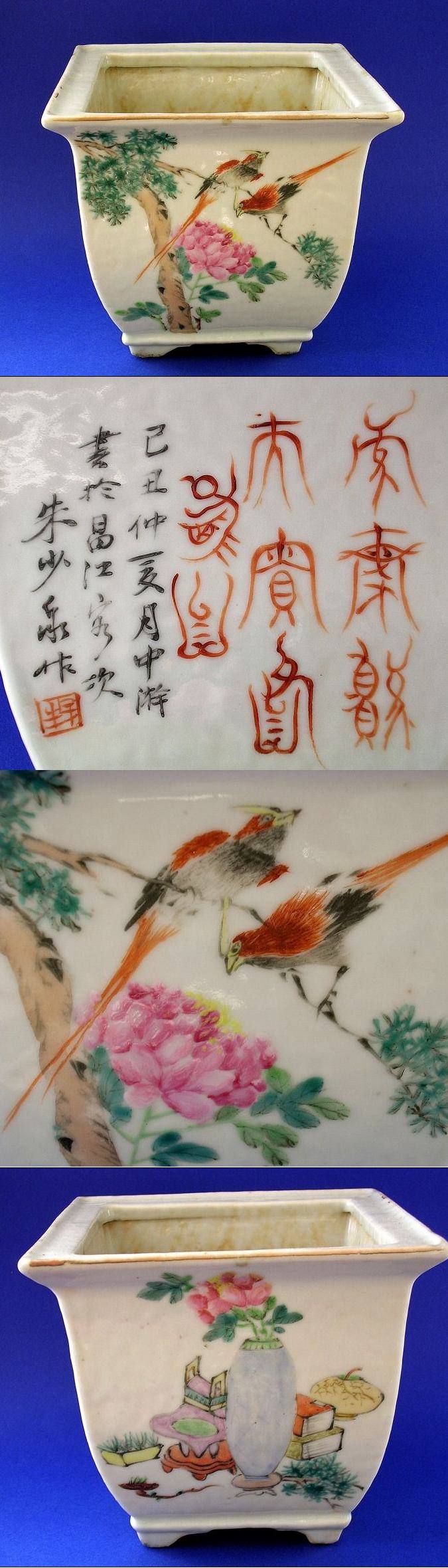 Signed by: Zhu Shao Quan |
Shao Quan | 1036. Planter, dated 1889. The calligraphy sides shows, on one side a poem about peonies, and on the other red calligraphy work in ancient script, and in black the Chinese year date for the planter, which is the Ji chou year 1889. There is also a seal signature for the artist Shao Quan | 1889 | 1036 | Square planter | 164 | ||
| Shao Sanshi | 1903 | Teapot | 165 | |||||
| Shao Xuan | 少轩 | Qianjiang artist. | 166 | |||||
| Shen Huanwen | 1906 | Vase | Tang Po Zao Hao | 167 | ||||
| Shen Huanwen | 1907 | Box | Guangxu Nian Zhi | 168 | ||||
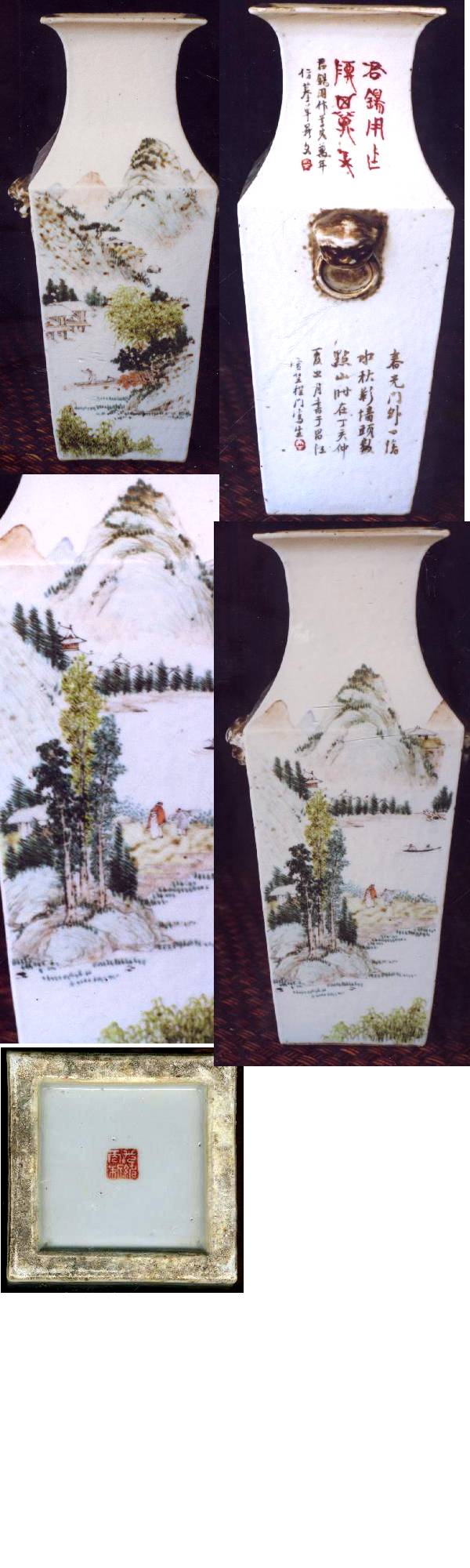 Signed by: Sheng Men |
Sheng Men | 621. Vase, dated 1887. Painted by Sheng Men (1887). Mark: Guangxu Nian Zhi (1875-1908). | 1887 | 621 | Square vase | Guangxu Nian Zhi | 169 | |
| SHI Huanying (1908-1968) | 时幻影 | Exhibit number 100 (Innovations and Creations, 2004). | 170 | |||||
| Shi Yuchu (1909-1972) | Exhibit number 114 (Innovations and Creations, 2004). | 171 | ||||||
| Shu Pinghen (Xu Pinheng) | 1893 | Bowl | Guangxu Nian Zhi | 172 | ||||
| Shuang Yicheng | 1919 | Teapot | Shuang Yi Cheng Zao | 173 | ||||
| Song Zhuxuan | 1917 | Vase | 174 | |||||
 Signed: Su Gong(?) Yue |
Su Gong ? Yue | 1192. Ewer, with the Chinese cyclical date jia zi (1924) in the inscription. Stamped base mark Cheng Long Wan Pin "Successful Grand Joyful Product". The mark, Wan Pin literal direct translation is Play Item. Here it should means collector or souvenir item. The artist name is Su Gong(?) Yue.
|
1924 | 1192 | Ewer | Cheng Long Wan Pin | 175 | |
| Su Gong Yue | 1924 | Ewer | Cheng Long Wan Pin | 176 | ||||
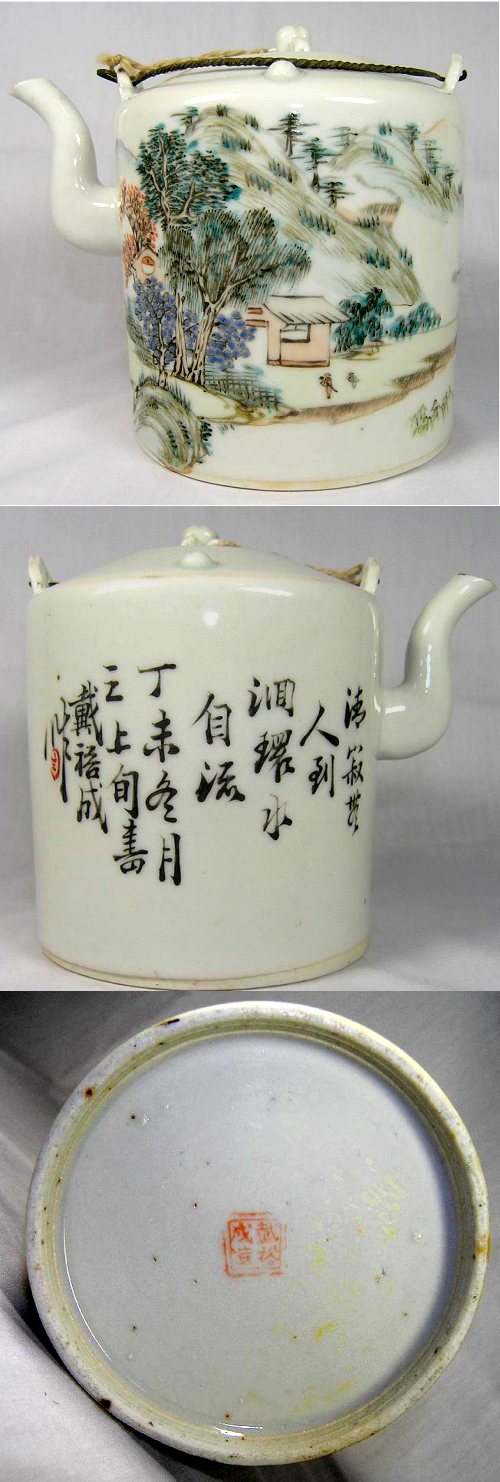 Seal on base: Tai Yueshing |
Tai Yueshing | 1117. Large tea pot, dated ding wei 1907. Red seal mark on the base of the artist Tai Yueshing Made. | 1907 | 1117 | Large teapot | Tai Yueshing (made) | 177 | |
| Tang Youguang | 汤有光 | 178 | ||||||
| Tao Dingnai () | Exhibit number 140-141 (Innovations and Creations, 2004). | 179 | ||||||
 Signed by Tian Hexian (1945) |
Tian Hexian (1894-1952) | 田鹤仙 | Favourite subject refreshing plum blossoms and landscapes. Liked diagonal composition. Independent painter of the 1930s with his own studio in which he worked on orders they had received. Second generation of the literati school of porcelain painting. Member of the Yueyuan Hua, later called Eight Friends of Zhushan from 1928. Studio name: Gushi Zhai (Simon Kwan, Brush and Clay, 1990 p.42, fig. 54-63). Exhibit number 56-59 (Innovations and Creations, 2004). Tian Hexian, whose original name was Tian Hexian, was also known as Huang Yuan Lao Mai. He was a native of Shaoxing city, Zhejiang province and born in Fuzhou, Jiangxi province in 1894, and died in 1952. He was one of the Eight Friends of Zhushan. The artist was proficient in painting landscape in his early life and specialized in painting plum blossoms in his mid-and late life. (Source: jdz.cn 2011). Tian Hexian (1894-1952), was employed by Jiangxi Porcelain Industy Company as a teacher of night school, was focusing on study painting landscape, and then on painting plums, and reached his unique style by his plum paintings. His plum paintings were influenced by Wang Mian (a famous Yuan Dynasty artist). |
180 | ||||
| Time Kangjiahui | 康家钟 | 181 | ||||||
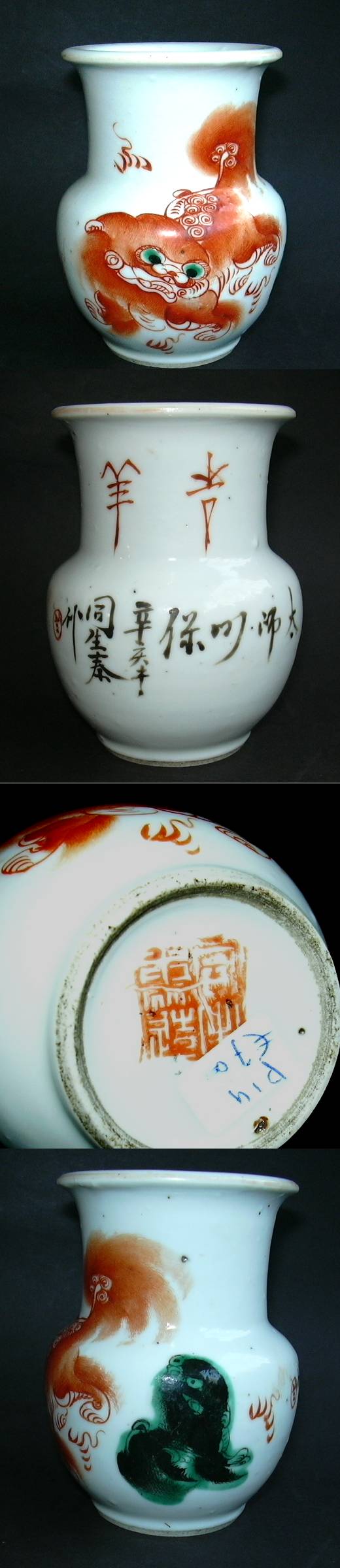 |
Tong Sang Tai (Shop) | 1154. Small 'liondog' decorated vase with an innovative shape, typical of the period. On the base a factory mark of the period Tong Sang Tai Made. Dated to the xin hai year in the calligraphy (1911). | 1911 | 1154 | Vase | Tong Sang Tai (Made) | 182 | |
| Tong Sheng Tai | 1910 | Brush pot | Tong Sheng Tai Zao | 183 | ||||
| Tsang Fook Hing (Cantonese) | 1946 | Plaque | 184 | |||||
 |
Tse Min | 672. Brush holder, with decoration in Qianjiang cai style of decoration, nice painting and calligraphy in dull black enamel, dated "1892". Mark: Tongzhi Nian Zhi - "Tongzhi period made", but Guangxu period.
Poem loosely translated: Poem signed by "Tse Min". |
1892 | 672 | Brush holder | Tongzhi Nian Zhi | 185 | |
| Tu Juting (-1970) | Third generation of the literati school of porcelain painting. (Simon Kwan, Brush and Clay, 1990 p.42, fig 99-100) | 186 | ||||||
| Wan Shaoyan | 1925 | Plaque | 187 | |||||
| Wan Yunyan (c.1910-c.1950) | 万云岩 | Third generation of the literati school of porcelain painting. (Simon Kwan, Brush and Clay, 1990 p.42, fig 135) | 188 | |||||
| Wan Ziming | 万子铭 | Qianjiang artist. | 189 | |||||
| Wandering Seagull | 1878 | Dish | Blue, eight char.s | 190 | ||||
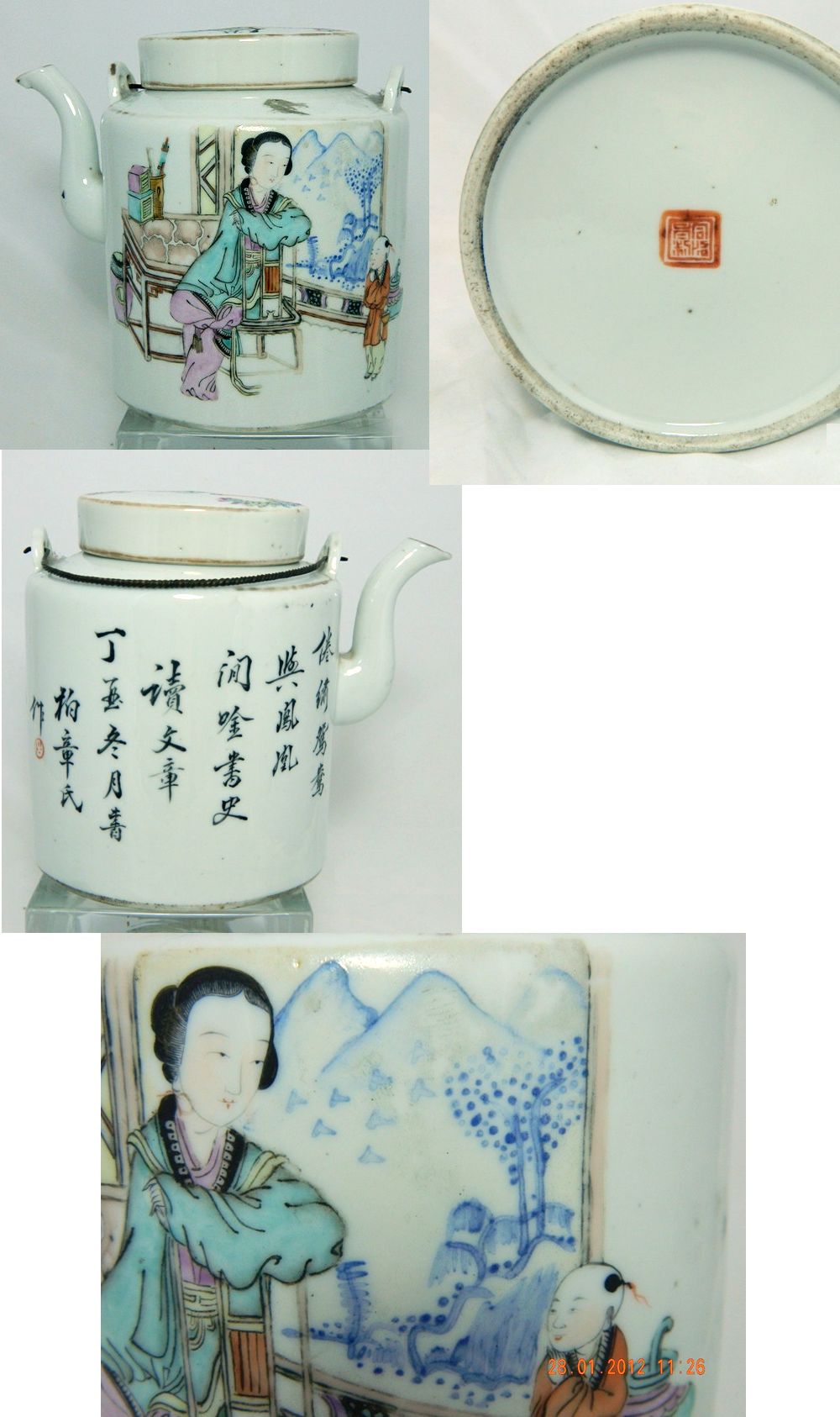 Signed: Po Zhang (1877) |
Po Zhang | 1427. Teapot. Square stamped four character basemark "Tongzhi Nian Zhi". The calligraphy signed Po Zhang and dated 1877. | 1878 | Teapot | Tongzhi Nian Zhi | 220 | ||
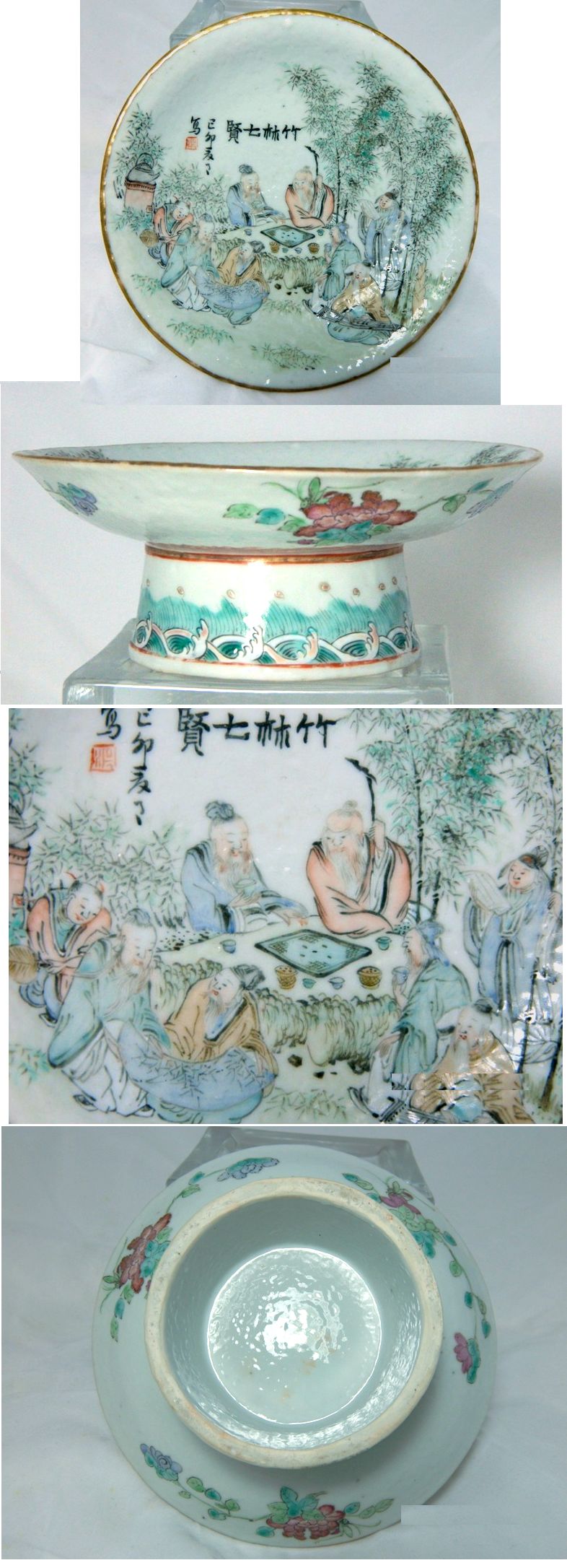 |
1429. Serving dish on a raised foot. Dated in the inscription to 1877 (or 1937). | 1878 | Serving dish | 222 | ||||
| Wang Bingrong | 王炳荣 | 191 | ||||||
| Wang Bu (1898-1968) | 王步 | Worked with underglaze blue. Work resembles both pencil drawings and ink paintings. Second generation of the literati school of porcelain painting. Significant but peripheral to the Eight Friends. (Simon Kwan, Brush and Clay, 1990 p.42, fig. 86-89). Studio name: Yuan Wen Wu Guo Zhi Zhai (Simon Kwan, Brush and Clay, 1990 p. 53). Exhibit number 73, 153-157 (Innovations and Creations, 2004).
Wang Bu was a ceramic artist born in Fengcheng County, Jiangxi Province, styled Renyuan,also known by his literary name Zhuxi. He often inscribed "the old man Taoqing" on the blue and white porcelain and Chinese national painting in his late years. His father, named Xiuqing, was expert at blue and white during the reigns of Tongzhi and Guangxu of Qing Dynasty. As a boy, Wang Bu was influenced by his father and specially being keen on liking for drawing. At the age of 9, he formally became a pupil to Xu Yousheng, an artisan in blue and white in Jingdezhen, and completed his apprenticeship in 1912. After the workshop closed down, he made a living by drawing bird feeder jars. Later he was hired by the famous ceramic artist Wu Aisheng to make porcelain in the styles of the ancients. Every day he copied well-known Guanyao wares of Ming and Qing dynasties, which laid foundation for his later innovation. After Wu died, he turned to drawing blue and white with the technique of Chinese brush drawing, thus creating liberal fresh works, and a new practice in the world of ceramic art. After the Anti-Japanese War, he had to give up blue and white for on-glaze decoration. But he returned to blue and white and created one new art works after another after the establishment of the People's Republic of China in 1949. By absorbing splash-ink of Chinese ink-painting, he invented a coloring pigment which made art works bright, lively and flowing. His decorative techniques of blue and white with underglaze colors and blue and white paste-on-paste are also impressive. During the sixty years or so from the year 1907 he arrived at Jingdezhen to his death in 1986, he created millions of ceramic art works with underglaze and overglaze colors, with paste-on-paste carving and incised decoration. He was known as "the king of blue and white". His work includes underglaze blue and underglaze red decorative plate "grapes", the porcelain plaque "green lotus pond", and the oblong-shaped vase "morning glory"; the blue and white porcelain plaques "double catfish", "the moon and shrimps", and "carrot and cabbage", the arrow holder "vegetables", and small jars with designs of pine trees, rock, glossy ganoderma and plum. (Source: jdz.gov.cn 2011) |
192 | |||||
| Wang Chengxian () | Exhibit number 158 (Innovations and Creations, 2004). | 193 | ||||||
| Wang Dacang | 汪大沧 | 194 | ||||||
| Wang Dachang (1901-1953) | Even freer landscapes than Wang Yeting. Second generation of the literati school of porcelain painting. Significant but peripheral to the 'Eight Friends'. (Simon Kwan, Brush and Clay, 1990 p.42, fig. 107-108). Exhibit number 62-63 (Innovations and Creations, 2004). | 195 | ||||||
| Wang Dafan (1888-1961) | 王大凡 | Independent painter of the 1930s with his own studio in which he worked on orders they had received. Excelled in figures, followed western method of chiaroscuro in faces. Second generation of the literati school of porcelain painting. Member of the Yueyuan Hua, later called Eight Friends of Zhushan from 1928. Studio name: Xiping Caolu (Simon Kwan, Brush and Clay, 1990 p.42, fig. 64-68). Based many of his designs on works by the 19th century Shanghai painter Ma Tao. Had great influence on fencai figure painting in Jingdezhen. From 1939 gave up using opaque arsenic white under layer for fencai enamels. (Biography, Kwan, Brush
and Clay, 1990, p. 91). Exhibit number 37-40 (Innovations and Creations, 2004).
Wang Dafan was a ceramic artist born in Yi County, Anhui Province, also named Kun and known by his literary name Yi Shall Tui Zi. He was a productive ceramic artist. During his ceramic creation of more than half a century, he made good use of the past things learned from the ancients, and used both fine and freehand brushwork in drawing figures which were simple, natural, careful and graceful, yet unrestrained. At age 27 in 1915, he created a large porcelain vase with figure patterns "riches, honor and longevity" that was awarded a gold medal at Panama International Fair. In 1939, he invented the ceramic technique of special famille rose, which directly applied pigments to the body, and made great achievements in carrying on Chinese fine arts and crafts. In order to develop ceramic art, he, together with Wang Qi, set up Jingdezhen ceramic fine art research house in the early years of the Republic of China (1912-1949), which enrolled over 300 members, held quite a few exhibitions and published more than twenty pictorials. Besides, he also started daily paper of Jingdezhen. Together with other artists such as Wang Qi and Wang Yanting, he started "Yue Yuan association" to research and innovate drawing techniques, which was later called "the Eight Friends of Zhushan". After the establishment of the People's Republic of China in 1949, he worked in Jingdezhen Ceramic Research Institute and created many works in praise of the Communist Party and the socialism. (Source: jdz.gov.cn 2011) Wang Dafan (1888-1961), mentored by Wang Xiaotang (1885-1924) from childhood, and also learned painting techniques from other several famous painters as that time, and then reached his own technique and style. He created his unique technique on powdered colour painting. His artwork Arhat with Cloth Bag, won the Gold Medal at the Panama International Exposition in 1915. |
196 | |||||
| Wang Dan Cheng (Fu Yuntang) | 王凤池 (丹城) 福云堂 |
Qianjiang artist (Koh). | 197 | |||||
| Wang Di (1885-1924) | Exhibit number 29-30 (Innovations and Creations, 2004). | 198 | ||||||
| Wang Dongrong () | Wang Dongrong was a native of Xiuning, Anhui. He painted figures and birds-and-flowers in the gongbi style. Early in his career he was a gucai painter. Most of his work was copies of old pieces. He does not appear to have inscribed his work. (Simon Kwan, Brush and Clay, 1990 p.41) | 199 | ||||||
| Wang Dongxun (Wang Huixun) | 1925 | Pot | 200 | |||||
| Wang Fan | 汪藩 | 201 | ||||||
| Wang Fengchi (Dancheng) | 王凤池 (丹城) |
202 | ||||||
| Wang Mao-cai | 汪茂才 | 203 | ||||||
| Wang Pan | 汪潘 | Qianjiang artist. | 204 | |||||
 Signed by Wang Qi (1930) |
Wang Qi (1884-1937) | 王琦 | Independent painter of the 1930s with his own studio in which he worked. Organized the Full Moon Society, Yueyuan Hua, in 1928, later called Eight Friends of Zhushan. Studio name: Taotao Zhai. Wang Qi, who was also known as Bizhen, was one of the Eight Friends of Zhushan. He was born in Xinzhan county, Jiangxi province in 1886 and died in 1938. He started his career as a portrait painter and later became famous for painting 'head and face of figures (Xi Fa Tou Zi)' on porcelain. (Source jdz.cn 2012). He specialized in drawings of human figures. His earlier works was done more in the gong bi style, which is characterized by the use of fine outlines for the human figures while his style later developed into a more free style. Wang Qi (1884-1934), came to Jingdezhen in 1901 to learn from Deng Bishan the porcelain painting art and portrait painting art, afterwards also learn from Qian Hui An (the most famous painter at that time). In 1916, Fuliang County (Jingdezhen belonged to Fuliang County at that time) Magistrate presented him a plate “Supernatural Techniqueâ€, and his fame was booming out. In 1916, he went with Wang Dafan to Shanghai to watch Shanghai Paintings Exhibition and knew with Eight Strange Masters of Yangzhou, he was especially impressed by the painting style of Huang Shen. Huang Shen (a member of Eight Strange Masters of Yangzhou), was especially expert on painting persons, also good at painting landscape and flowers & birds. Wang Qi, for he had experience of making portraits and sculptures and painting portraits on porcelains, also for he absorbed the techniques from Western Paintings, thus reached a new high art level on his porcelain paintings. |
205 | ||||
| Wang Shaoping | 汪少平 | 206 | ||||||
| Wang Shaowei (active 1862-1908) | 王少维 | One of the most famous qianjiang painters on porcelain in the Tongzhi and Guangxu periods. Did landscapes, figures and portraits, noted for his paintings of monkeys. Treated the porcelain medium as if it were paper. Was a pioneer of the literati school. (Simon Kwan, Brush and Clay, 1990 p.40, fig.2). Pioneered the art of porcelain painting in the late Qing (Simon Kwan, Brush and Clay, 1990 p. 82). Employed for a period as decorator in the Imperial Porcelain Factory in Jingdezhen. Biography (Simon Kwan, Brush and Clay, 1990 p.86). Worked in Bangong Yuan (Imperial factory office) of Zhushan. (Simon Kwan, Brush and Clay, 1990 p.87). Exhibit number 10 (Innovations and Creations, 2004). So far no work of his dated after 1895 has been found. (Koh) | 207 | |||||
| Wang Tingfang | 王庭芳 | 208 | ||||||
| Wang Xiaofan (1918-1963) | Exhibit number 76 (Innovations and Creations, 2004). | 209 | ||||||
| Wang Xiaotang (1885-1924) | 汪晓棠 | One of the two most famous porcelain painters of Jingdezhen in the early years of the Republic. Painted in fencai enamels, totally different from the of the qianjiang school. Painted figures in the traditional gongbi style. Did usually not inscribe his work. Presumable active 1910-24. (Simon Kwan, Brush and Clay, 1990 p.41). Outstanding fencai artist of the 1910s and 1920s. (Simon Kwan, Brush and Clay, 1990 p. 82). Biography (Simon Kwan, Brush and Clay, 1990 p.89). Studio mark: Tongyun Shanfang (Simon Kwan, Brush and Clay, 1990 p. 53) | 210 | |||||
| Wang Xiaoting (-1970) | 汪小亭 | Third generation of the literati school of porcelain painting. (Simon Kwan, Brush and Clay, 1990 p.42, fig 101-106) | 211 | |||||
| Wang Xihuai (1932-1982) | Exhibit number 110 (Innovations and Creations, 2004). | 212 | ||||||
| Wang Xiliang (b. 1922, active 1930-45) | Slightly later, third generation of the literati school of porcelain painting. (Simon Kwan, Brush and Clay, 1990 p.42, fig 114) | 213 | ||||||
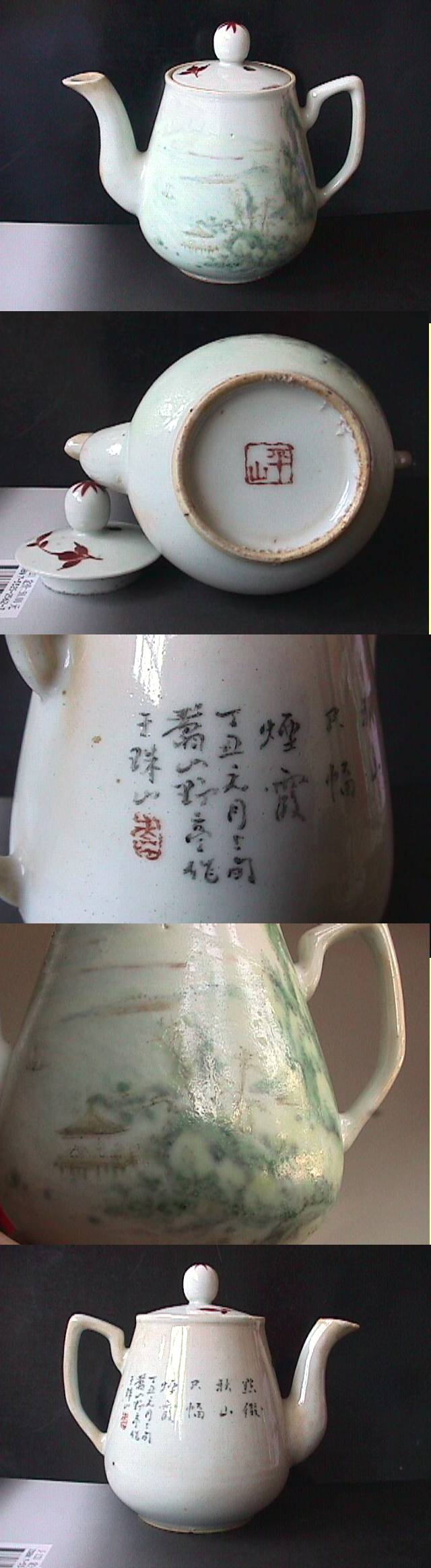 |
Wang Yeting (1884-1942) | 汪野亭 | 1082. Teapot dated in the inscription to the ding chou year, meaning 1937. Base mark is Pingshan, by Wang Yeting. Landscape specialist and one of the 'Eight Friends'. | 1937 | 1082 | Teapot | Pingshan | 214 |
| Wang Yeting (1884-1942) | 汪野亭 | 1932 | Vase | Pingshan | 215 | |||
| Wang Yeting (1884-1942) | 汪野亭 字 鉴, 号 平山 |
Specialized in landscapes with strong brushwork, lack of attention to details. Independent painter of the 1930s with his own studio in which he worked on orders they had received. Second generation of the literati school of porcelain painting. Member of the Yueyuan Hua, later called Eight Friends of Zhushan from 1928. Studio name: Pingshan Caotang (Simon Kwan, Brush and Clay, 1990 p.42, fig. 31-41). Exhibit number 41-47 (Innovations and Creations, 2004).
Wang Yeting (1884-1942), mentored by Zhang Xiaogeng and Pan Taoyu, his painting skill was follow Shen Yuan (the famous painter in Ming Dynasty) and Wang Shigu (the famous painter in Qing Dynasty), especially exellent on painting landscape. He reformed Porcelain Landscape Paintings to make them more natural and lively, and reached his Wang’s painting style. |
216 | |||||
| Wang Yijun (1904-1989) | Exhibit number 89 (Innovations and Creations, 2004). | 217 | ||||||
| Wang Yizhi () | Exhibit number 75 (Innovations and Creations, 2004). | 218 | ||||||
 Signed: Wang Yongtai, 1914 |
Wang Yongtai (Fanglin) | 汪永泰 (字芳林) |
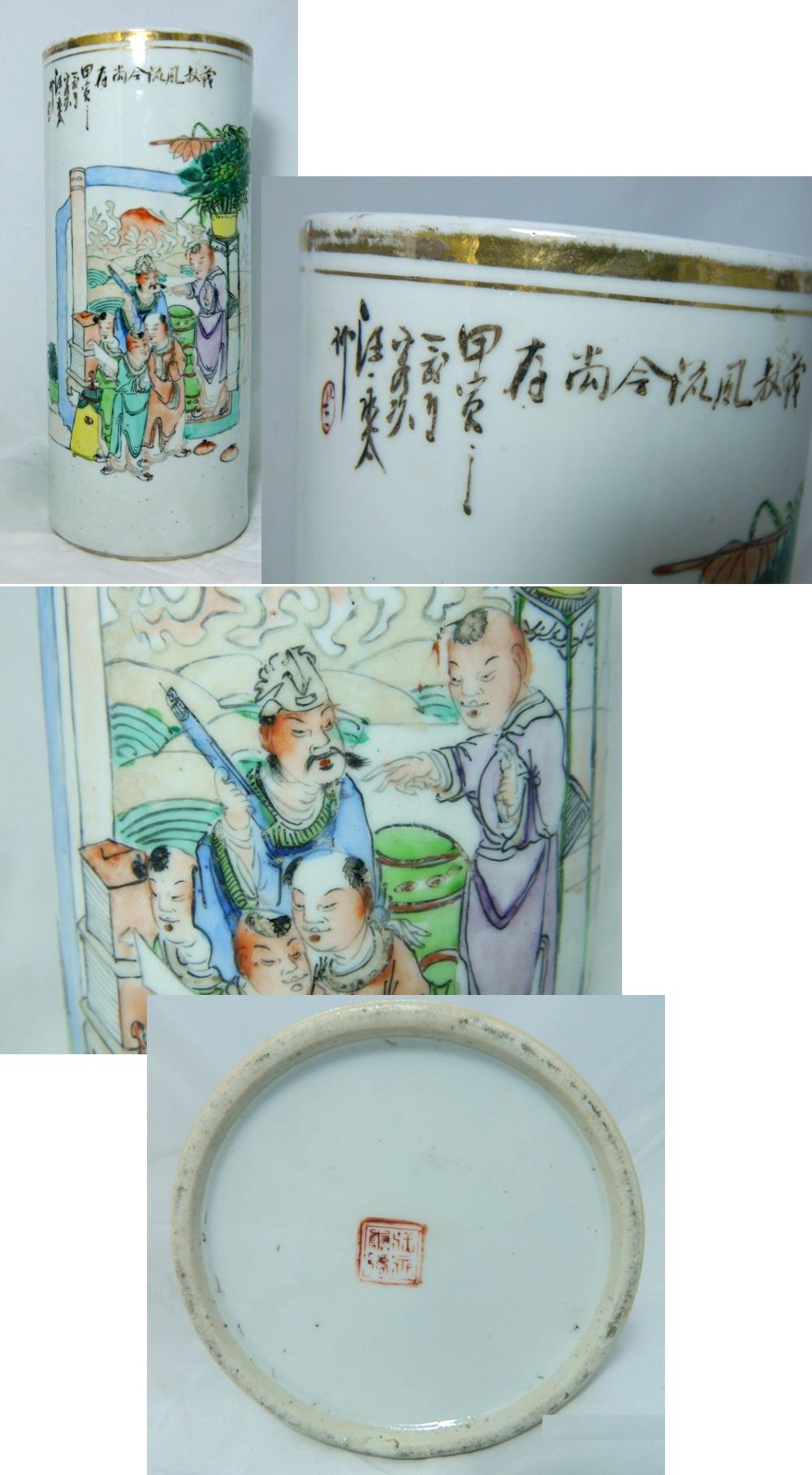
1425. Mark: Wang Yongtai xx Dated 1914.. | Vase | Wang Yongtai xx | 219 | ||
 Signed and base mark: Wang Youtang Zuo |
Wang Youtang (Wanghong) | 汪友棠 (汪棣) |
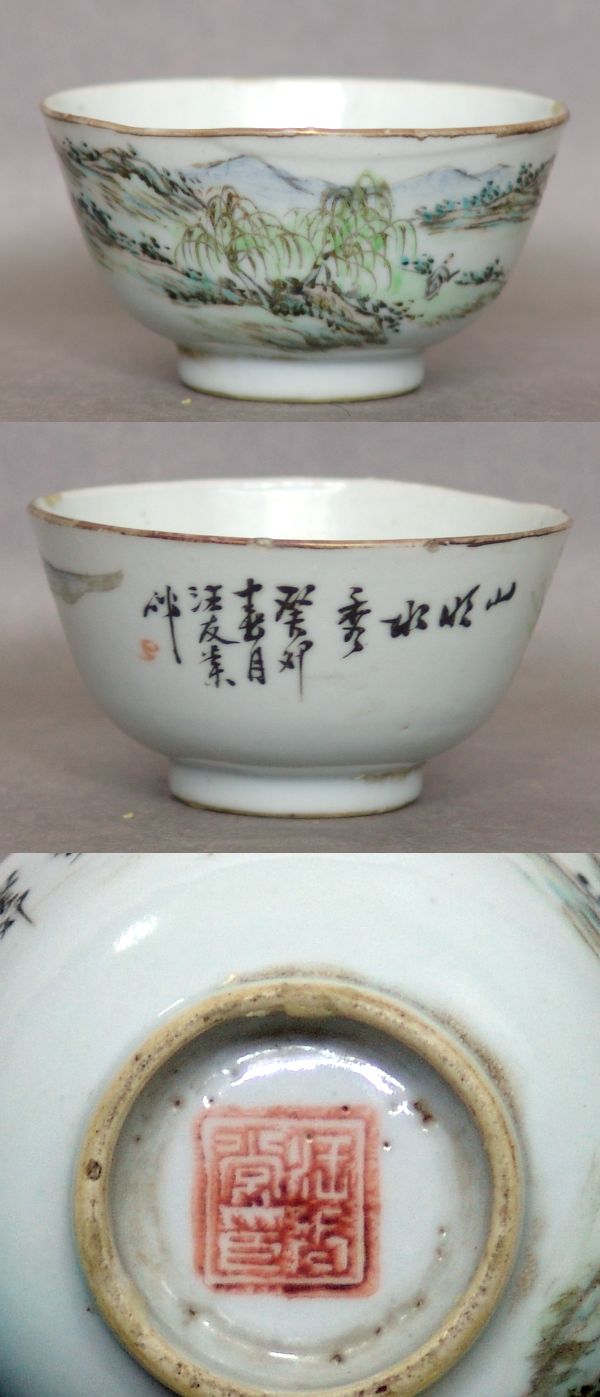
1001. Bowl. Diameter 8 cm. Stamped base mark: Wang Youtang Zuo. Wang was a good porcelain painter. He made many pieces, some very good. Around 1900 he is also known to have made porcelain plaques. Bowl signed and dated in the calligraphy, to the gui mao year (1903). | 1001 | Bowl | Wang Youtang Zuo | 221 | |
| Wang Zhang | 汪章 (字汉云) |
Wang Zhang is now widely regarded as a great qianjiang artist. He was active during the Guangxu period. He is also an all round artist, good in all aspects of Chinese painting, ie. landscape, human figures and birds/flower. He is especially good in drawing human figures. (Koh) | 223 | |||||
| Wang Zhang (Zi: Hanyun) | 汪章 (字汉云) |
224 | ||||||
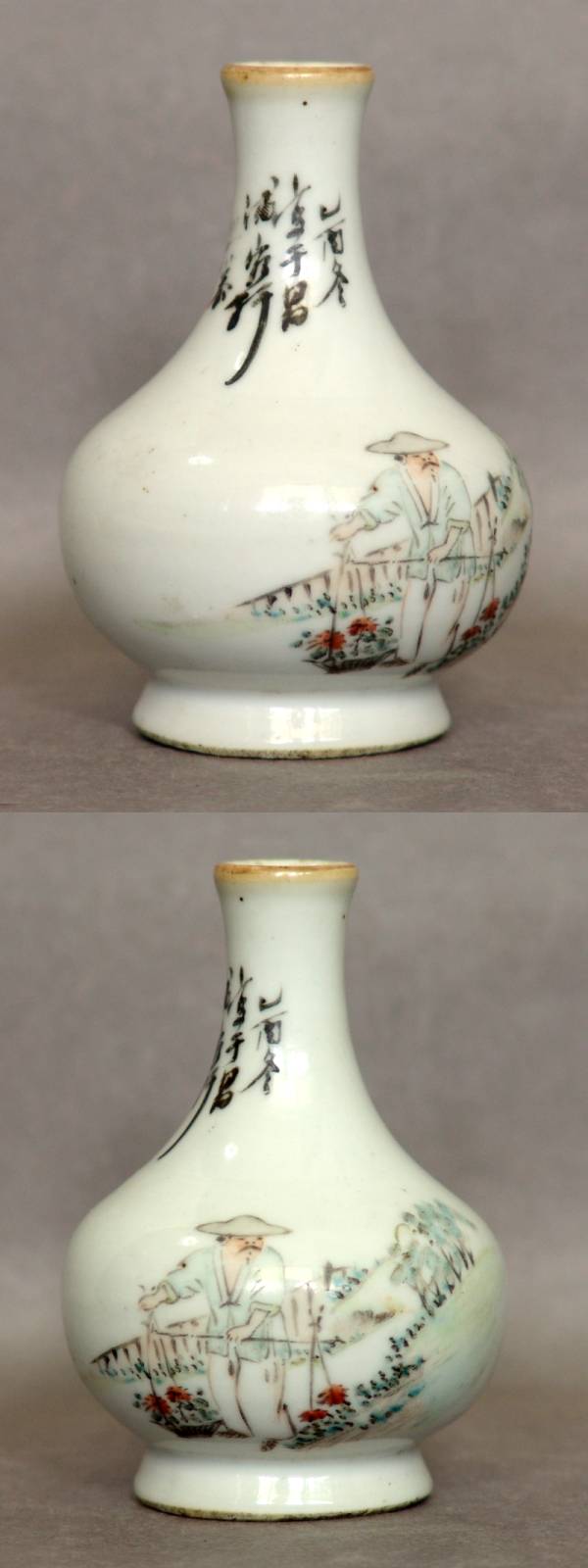 Signed by: WANG Zhao Li |
Wang Zhaoli | 汪照黎 (字筱青) |
992. Small vase. No mark. Dated in the inscription to "yi you" meaning 1885, signed Wang Zhaoli. Height 9 cm. | 1885 | 992 | Vase | 225 | |
| Wang Zhaoli | 汪照黎 (字筱青) |
1915 | Bowl | Zhao Li Du Zao | 226 | |||
| Wang Zhaoli (Zi: Xiaoqing) | 汪照黎 (字筱青) |
227 | ||||||
| Wang-Jun | 汪以俊 | 228 | ||||||
| Wei Hongtai () | Exhibit number 161 (Innovations and Creations, 2004). | 229 | ||||||
| Wei Rongzheng (1910-1975) | Exhibit number 78-79 (Innovations and Creations, 2004). | 230 | ||||||
| Wei Shan | 1882 | 231 | ||||||
| Wei Yongsheng | 魏镛生 | 232 | ||||||
| Wen Bo | 1892 | Brush pot | 233 | |||||
| Wen Zao (Chen Huanwen) | 1894 | Cup | 234 | |||||
| Wong Qishun | 1914 | Jar | 235 | |||||
| Wu Aisheng (1886-1926) | (Simon Kwan, Brush and Clay, 1990 p.43). Exhibit number 31 (Innovations and Creations, 2004). | 236 | ||||||
| Wu Chengren (1909- ) | Exhibit number 105 (Innovations and Creations, 2004). Wu Chengren, was born in Qimen county, Anhui province in 1909. He was expert at on glaze painting decoration, and studied pattern decoration industriously at ordinary times, keeping improving. His decoration techniques were flexible and of various kinds, including famille rose, foreign color (Yangcai), and gilding, etc. In his late life, he also applied true and false acid gilding decoration techniques creatively. He draw patterns with vigorous technique of drawing, fluent lines, compact structure, lavish and well-proportioned arrangement. The color designs of the patterns he painted were elegant, graceful and showed good artistic effect. His works was chosen for the national exhibition at several occasions and gained extensive praise and many rewards. Sky blue colored glaze gilding patterns big vases and eight-square bowls are also precious works, which were made when he was working in the Ceramic Research Institute. |
237 | ||||||
| Wu Haifeng | 吴海峰 | Qianjiang artist. | 238 | |||||
| Wu Lichang | 1916 | Jar | WU Li Chang Zao | 239 | ||||
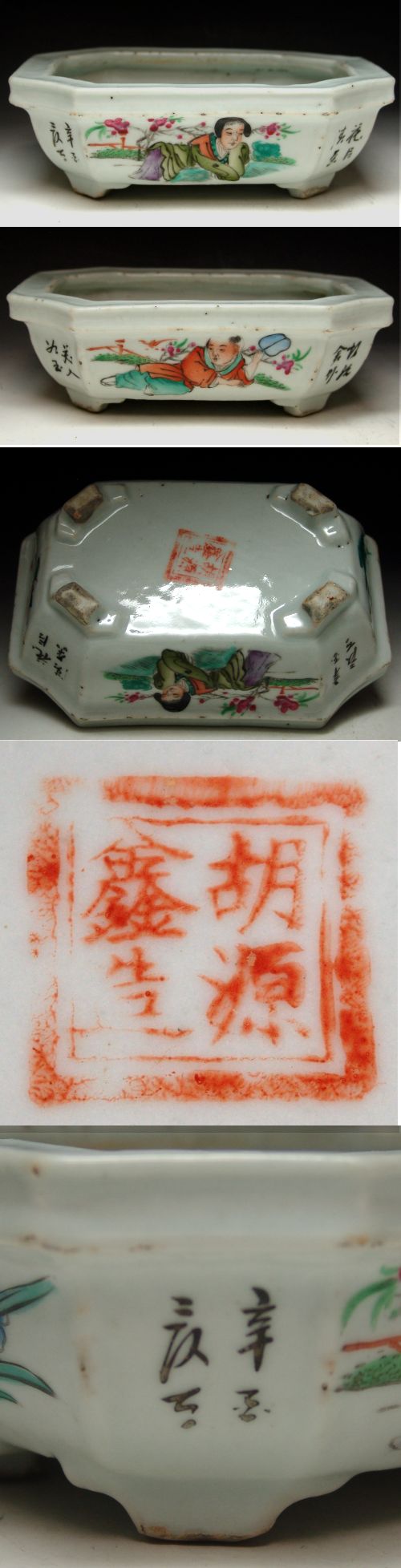 |
Wu Yuankum Zao | 1177. Narcissus Bowl. Red stamped mark Wu Yuankum Made on the base. Dated in the calligraphy to the year of xin you (1921). | 1177 | Low six sided bowl | Wu Yuankum Zao | 240 | ||
| Xia Bingmao | 1889 | Bowl | Tongzhi Nian Zhi | 241 | ||||
| Xian Cuo | 仙搓 (钱安) |
Qianjiang artist. | 242 | |||||
| Xiao Dou (Tao) | Decoration of "Seven Sages of the Bamboo Grove". Artist's pen name, "little big wave". The translation on the calligraphy should be something like this : The fun/joy of stone river(spring/stream), who can comprehend? Ancient name of the hut(in the garden), who can name(or praise)? 1877, Written at North Window of Changjiang. Xiao Dou. The two red seals said "North Window". If correct, a pioneer work in the Qianjiang style of porcelain painting done in 1877, some 8 years before the tipping point thrust this school into general popularity |
1877 | Plaque | 243 | ||||
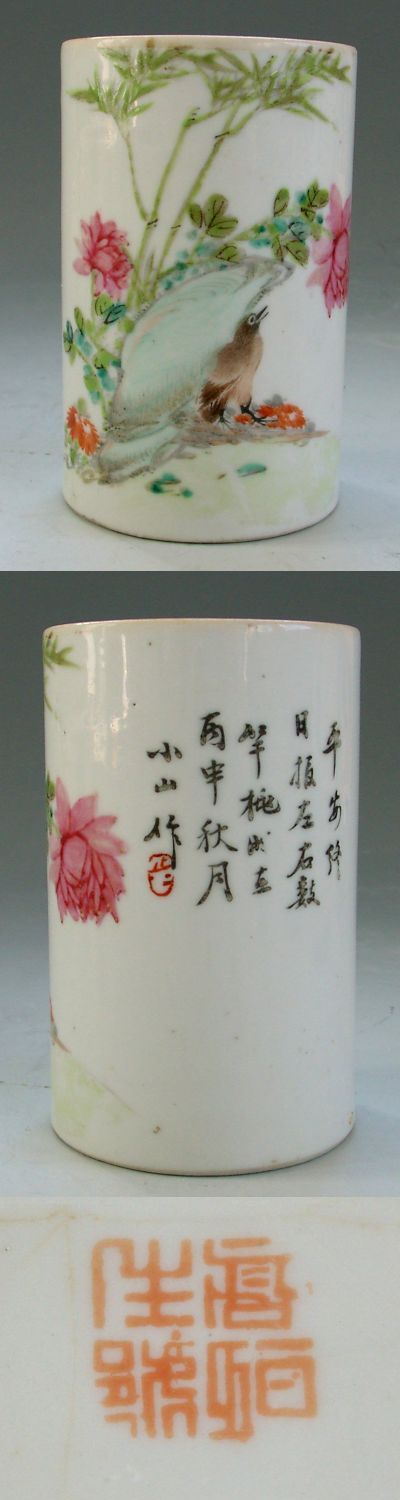 Signed by: Xiao Shan |
Xiao Shan | 小山 | 517. Bing Shen Qiu Rou - "Bing Shen (Year) Autumn Month". Most likely year matching "Bing Shen" are 1896. Xiao Shan Zuo - Xiao Shan ( Artist's name ) Painted. Base red mark : Gao Bosheng Hao - Gao Bosheng Company.
Item is donated to the gotheborg.com reference collection by N K Koh. |
1896 | 517 | Brush pot | Gao Bosheng Hao | 244 |
| Xin Loushan Ren/Hua Yan | 1879 | Cabaret set | 245 | |||||
| Xio Wenfa | 1924 | hatstand | 246 | |||||
| Xiong Xiaofeng () | Exhibit number 115 (Innovations and Creations, 2004). | 247 | ||||||
| Xiong Ziyu | 1919 | Jar | 248 | |||||
| Xiong Zuoxian () | Exhibit number 60 (Innovations and Creations, 2004). | 249 | ||||||
| Xi-Ren | 刘希任 | 250 | ||||||
| Xu Bosheng (1891-1966) | Xu Bosheng named Shunyuan, with another name of Pango, is a native of Fengcheng county of Jiangxi province. He went to Jingdezhen to learn skills, and specialized in blue and white,mould carving, and then learned relief. On the base of learning from the predecessors,he views other techniques of arts and crafts. In the light of the the firing characters of the porcelain raw materials,he combined the painting, carving, engraving,shaping and pinching etc.. He created porcelain open works of dragon boat in the style of sculpture, which pushed the skill of open work into a new peak and make the porcelain world sensational. Then he created the technique of making dragon boat with "Suojiang method" which make the effect of the technique and art a sense of refreshment. However, the talent folk crafts man was oppressed by life and led to psychological unhealth before the establishment of the People's Republic of China in 1949. After the establishment of the People's Republic of China in 1949, the party and the government found him back and send doctors to treat and take care of him which made him better and also stimulated his zest for creation and created many good works. See further Bosheng Company for possible relation, index nr 244. (Source: jdz.gov.cn 2011). | 556 | ||||||
| Xu Cheng (1907-1975) | Exhibit number 101 (Innovations and Creations, 2004). | 251 | ||||||
| Xu Dasheng | 许达生 | Qianjiang artist. | 1921 | Cup | XU Zhen Xiang Shi | 252 | ||
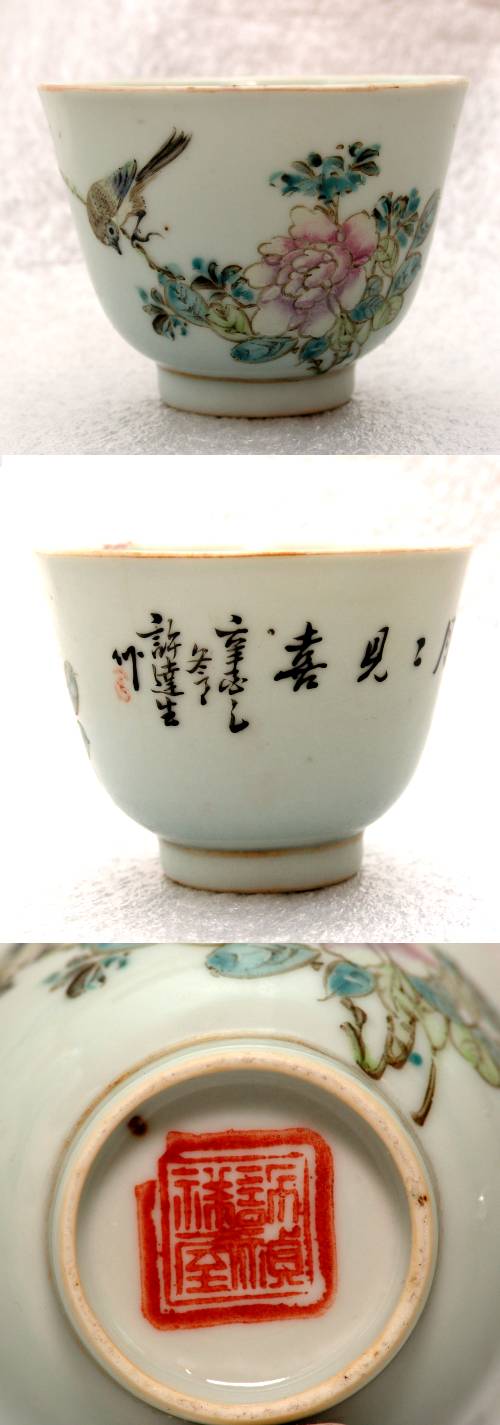 Painted by: Xu Dasheng |
Xu Dasheng | 许达生 | 1145. Cup. The poem from right to left yue yue jian xi meaning "Moon Moon See Happiness "or "See happiness every month". First and second column unclear but might contain a date xin you (1921) year. Dong "winter ...". Third and fourth columns read Xu Dasheng zuo (made by Xu Dasheng). Red stamped basemark Xu Zhen Xiang Shi "Xu's Hall of Good Omen"
|
1145 | Cup | Xu Zhen Xiang Shi | 253 | |
| Xu Fengsheng | 许逢生 | Qianjiang artist. | 254 | |||||
| Xu Pinheng | 许品衡 | 1894 | Jar | Guangxu Nian Zhi | 255 | |||
| Xu Pinheng | 许品衡 | Artist mentioned in 'The Official Kiln Porcelain of the Chinese Qing Dynasty', Nanjing Museum, 2003, p. 453. Quite a well known artist for the 'hundred treasures' decoration. Xu Pinheng was also employed in the Imperial kiln during late Qing period | 1896 | Teapot | Guangxu Nian Zhi | 256 | ||
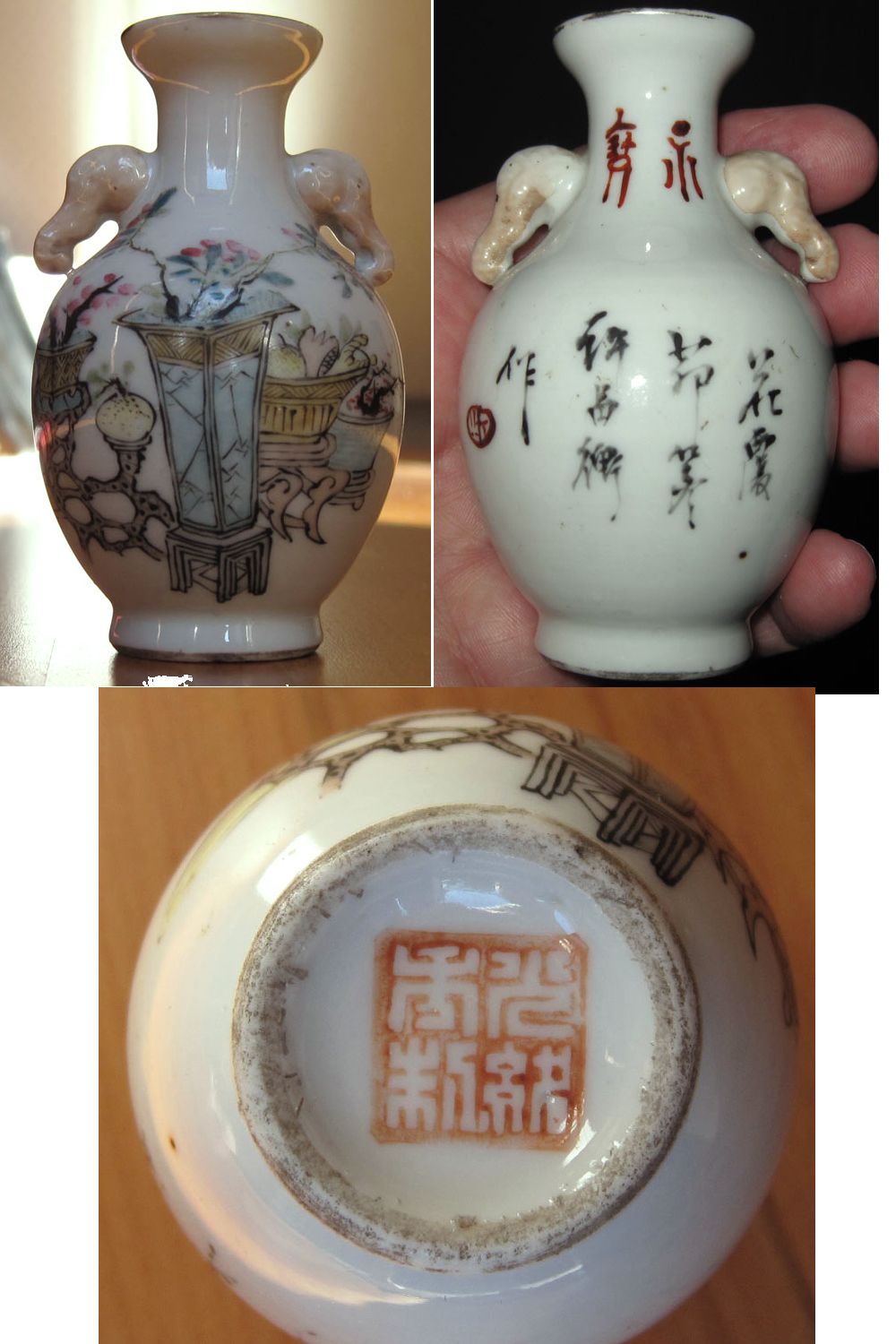 Painted by: Xu Pinheng |
Xu Pinheng | 许品衡 | 1415. Small vase w elephant handles. Mark: Iron red stamped seal mark Guangxu Nian Zhi (1875-1908). Decoration signed by Xu Pinheng. On the opposite side a verse. Date c. 1895. | 1895 | 1415 | Cup | Guangxu Nian Zhi | 258 |
| Xu Pinheng | 许品衡 | 1907 | Vase | Da Qing Guangxu Nian Zhi | 257 | |||
| Xu Shangli () | Native of Shidi, Anhui. Said to have specialized in flowers and birds. Plaques with this signature appears to be in post 1930s style. (Simon Kwan, Brush and Clay, 1990 p.41) | 259 | ||||||
| Xu Shanqin (Zi: Changgeng, Hao: Yunxian) | 徐善琴 (字长庚, 号韵仙) |
260 | ||||||
| Xu Tianmei (1910-1994) | Exhibit number 92 (Innovations and Creations, 2004) Xu Tianmei, was born in Nanchang, Jiangxi province in 1910. His father Xu Zhongnan was a famous artist in Jingdezhen. He started to learn painting, poem, calligraphy and inscription from his childhood under the instruction of his father. He did very well in painting animal, and was especially good at painting tigers and monkeys. By the influence of his family background, he was also adept at observing and thinking and can master the dynamic features accurately, so his works were vivid, lively and full of life, and he had formed his unique style. His paintings of landscape, flowers and birds are also very beautiful with dedicate, graceful style and lively, simple but elegant tone. His main works include 200 Jian Tiger Vase, six-folded screen with the landscape of the People's Park and Twelve Birds on Pine Tree, etc. (Source: jdz.gov.cn 2011.) |
261 | ||||||
| Xu Xiangxing | 1921 | Vase | 262 | |||||
| Xu Xiting | 1893 | Tray | 263 | |||||
| Xu Yungfeng | 1921 | Teapot | Xu Yungfeng Zao | 264 | ||||
| Xu Zhenjia () | Exhibit number 107 (Innovations and Creations, 2004). | 265 | ||||||
| Xu Zhongnan (1872-1953) | 徐 仲南 | Favorite subject was pine and bamboo. Independent painter of the 1930s with his own studio in which he worked on orders they had received. Second generation of the literati school of porcelain painting. Member of the Yueyuan Hua, later called Eight Friends of Zhushan from 1928. Studio name: Qibi Shanguan (Simon Kwan, Brush and Clay, 1990 p.42, fig. 84-85). Employed by Jiangxi Porcelain Company in 1918 as head of porcelain painting. Biography Kwan, Brush and Clay, 1990, p. 93. Exhibit number 53-55 (Innovations and Creations, 2004). Qu Zhongnan, whose original name was Gai, was also known as Zhu Li Lao Ren and a native of Nanchang, Jiangxi province. He was born in 1872 and died in 1953. He was one of the Eight Friends of Zhushan and good at painting bamboo. (Source: jdz.cn 2011) Xu Zhongnan (1872-1952), learned porcelain art at childhood in a porcelain artshop, was employed by Jiangxi Porcelain Industy Company in 1918 to manage the business of art porcelains, good at painting pines and bamboos, his painting style was elegant. He was influence by Dai Xi (famous Qing Dynasty painter), and was also influenced by the style of Shanghai Painters Group and Song Dynasty style, after which he developed a style of his own. |
266 | |||||
| Yan Ruzhen () | Porcelain painter or sculptor of Jingdezhen in the first half of the twentieth century. (Simon Kwan, Brush and Clay, 1990 p. 43) | 267 | ||||||
| Yan Xiaoyun (Shaoshan - Small Mountain) | 颜筱云 (少山) |
Qianjiang artist (Koh). | 268 | |||||
| Yang Haisheng (1922-1970) | Yang Haisheng is a ceramic artist with a name of Haimeizi, a native of Fengcheng county of Jiangxi province. In his childhood,he took the old craftsman Cai Shousheng as his teacher in Jingdezhen to learn embossed and carved techniques. Because of his modesty and studiousness, he had achieved a lot in carved decoration, embossed decoration, engraving and applied relief. In his young ages, he became a celebrity of Jingdezhen painting profession. His works were actively sought after by foreign collectors. After the establishment of the People's Republic of China in 1949, he entered the ceramic institute to work. He majors in applied relief. His skill is all-round. He has made great attainments in arts. His works is bright, smooth, unconstrained with a unique style. He contributes a lot to the development of the ceramic applied relief technique of Jingdezhen. His masterpieces are big flower basket with all flowers blooming, China rose hanging plate with colored glaze and stationery etc. (Source: jdz.gov.cn 2011) |
555 | ||||||
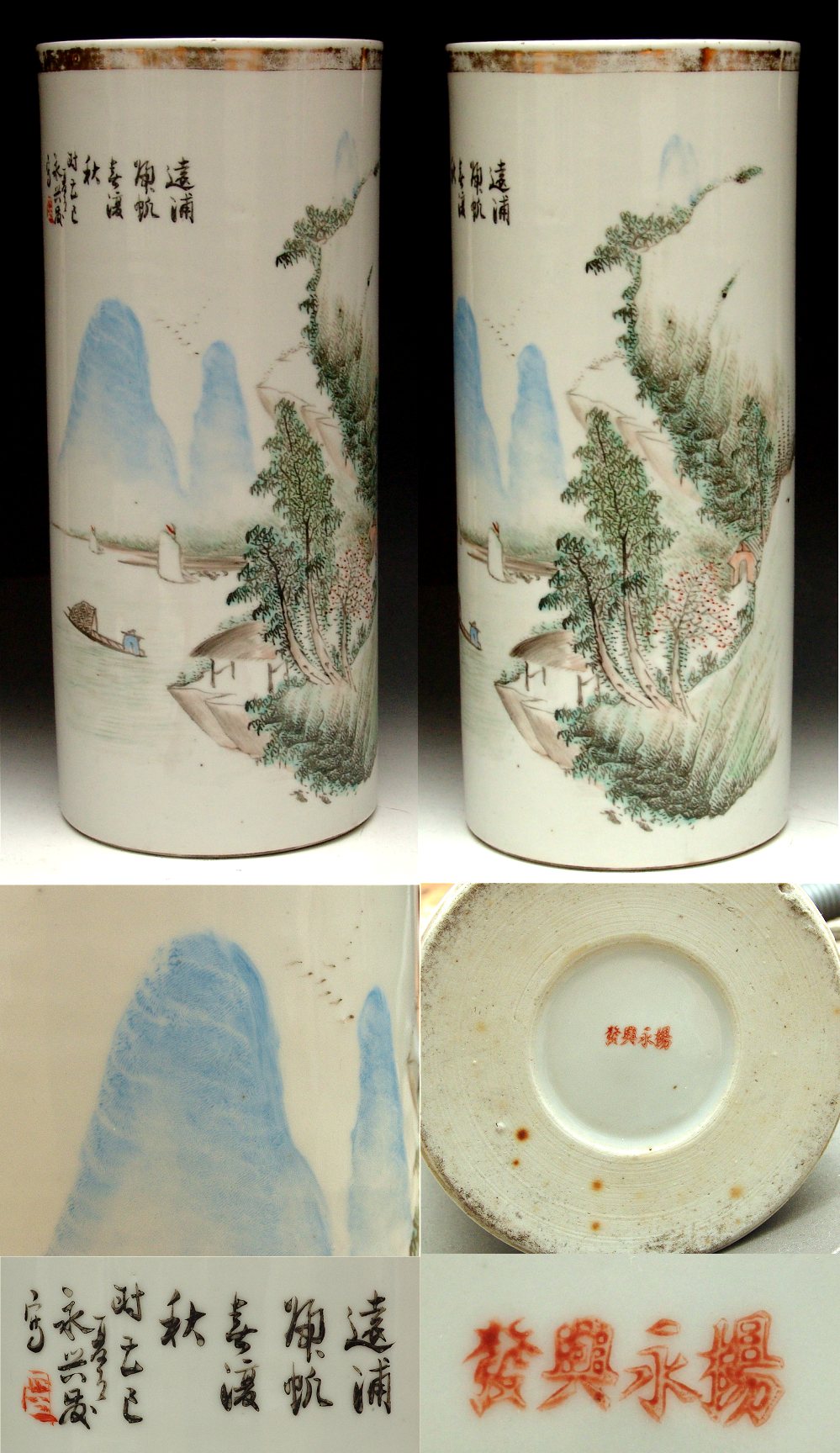 |
Yang Yong Xing Fa | 1112. Vase or Hatstand. Four character iron red stamped mark on the base: Yang Yong Xing Fa (same Yong Xing Fa occurs in the inscription) where Yang is a surname probably of the artist, and Yong Xing Fa is the 'company' name. Dated in the calligraphy to the year of ji ci (1929). Inscription: yuan (distant), pu (shore), X, fan ("sails"), X, X, qiu (autumn) shi (time/period) ji si (1929), ?? in margin, yong (eternal), xing (happy), fa (South Chinese name for 'company'), xie (written by). Yang was either employed by the Yong Xing Fa Company or the factory owner. Porcelain factory owners were often good porcelain painters in those days.
|
1929 | 1112 | Vase | Yang Yong Xing Fa | 270 | |
| Yang Qinchuan (1914— ) | Yang Qinchuan, who was also known as Qinsheng, was born in Fengcheng county, Jiangxi province in 1914. He came to Jingdezhen to learn sculpture on ceramics with his elder brother, and was also trained to make ceramic sculpture of dragon boat and pavilion. He made quick progress in art and craft because of his modest and hard study, and got much attention from craft brothers. Many ceramic seller ordered his works at very high price. After 1949 he came to work in Ceramic Research Institute and design many precious hollowed out or incised ceramic works. His skills were comprehensive. He was good not only at pilling art, carving, mould carving, plasticizing, also at hollow cutting. His crafts of hollow cutting were solid with orderly fine and smooth artistry of wielding the knife. The model of his works is of primitive simplicity, and he has formed unique style of his own. Many of his works are unparalleled in the human history, whether in scale or in difficulty of the crafts. His main works included All Flowers Are in Bloom big baskets of flower, big dragon boats and small dragon boats, which were in mould carving and hollow cutting. (Source: jdz.gov.cn, 2011) | 557 | ||||||
| Yangzi Qing | 杨紫卿 | Qianjiang artist (Koh). | 271 | |||||
| Ye Yichun / Dan Qing | 1922 | Vase | 272 | |||||
 |
Yen Sensen | 990. Bowl dated "1925" in the inscription. Mark: company "Yen Sensen".
|
1925 | 990 | Bowl | Yen Sensen | 273 | |
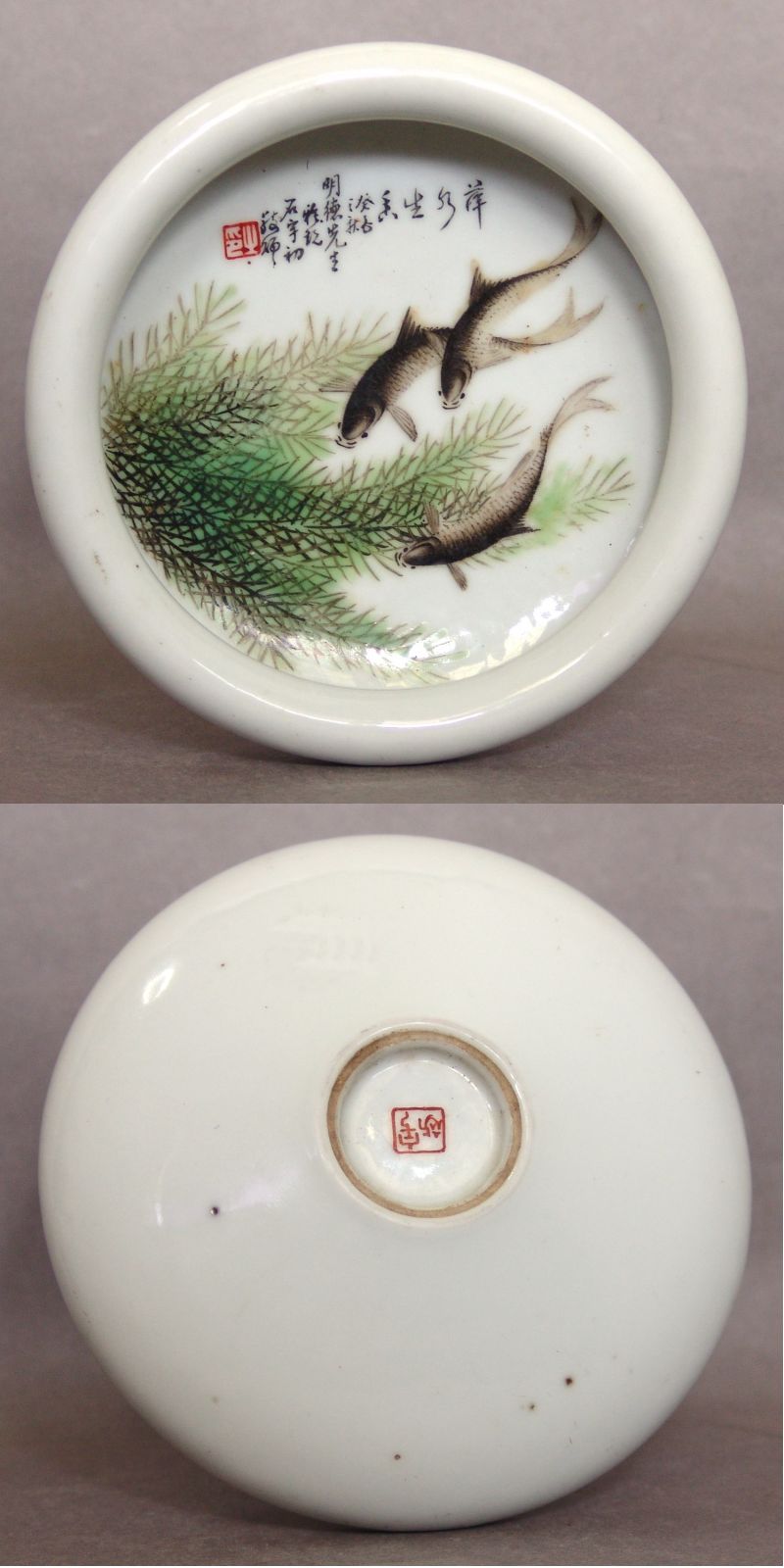 |
Yi Chun | 1000. Brush washer dish, dated in the inscription as the year gui you, meaning "1933". Red base mark of Yi chun. | 1933 | 1000 | Brush washer | Yi Chun | 274 | |
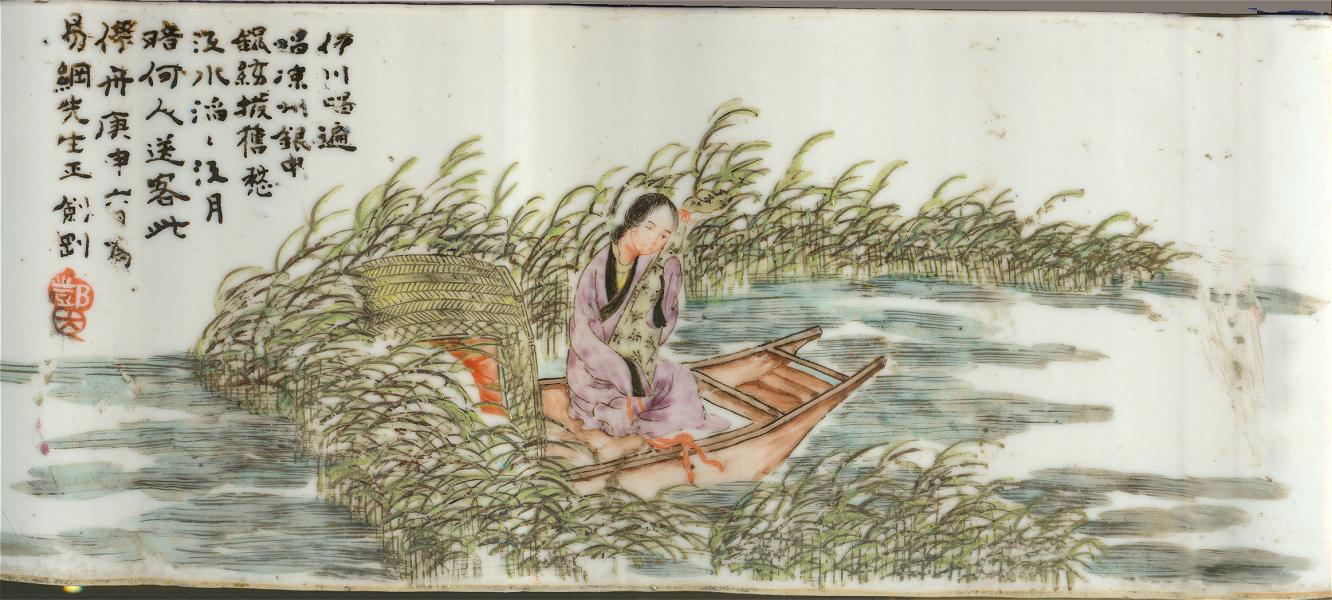 |
Yi Gong | 1004. Brush pot. The decoration is a scene described in the ode called "Pipa xing" written by the Tang poet Bai Juyi. No base mark. Dated in the inscription to the geng shen year which could be either of 1860 or 1920 of which 1860 is unlikely considering how the woman is rendered.Â
|
1920 | 1004 | Brush pot | 276 | ||
| Yi Hongchang | 义洪昌 | Qianjiang artist. | 277 | |||||
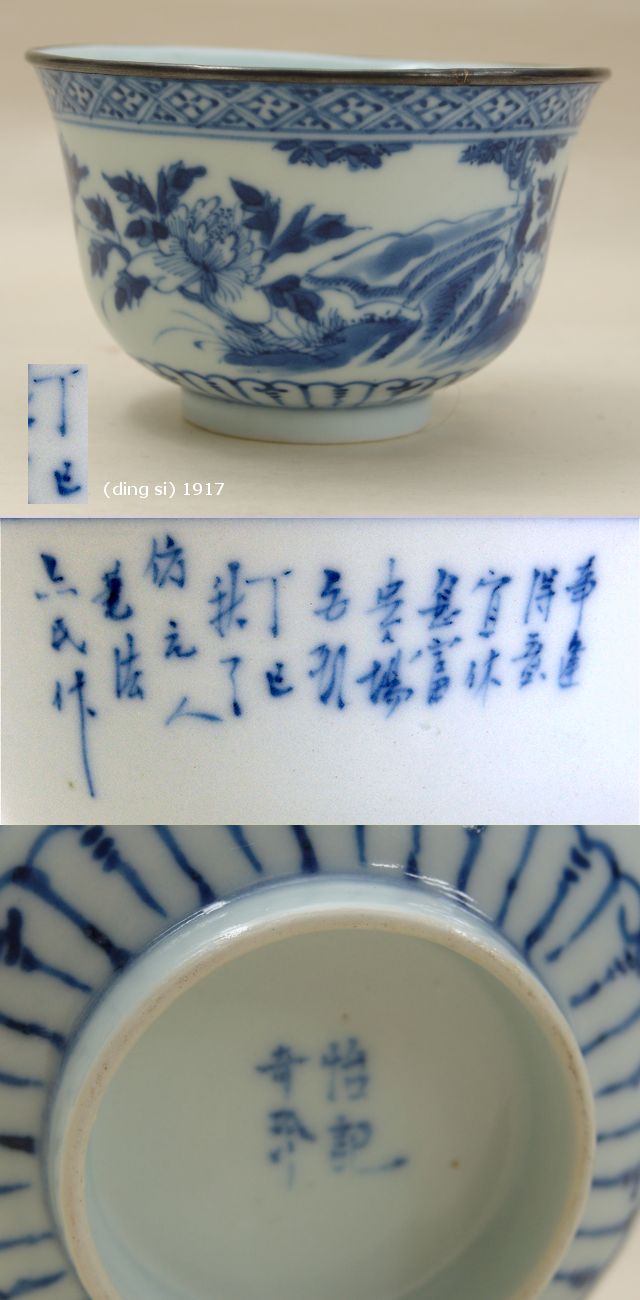 |
Yi Ji Qi Zhen | 1222. Bowl. Mark: mark is Yi Ji Qi Zhen (Factory mark). Dated in the inscription to the ding si year (1917). | 1917 | 1222 | Bowl | YIiJi Qi Zhen | 278 | |
 |
Yi Xinglong | 113. Yi Xinglong Zhu - "Yi Xinglong" Factory Made. Fencai enamels. Dated 1909. | 1909 | 113 | Vase | Yi Xinglong Zhu | 279 | |
| Yi Zang | 1965 | Vase | 280 | |||||
| Yi Zhumin | 1891 | Teapot | Guan Yao Nei Zao | 281 | ||||
 |
Ying Gongzeng | 704. Xin Mei Di Luo / Ji Nian / Ying Gong Zeng / 1929.4 - (To my) lovely sister Di Luo (girl's name) as a memory of Ying Gong (man's name) given 1929.4. | 1929 | 704 | Dish | 282 | ||
| Yishun | 义顺 | 283 | ||||||
| You Changzi () | Porcelain painter or sculptor of Jingdezhen in the first half of the twentieth century. (Simon Kwan, Brush and Clay, 1990 p. 43) | 284 | ||||||
| You Ru (Zhu) | 1888 | Jar | 285 | |||||
| Yu Chun (Ziliang) | 喻春 (字子良) |
286 | ||||||
 Signed by artist: Yu Chung painted |
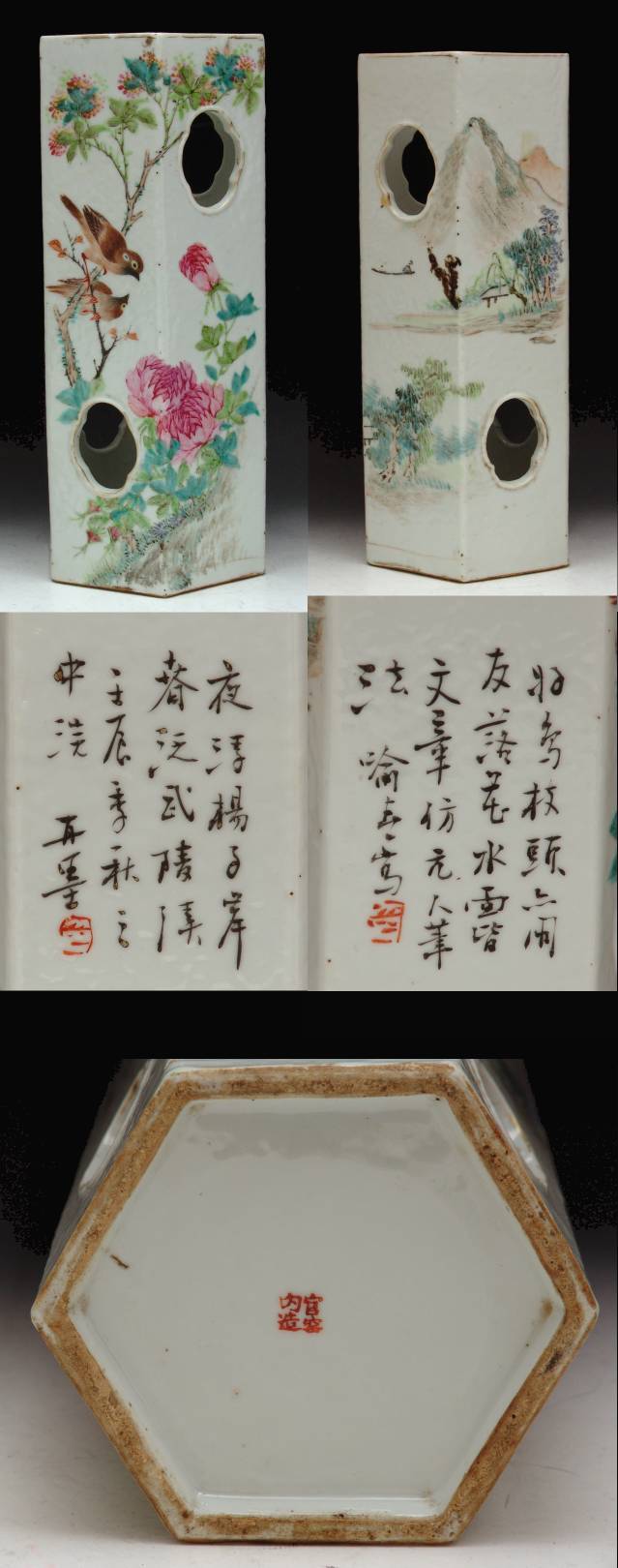
Yu Chung | 1155. Six sided hatstand, dated in the calligraphy to the ren chen year (1892). Height 28 cm. Red base mark Guan yao nei zao (Imperial Kiln for Inner Palace). Signed by the artist: Yu Chung painted. | 1892 | 1155 | Six sided hatstand | Guan Yao Nei Zao | 287 | |
| Yu Hanqing (1902-1987) | Slightly later, third generation of the literati school of porcelain painting. Active 1930-45. (Simon Kwan, Brush and Clay, 1990 p.43, fig 117-118). Exhibit number 94 (Innovations and Creations, 2004). | 288 | ||||||
| Yu Hongbin | 余鸿宾 | Qianjiang artist. | 1892 | Bowl | Tongzhi Nian Zhi | 289 | ||
| Yu Huanwen | 余焕文 | Qianjiang artist (Koh). | 290 | |||||
| Yu Wenxiang (1910-1993) | 'The King of Snow Landscapes'. Learnt snow painting from He Xuren (1882-1940). Second generation of the literati school of porcelain painting. (Simon Kwan, Brush and Clay, 1990 p.42). Exhibit number 90 (Innovations and Creations, 2004). | 291 | ||||||
| Yu Yuansheng | 1917 | Plate | YU ? Chang Zhi | 292 | ||||
| Yu Yuanxing/Yu Hongbin | 1916 | Yu Yuanxing/Yu Hongbin | 293 | |||||
| Yu Ziming | 俞子明 | 1887 | Shard | 294 | ||||
 Seal on base: Yu Ziming |
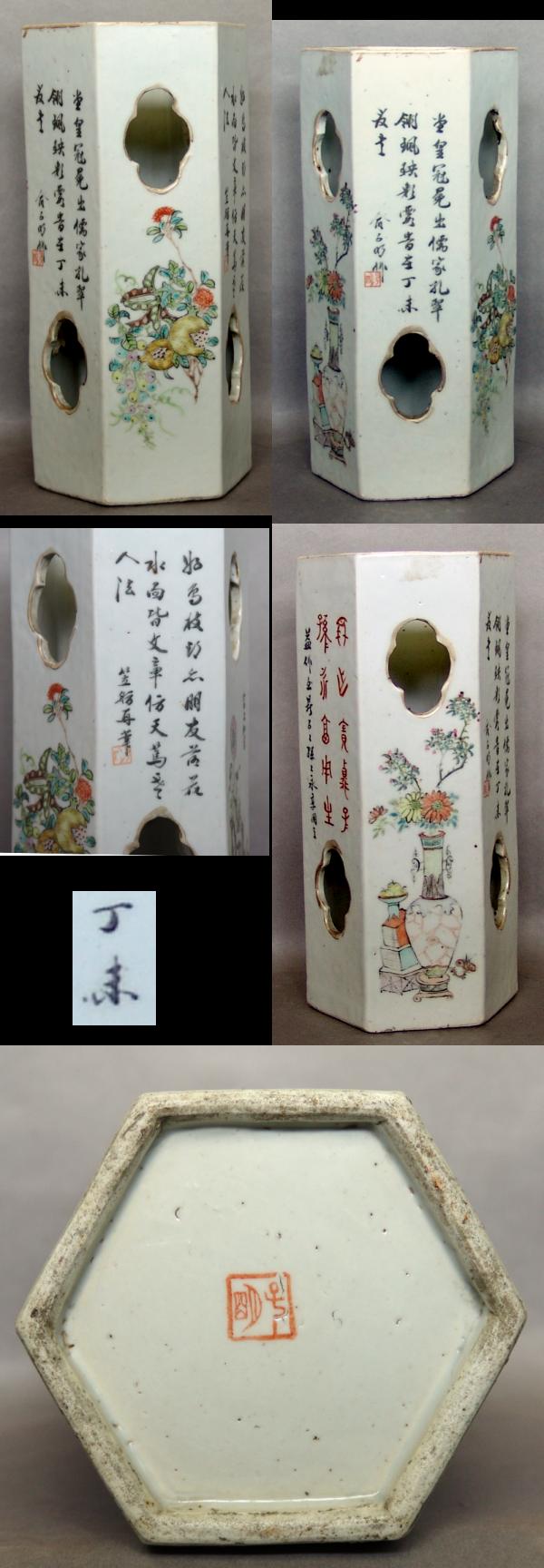
Yu Ziming | 俞子明 | 1012. Six sided hatstand, dated ding wei 1907. Red seal mark on the base, signed by the personal seal of Yu Ziming | 1907 | 1012 | Six sided hatstand | Yu Ziming | 295 |
| Yu Ziming | 俞子明 | 1910 | Jar | 296 | ||||
| Yu Ziming | 俞子明 | 297 | ||||||
| Zang Yitai | 1903 | Teapot | Zang Yitai Hui | 298 | ||||
| Zang Yitai | 1904 | Tea pot | Zang Yitai Zao | 299 | ||||
| Zeng Longsheng (1900-1964) | (Simon Kwan, Brush and Clay,
1990 p. 43). Exhibit number 162-163 (Innovations and Creations, 2004).
Zeng Longsheng (1900-1961) Zeng Longsheng was a ceramic artist and was a native of Fengcheng county, Jiangxi Province. At the age of 14 he came to Jingdezhen to learn sculpture. Because of his diligence he made high progress in technique. In his early years his 3-meter high Zhongshan porcelain sculpture won the gold medal in the Panama national exhibition. His traditional technique base is strong and sturdy. He learned new things constantly, probed new ways, pursued new styles and made his works merging styles and contents into a whole body. He is skilled in traditional figures, such as Eighteen disciples of Buddha and Jigong monk ect. He also created works of reflecting realistic life, praising great ages and regarding the daily life of people as the subjects which all won high comments. His masterpieces are Goddess Scatters flowers, Big Dragon Boat, Zhongkui and fat doll. (Source jdz.gov.cn 2011.) Zeng Longsheng (1901-1964)was a ceramic artist in China. He was born in Fengcheng in Jiangxi Province where his father made a living by wood carving. He worked as an apprentice in Jingdezhen learning ceramic skills since his childhood because of disadvantaged background. He became skilled at ceramic art after a long time of hard work and thus gained his fame. In 1930s, he accepted the invitation of one Chinese American and designed and made large-scaled porcelain sculpture of Sun Yixian which was exhibited in USA later. After civil war, he became more experienced and his works like Fairy Scattering Flowers, Dragon Boat were displayed in Jiangxi Hall in Great Hall of the People. In his later years, he made more creations on ceramic art. |
300 | ||||||
| Zhan Shuntai | 詹顺太 | Qianjiang artist. | 301 | |||||
| Zhang Jian (1917— ) | Zhang Jian, who was also known as Xiwu , was born in Jinxian county, Jiangxi province in 1917. In 1936, he graduated from the decorative porcelain section of Ceramic Vocational School, in Fuliang county. He was adept in painting image on porcelain, and he also painted flowers, birds and feather, etc. He had already revealed his talent in ceramic art in his youth. After he came to work in the Ceramic Research Institute of Light Industry Ministry in 1954, his brilliance in fine art was brought into play and advanced, and his mastery craftsmanship had certain effect in the circle of painting image on porcelain. He broke the history of using homochromy to paint image on porcelain by means of applying the techniques of oil painting, water color and charcoal drawing to ceramic decoration. To enrich the color on the multiple decoration and multiple firing, making the art of painting image on porcelain get more development and advance, so his porcelain image works show people dedicate, fine and smooth aesthetic feeling. He had formed the unique style of his own and gained high reputation home and abroad. His main works included Stalin colored half-length figure, 500 Jian fish tail bottle Founder's Image, ceramic mural painting Eight Horse and the Song of Forest, etc. (Source jdz.gov.cn 2011) | 559 | ||||||
 Signed by: Zhang Jianxiang |
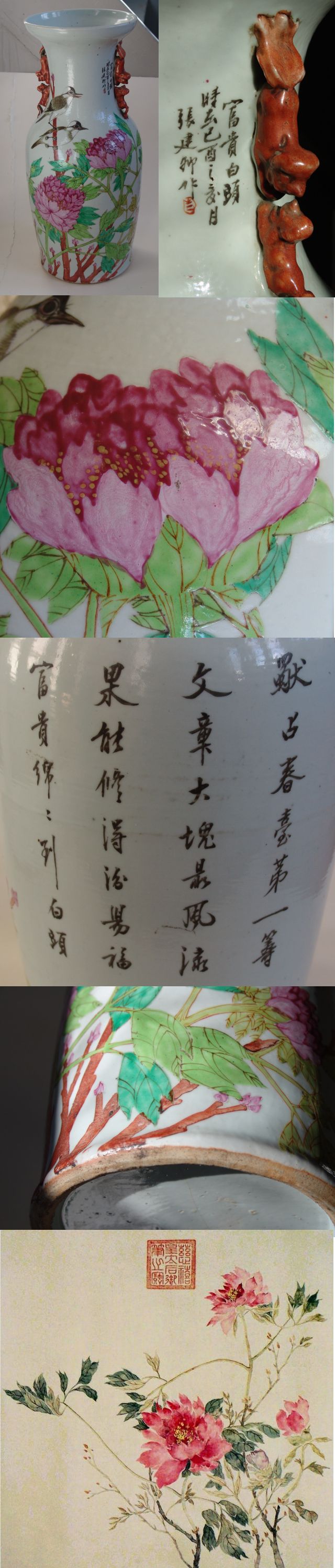
Zhang Jianxiang | 1203. Vase. Verse direct translation is "prosperity/wealthy and grey hair". The bird symbolize wealth and longevity. Made in the ji you year (1909) by Zhang Jianxiang. No mark. Height 18 inches (c. 46 cm). Decoration in the style of silk paintings signed by the Empress Dowager Cixi. Apparently these paintings were all the rage in the Qing court. Most of the concubines including Cixi spent their free time learning and painting these flowers and also birds. | 1909 | 1203 | Vase with fu dog handles | 302 | ||
| Zhang Peixuan (c.1900-c.1950) | Third generation of the literati school of porcelain painting. (Simon Kwan, Brush and Clay, 1990 p.42, fig. 121) | 303 | ||||||
| Zhang Shibao (1909-1987) | Exhibit number 102 (Innovations and Creations, 2004). | 304 | ||||||
| Zhang Tianxiang | 1909 | Vase | 305 | |||||
| Zhang Xiaogeng () | Porcelain painter or sculptor of Jingdezhen in the first half of the twentieth century. (Simon Kwan, Brush and Clay, 1990 p. 43) | 306 | ||||||
 Signed: Zhang Yitai Zuo (Made)) |
Zhang Yitai | 754. Mark: Tongzhi Nian Zhi - "Tongzhi Period Made". According to the calligraphy this was made by Cheung Wen-tai in the winter of 1909. The meaning of the calligraphy is to congratulate people on a bright and promising career etc., maybe a promotion.
The inscription reads and means: Tai shi sheng dian, shao bao zun rong - "The assistant is honored when the master is empowered ". (Tai shi is the title of a high ranking official or teacher to the future emperor, while Shao bao is an assistant) Ji you zhong dong yue - "ji you year (1909), month of mid winter". Zhang Yitai zuo - "Made by Zhang Yitai"
|
1909 | 754 | Brush pot | Tongzhi Nian Zhi | 307 | |

Signed by artist: Drawing by Zhang Yi Tai |
Zhang Yitai | 1197. Tea pot. Mark: "Zhang Yi Tai Hui", or Drawing by Zhang Yi Tai. Dated in the decoration to the gui mao year (1903). In Straits Chinese porcelain Zhen Yi Tai is a common mark. Zhang Yi is probably the name of a company (Tai). A number of old businesses in San Francisco Chinatown have this same tai character as the last one in a three-character name, for example "Jiu Jong Tai," "Fa Ming Tai," "Guang Xing Tai," etc. | 1903 | 1197 | Tea pot | Zhang Yitai Hui | 308 | |
| Zhang Yun (Zi: Ziying, sunflower) | 张云 (字子英) |
1897 | hatstand | 309 | ||||
| Zhang Zhitang (1893-1971) | Painted horses and Landscapes in gongbi, in panels on a densely decorated ground, popular in the 1930s. Independent painter of the 1930s with his own studio in which he worked on orders they had received. Second generation of the literati school of porcelain painting. Significant but peripheral to the Eight Friends. Studio name: Yitao Zhai (Simon Kwan, Brush and Clay, 1990 p.42, fig. 92-94, 145-146). Exhibit number 86-88 (Innovations and Creations, 2004). | 310 | ||||||
| Zhang Zishuai | 1919 | hatstand | Guan Yao Nei Zao | 311 | ||||
| Zhang Zixiang | 1920 | Congee | 312 | |||||
| Zhang Ziying (Zhang Xing) | 1922 | Jar | 313 | |||||
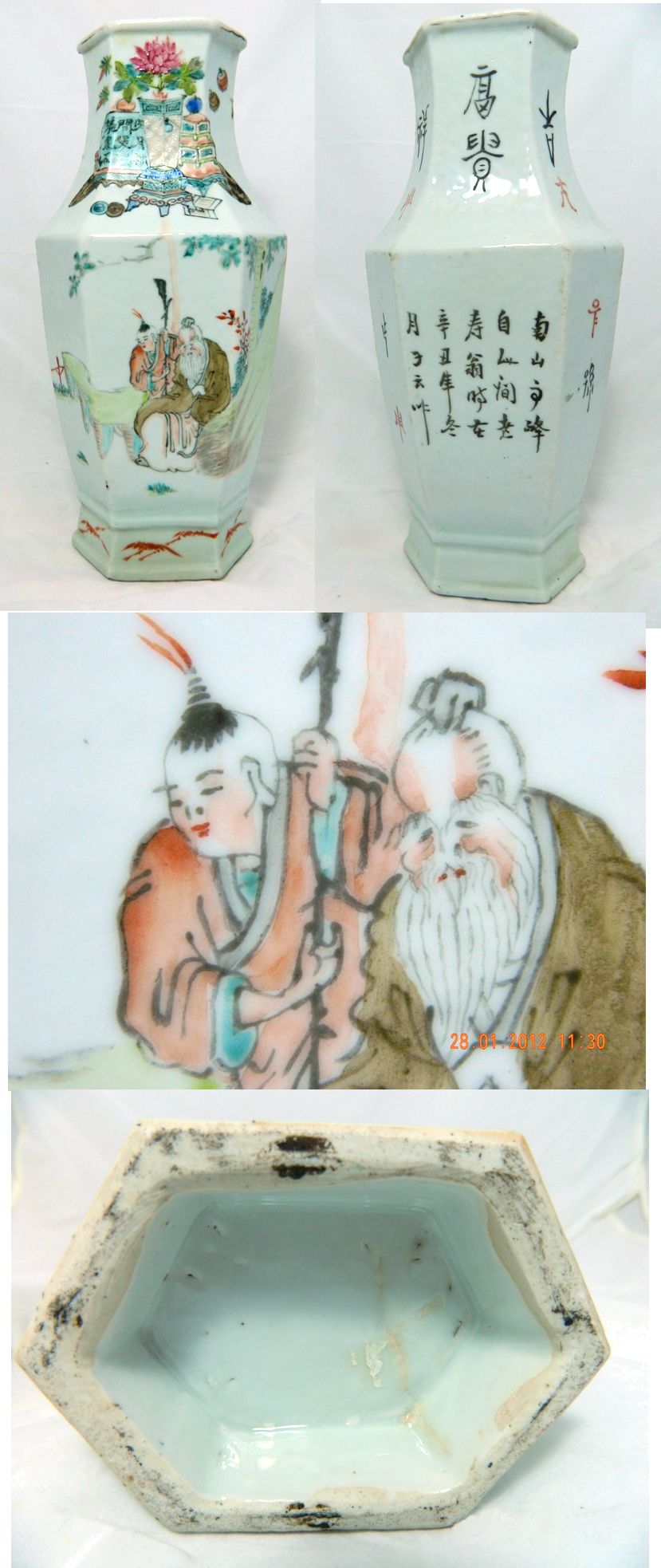 Signed: Zhang Zi Yun (or Zhang Zi Ying) |
Zhang Ziying (Zhang Xing) | 1426. Vase by the Qianjiang master Zhang Zhi Yun (or Zhang Zhi Ying). Dated 1901. (No base mark.) Artist mentioned in 'The Official Kiln Porcelain of the Chinese Qing Dynasty', 2003. | 1901 | Vase | 314 | |||
| Zhi Ming | 1887 | 315 | ||||||
| Zhong Jinshan | 1922 | Box | Red 4 character | 316 | ||||
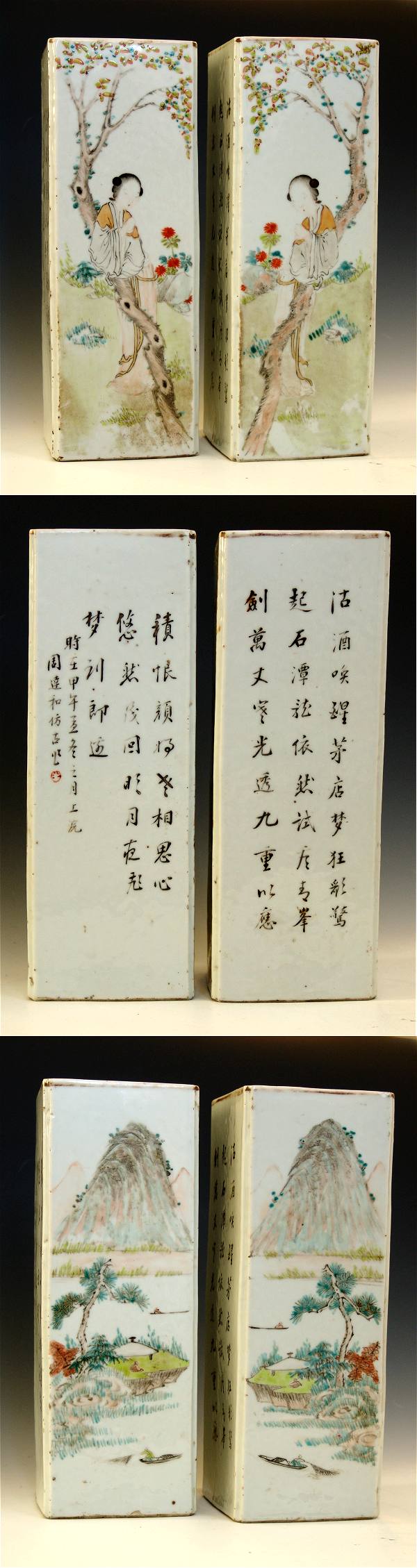 Signed by: Zhou Dahe |
Zhou Dahe | 周达和 | 835. Pair of vases with mirrored decoration. No marks. Signed by: Zhou Dahe and dated in the inscription to the jia wu year (1894).
|
1894 | 835 | Square vases | 317 | |
| Zhou Wenzao | 皱文藻 | Qianjiang artist. | 318 | |||||
| Zhou Xiangfu (1895-1978) | Exhibit number 119 (Innovations and Creations, 2004). | 319 | ||||||
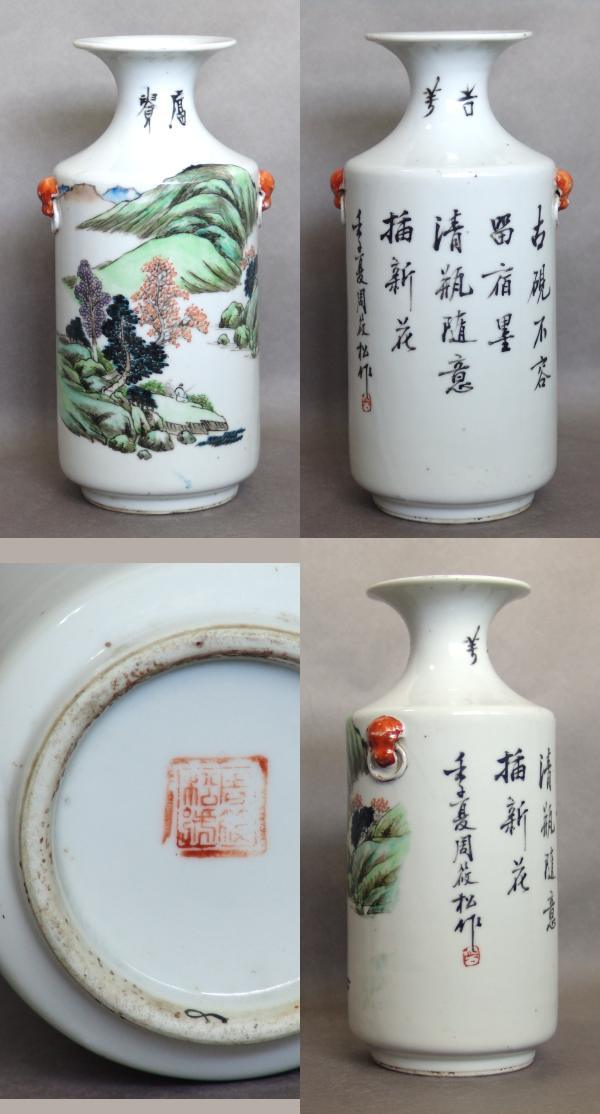 Signed by: Zhou Xiaosong |
Zhou Xiaosong (active 1910-20s) | 周筱松 | 1014. Vase. Dated to the ren zi year (1912). Square iron red seal mark on the base Zhou Xiaosong Zhi, and signed by Zhou Xiaosong in the calligraphy. The poem is a duplet, i.e. made up of two sentences with seven words each, reading: " Gu yan bu rong liu su mo; Meaning The poem is identical with that on the vase #1011. |
1912 | 1014 | Vase | Zhou Xiaosong Zhi | 320 |
| Zhou Xiaosong (active 1910-20s) | 周筱松 | Zhou Xiaosong was a native of Sichuan and excelled in painting figures of deities, such as Zhong Kui and lohan. He does not appear to have inscribed his work. Famous painter active in the 1910-20s. (Simon Kwan, Brush and Clay, 1990 p.41, citing 'Jingdezhen taoci shi gao') | 321 | Zhou Yousong | 周友松 | 323 | ||
| Zhou Youxiong | Artist mentioned in 'The Official Kiln Porcelain of the Chinese Qing Dynasty', 2003. | 324 | ||||||
| Zhou Zishan | 周子善 | Qianjiang artist. | 325 | |||||
| Zhu Shaoquan | 朱少泉 | Qianjiang artist. | 1890 | Dish | Guan Yao Nei Zao | 326 | ||
| Zhu Shaoquan | 朱少泉 | Qianjiang artist. | 1894 | Box | 327 | |||
| Zhu Shouzhi () | Porcelain painter or sculptor of Jingdezhen in the first half of the twentieth century. (Simon Kwan, Brush and Clay, 1990 p. 43) | 328 | ||||||
| Zi Jiu (Huang Gong Wang) | 1902 | Box | 329 | |||||
| Zi Yushi | 1913 | hatstand | Red 6 characters | 330 | ||||
| Zixiang | 子祥 | Zixiang. Qianjiang artist (Koh). | 331 | |||||
| Zou Wenhou (-1951) | Third generation of the literati school of porcelain painting. (Simon Kwan, Brush and Clay, 1990 p.42, fig 115) | 332 | ||||||
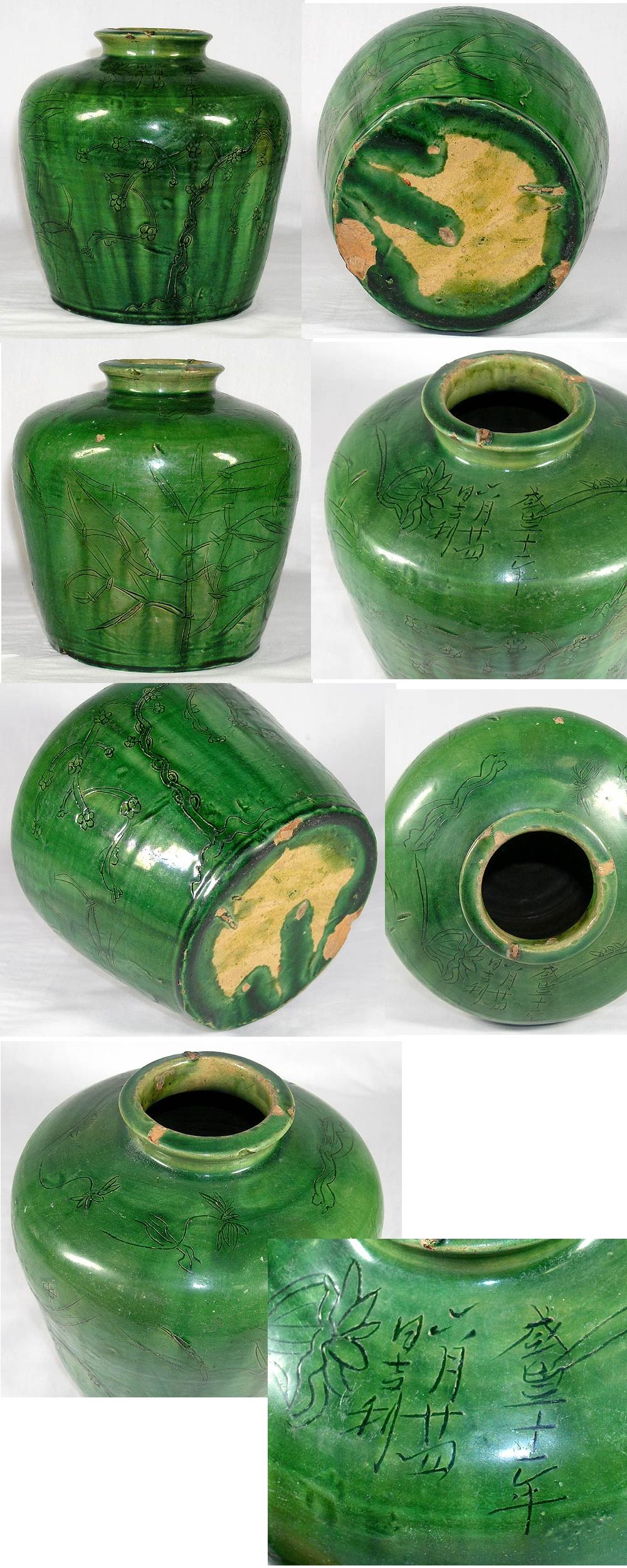 |
1424. Jar covered with green lead glaze in Han dynasty style on red pottery. Date inscised under the glaze "The Xianfeng, 11th year, sixth month, twenty-fourth day, propitious" | 1861 | Pottery | 333 | ||||
| 1871 | Da Qing Tongzhi Nian Zhi | 334 | ||||||
| 1878 | Box | Guangxu Nian Zhi | 335 | |||||
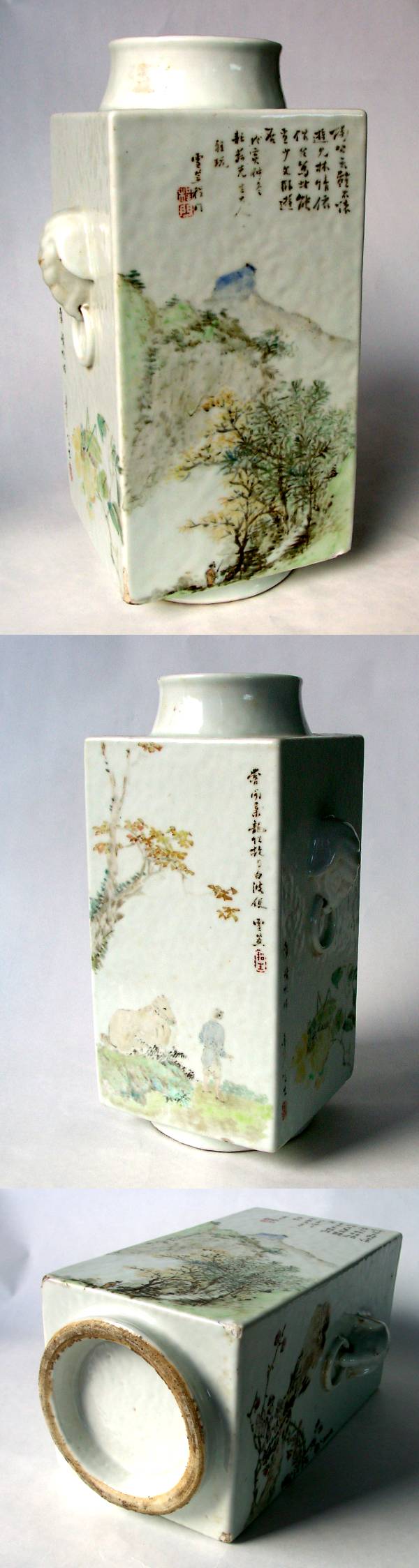 |
648. Square vase with elephant's heads handles. Undulating glaze - special dull enamels of a kind of their own. Rough foot rim. | 1878 | 648 | Square vase | 336 | |||
| 1882 | Bowl | 4 red characters - Tongzhi? | 337 | |||||
| 1882 | Bowl | 338 | ||||||
| 1882 | Wall vase | 339 | ||||||
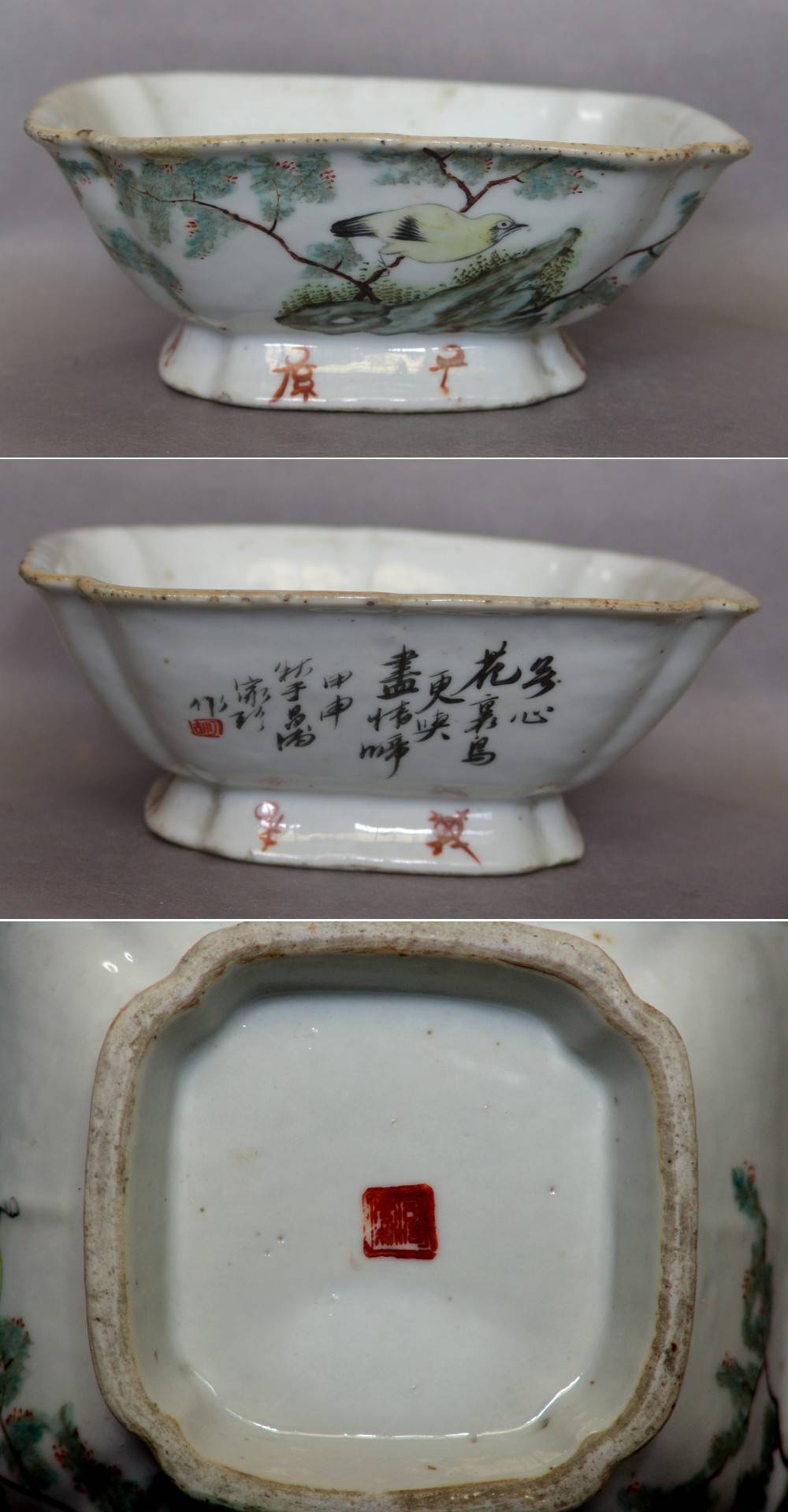 Signed by: Fang Jiazhen |
988. Narcissus bowl. Signed by: Fang Jiazhen, Stamped base mark: Tongzhi Nian Zhi "Tongzhi period make". Dated to the jia shen year (1884). |
1884 | 988 | Square bowl | Tongzhi Nian Zhi | 340 | ||
| 1885 | Bowl | 341 | ||||||
| 1885 | Bowl | 342 | ||||||
 |
1025. Vase, dated Ding Hai year meaning, 1887. No base mark. | 1887 | 1025 | Round vase | 343 | |||
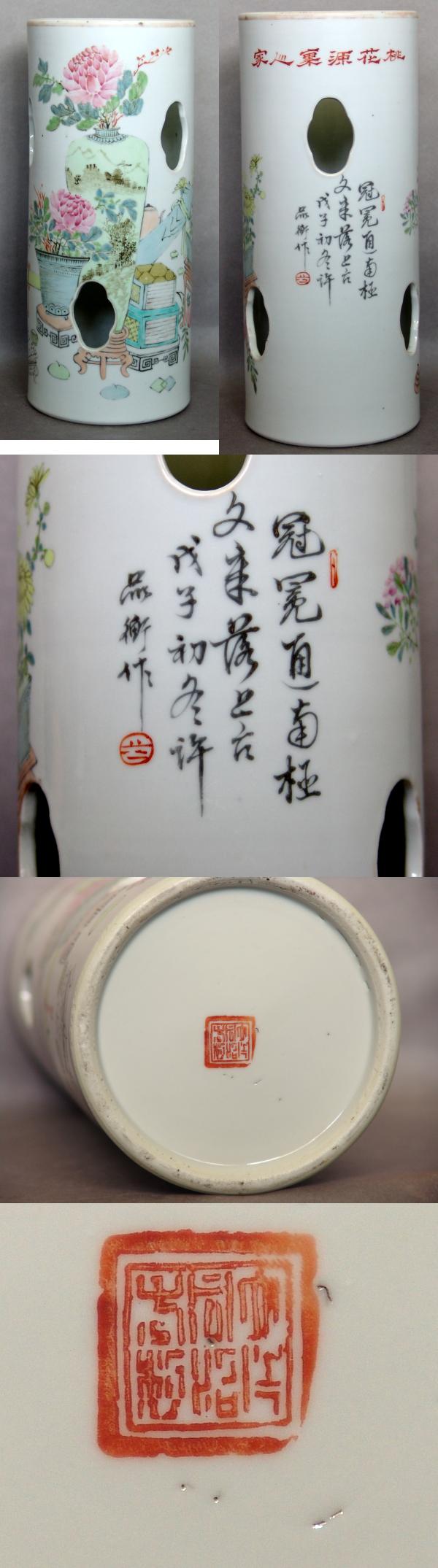 |
1021. Hat stand, height 28 cm. Dated to the wu zi year in the inscription, matching the western date 1888. On the base a stamped square iron red mark Da Qing Tongzhi Nian Zhi meaning "Great Qing Tongzhi Period Make". | 1888 | 1021 | hatstand | Da Qing Tongzhi Nian Zhi | 344 | ||
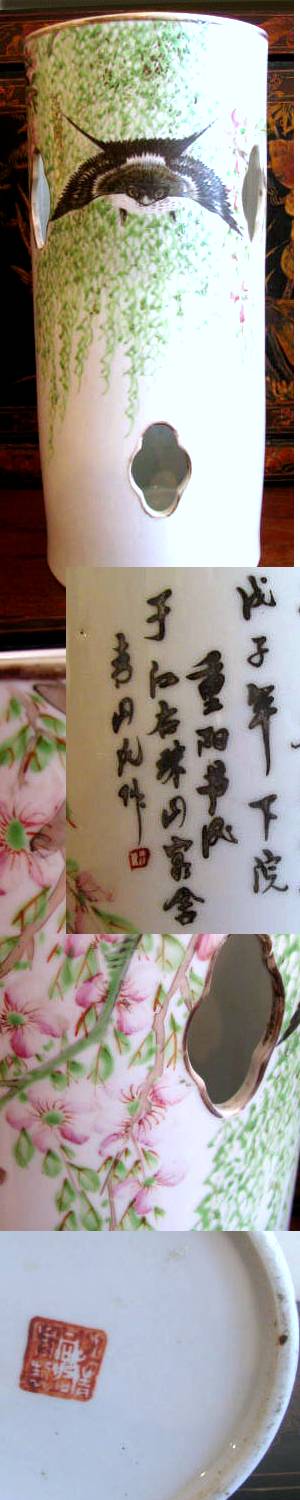 |
1147. Hat stand. Decorated with a swallow. Dated to the wu zi year (1888) in the inscription. Unclear/illegible stamped mark on the base, possibly six character Da Qing Tongzhi Nian Zhi meaning "Qing Dynasty Tongzhi Period Make". | 1888 | 1147 | hatstand | Da Qing Tongzhi Nian Zhi | 345 | ||
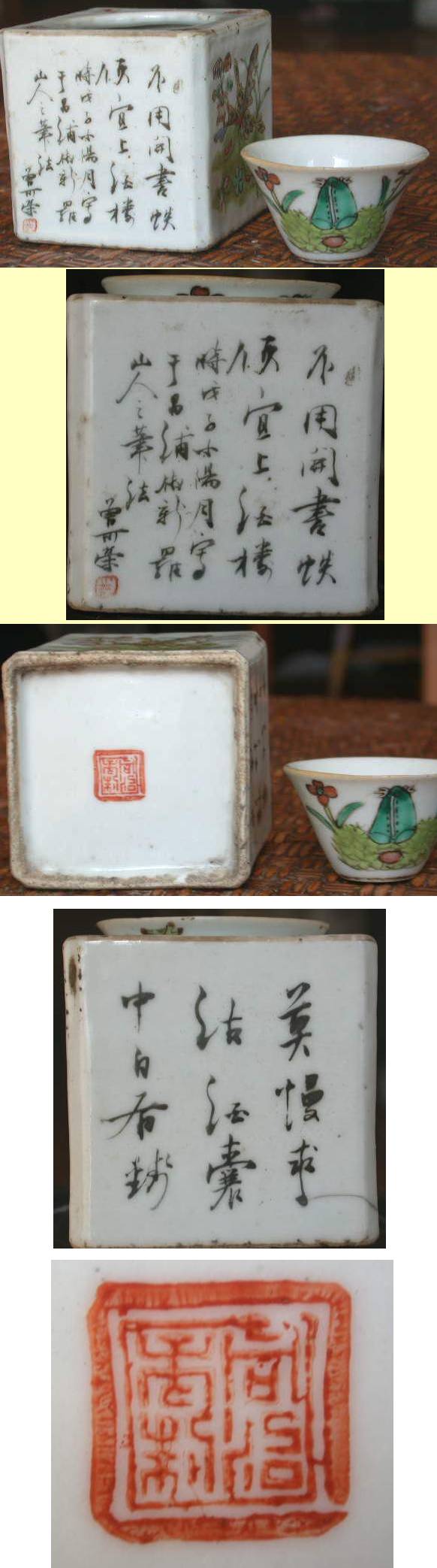 |
1081. Wine warmer. Dated to the wu zi year in the inscription, matching the western date 1888. On the base a stamped square iron red mark Tongzhi Nian Zhi meaning "Tongzhi Period Make". | 1888 | 1081 | Wine warmer | Tongzhi Nian Zhi | 346 | ||
 |
1026. Large square vase. Dated to the wu zi year in the inscription, matching the western date 1888. No base mark. | 1888 | 1026 | Square vase | 347 | |||
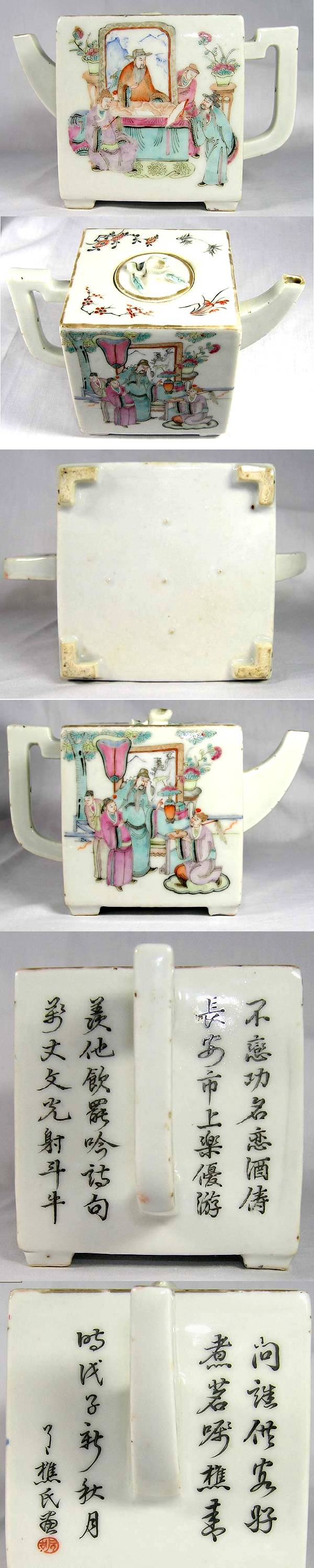 |
1120. Teapot. Dated to the wu zi year (1888) in the inscription. No base mark.
|
1888 | 1120 | Square tea pot | 348 | |||
| 1888 | Plaque | 349 | ||||||
| 1889 | Censer | 350 | ||||||
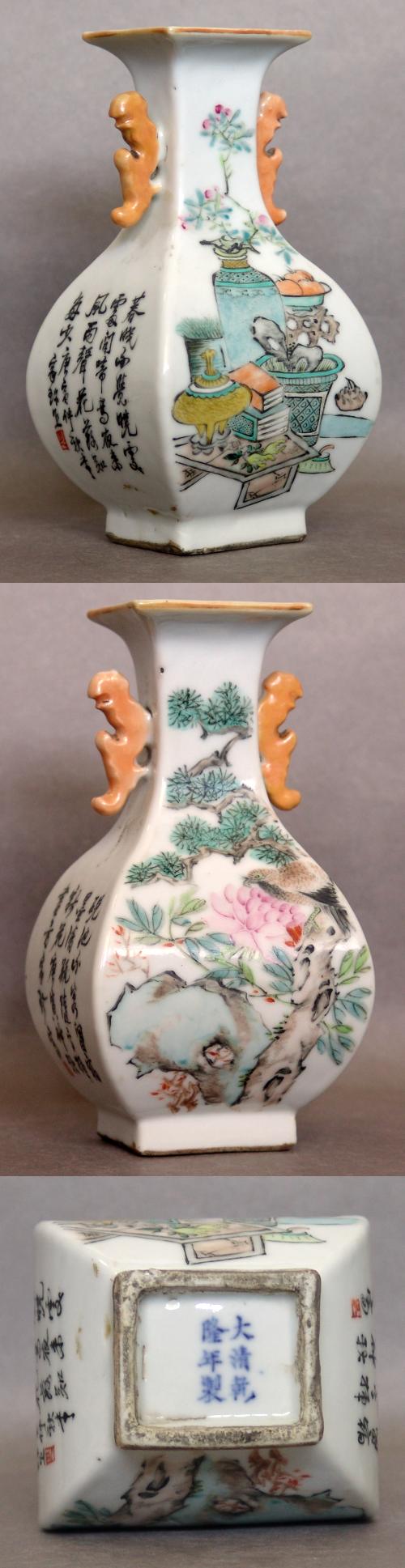 |
1018. Square vase with moulded ears. Dated to the geng yin year (1890) in the calligraphy. Underglaze blue mark Da Qing Qianlong Nian Zhi meaning "Great Qing Qianlong Period Make". Height 15 cm. | 1890 | 1018 | Square vase | Da Qing Qianlong Nian Zhi | 351 | ||
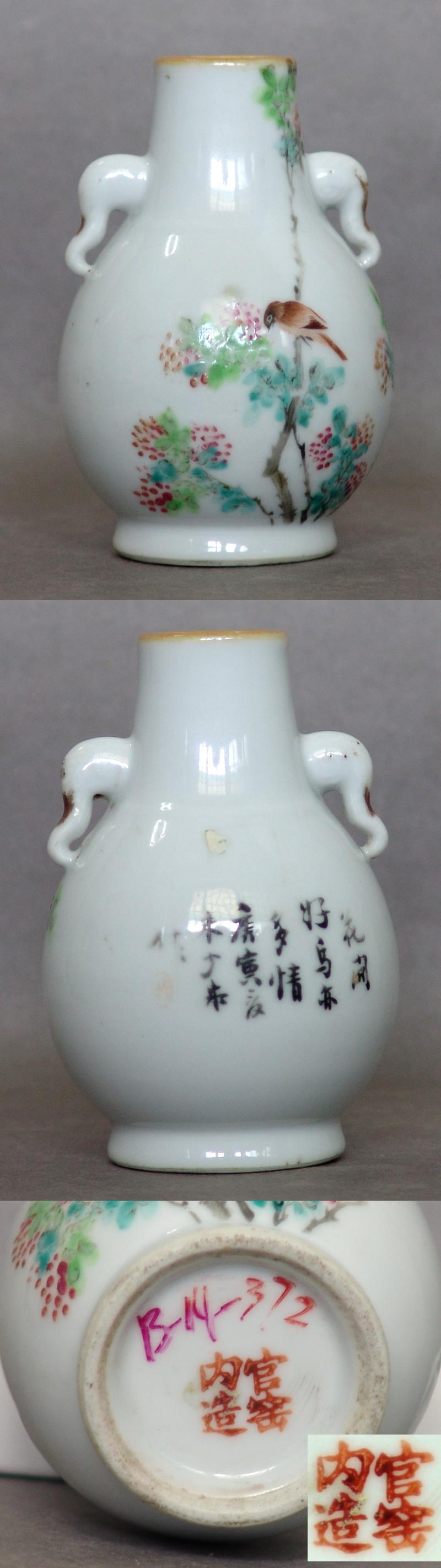 |
1005. Vase with elephant's trunk handles. Dated to the geng yin year (1890) in the calligraphy. Red base mark Guan yao nei zao meaning "Imperial Kiln for Inner Palace". Height 10 cm. | 1890 | 1005 | Vase with elephant handles | Guan Yao Nei Zao | 352 | ||
| 1890 | 3 Vases | Guan Yao Nei Zao | 353 | |||||
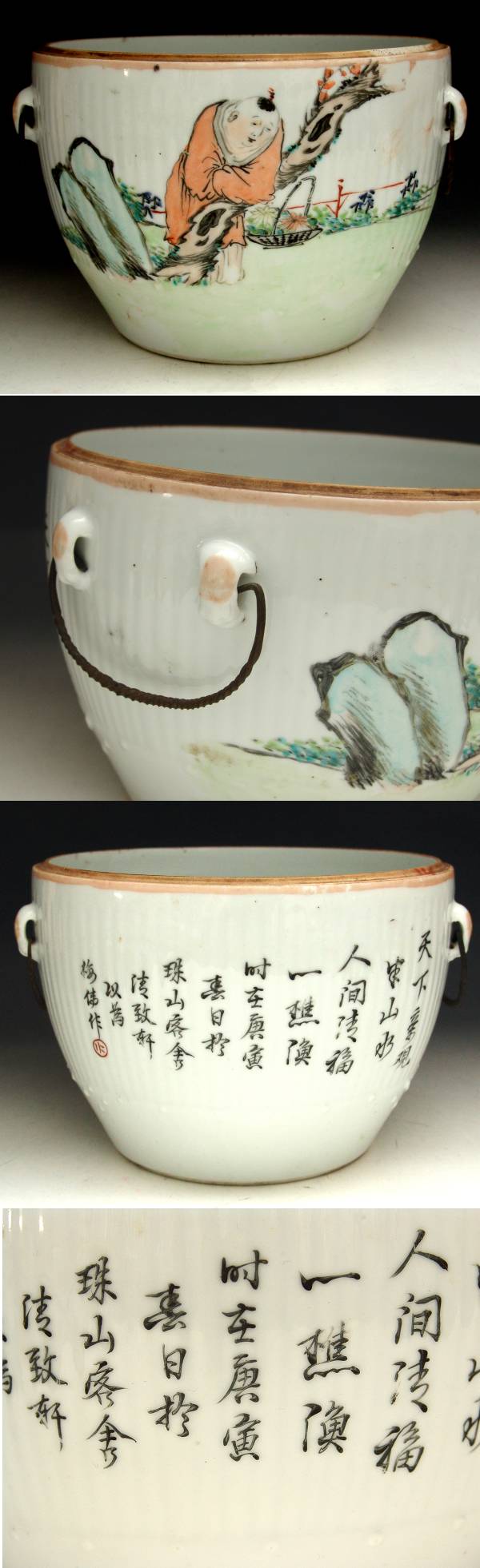 |
1115. Quite large lidded bowl 'Kamcheng', but missing its lid. No mark, cut foot rim, dated in the inscription to the geng yin year (1890). Decoration mostly unchanged 12 years later as in 1111. Width, diam. 17 cm, Height bottom section as on the picture 4 3/4" (12 cm).
|
1890 | 1115 | Kamcheng | 354 | |||
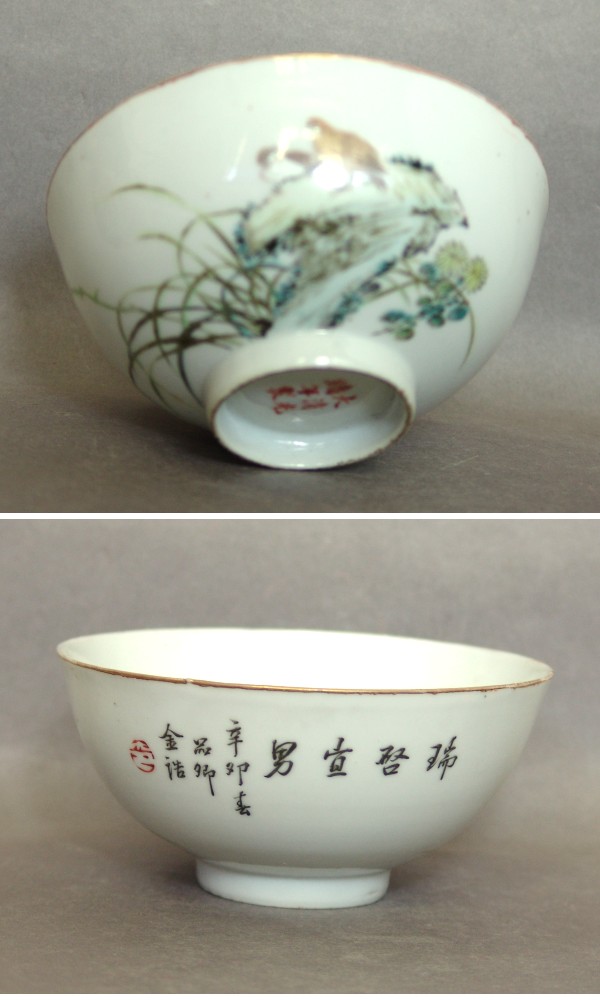 |
987. Bowl with Quails on rocks, dated 1891. Base mark, hand written mark Da Qing Guangxu Nian Zhi (Qing dynasty Guangxu period make). | 1891 | 987 | Bowl | Da Qing Guangxu Nian Zhi | 355 | ||
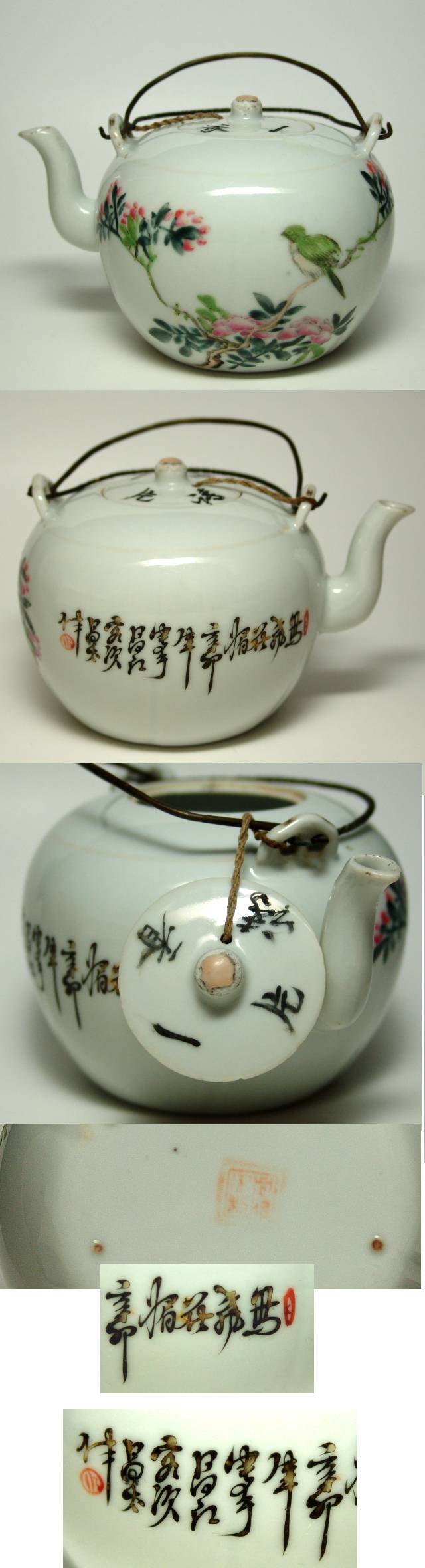 |
1199. Tea pot. Dated in the inscription to the xin mao (1891) year. On the base a stamped 'Tongzhi Nian Zhi' seal mark in iron red. | 1891 | 1199 | Tea pot | Tongzhi Nian Zhi | 356 | ||
| 1891 | Teapot | Tongzhi Nian Zhi | 357 | |||||
| 1891 | Tea Caddy | 358 | ||||||
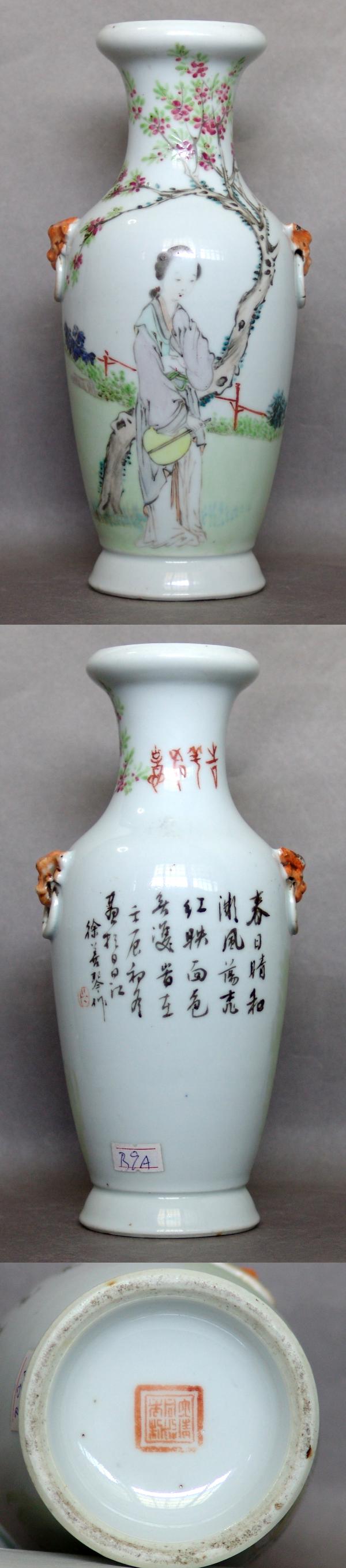 |
1003. Vase, dated in the inscription to the ren chen year = 1892. On the base a stamped square iron red mark Da Qing Tongzhi Nian Zhi meaning "Great Qing Tongzhi Period Make". | 1892 | 1003 | Vase | Da Qing Tongzhi Nian Zhi | 359 | ||
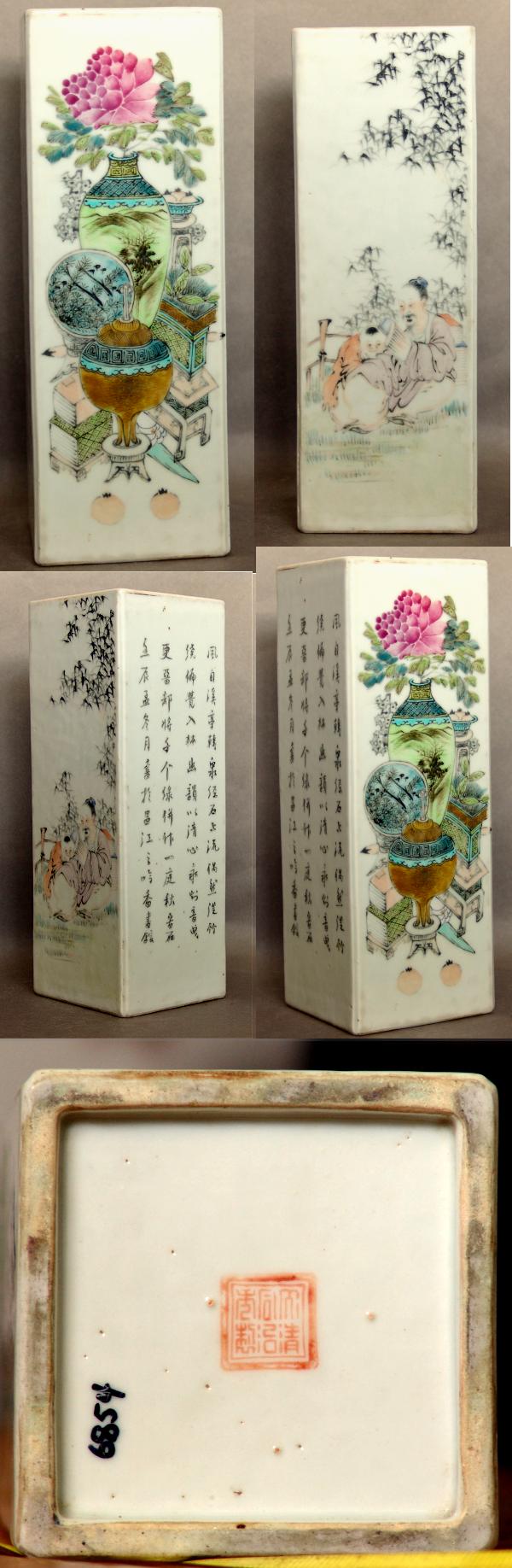 |
1019. Square Vase, dated in the calligraphy to the ren chen year = 1892. Height 27 cm. On the base a stamped square iron red mark Da Qing Tongzhi Nian Zhi meaning "Great Qing Tongzhi Period Make". | 1892 | 1019 | Square vase | Da Qing Tongzhi Nian Zhi | 360 | ||
 |
671. Three lobed bowl, with calligraphy in dull black enamel "Flowers dancing in the breeze, Spring arrives, birds find their tunes", dated "1892". Red base mark Guan yao nei zao (Imperial Kiln for Inner Palace). | 1892 | 671 | Three lobed bowl | Guan Yao Nei Zao | 361 | ||
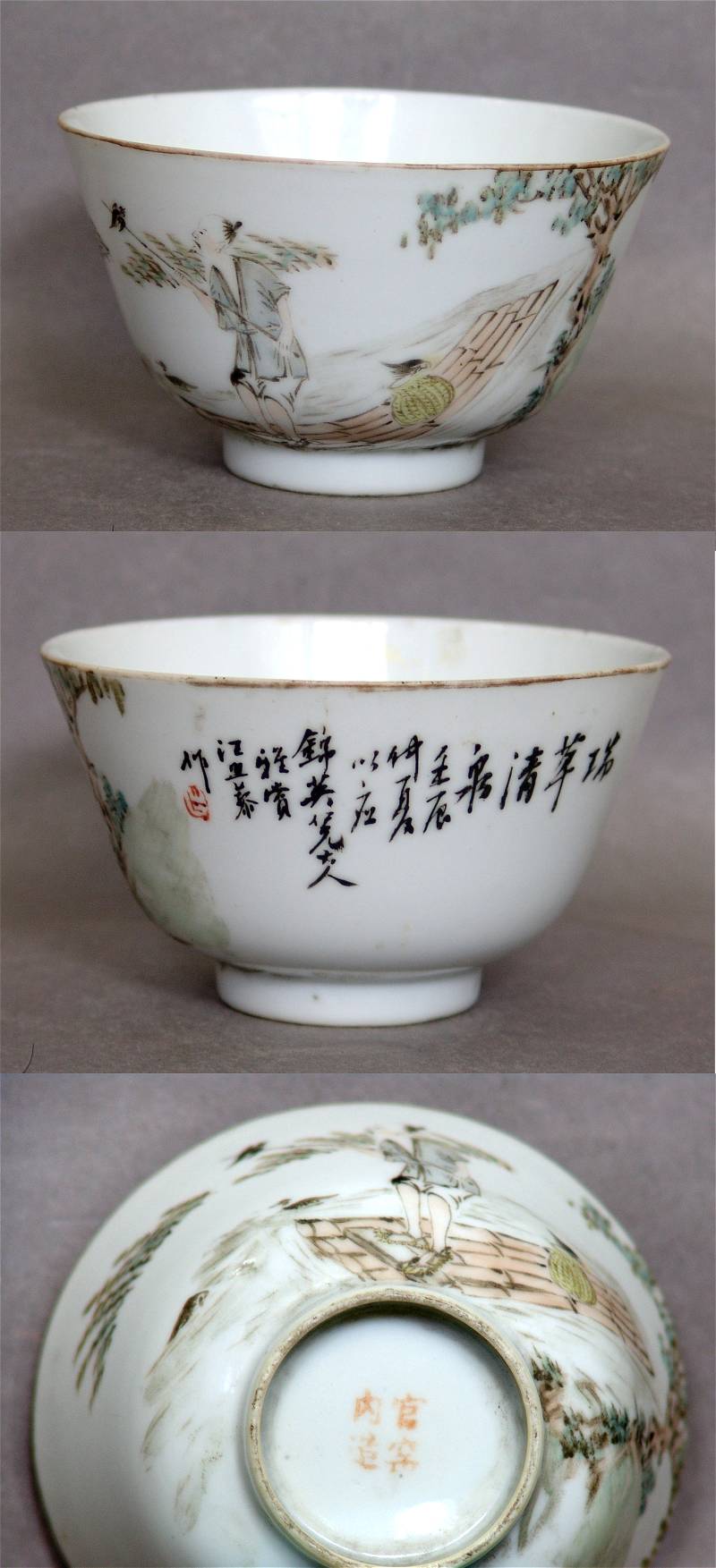 |
993. Bowl, dated "1892". Red base mark Guan yao nei zao (Imperial Kiln for Inner Palace). | 1892 | 993 | Bowl | Guan Yao Nei Zao | 362 | ||
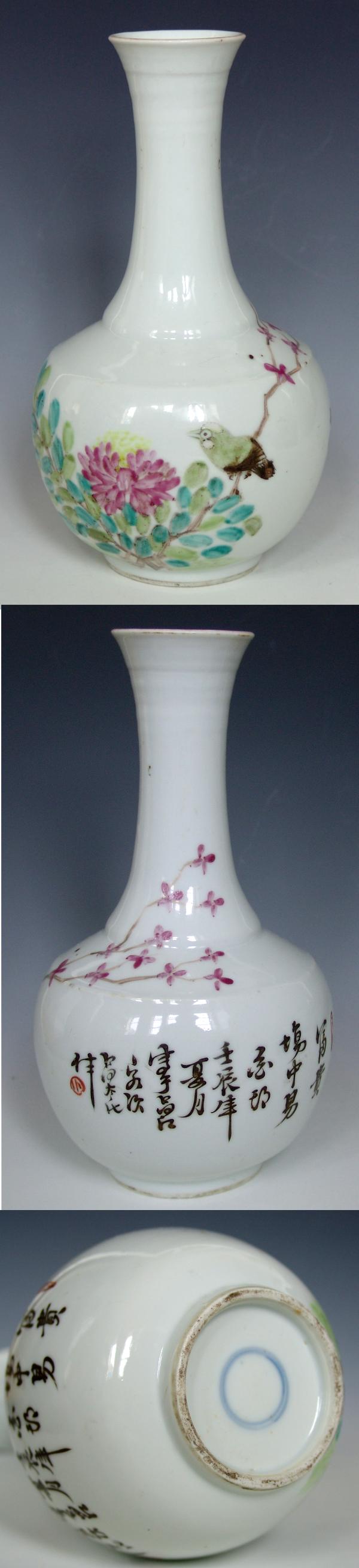 |
1008. Vase, dated in the calligraphy to the ren chen year = 1892. On the base a double ring in underglaze blue; no mark. | 1892 | 1008 | Vase | 363 | |||
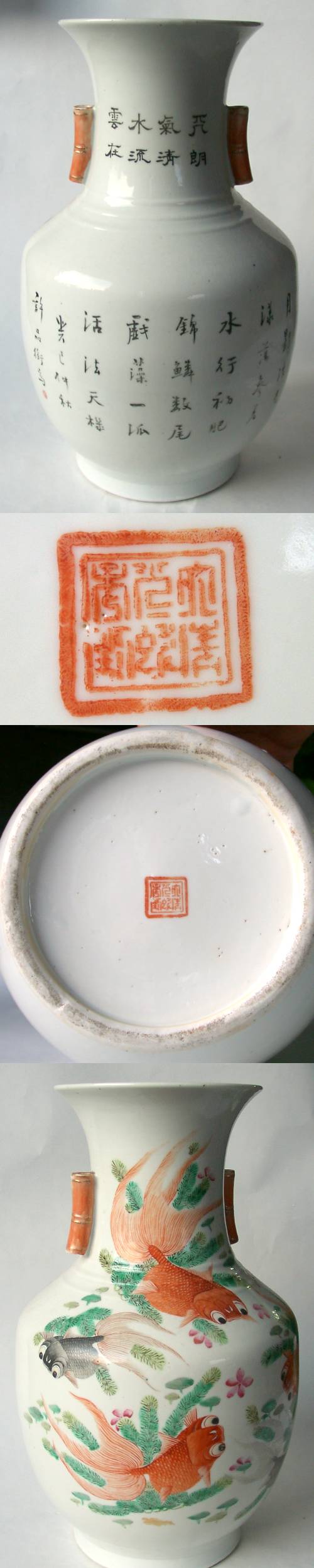 |
661. Vase. Mark: Da Qing Guangxu Nian Zhi (1875-1908), Dated to the gui si year, 1893, which matches with the Guangxu period. | 1893 | 661 | Arrow vase | Da Qing Guangxu Nian Zhi | 364 | ||
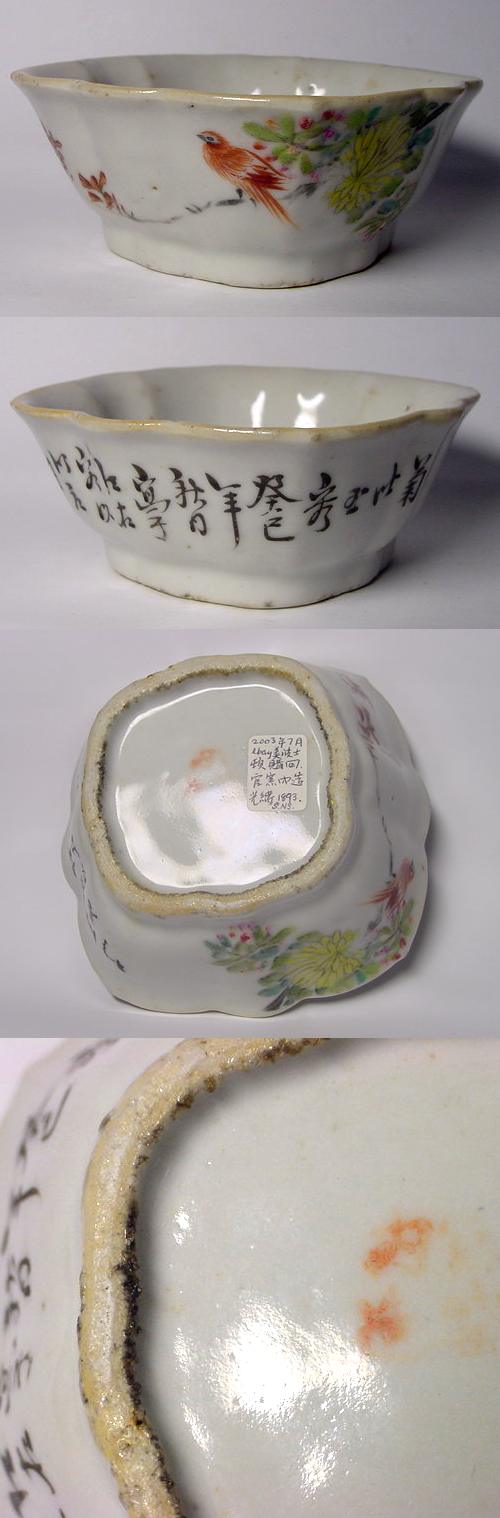 |
1010. Bowl. Red base mark Guan yao nei zao (Imperial Kiln for Inner Palace). Dated in the calligraphy to the gui si year, 1893. | 1893 | 1010 | Lobed bowl | Guan Yao Nei Zao | 365 | ||
 |
1106. Hatstands. Two, with mirrored decoration. Both has the same general text saying wealthy life blessed by the peonies. The practice on signing porcelain seems to be that the painter usually only signed date and name on one piece of a pair. On the bases of both a very faint mark Guan yao nei zao (Imperial Kiln for Inner Palace). Dated in the calligraphy of one of the hat stands, to the gui si year, or 1893.
|
1893 | 1106 | hatstands | Guan Yao Nei Zao | 366 | ||
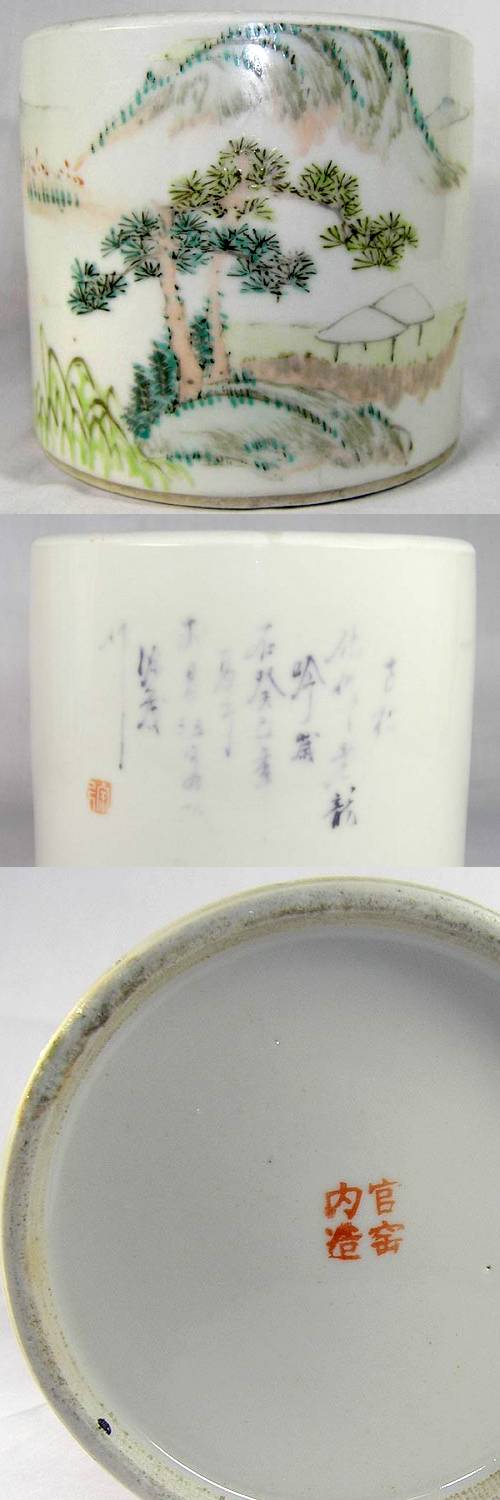 |
1127. Brush pot. Mark: mark Guan yao nei zao (Imperial Kiln for Inner Palace). Dated to the gui si year (1893) | 1893 | 1127 | Brush pot | Guan Yao Nei Zao | 367 | ||
| 1893 | hatstand | Guan Yao Nei Zao | 368 | |||||
| 1893 | Cup | Guangxu Nian Zhi | 369 | |||||
 |
1031. Hatstand. Red base mark Tongzhi. Dated in the calligraphy to the gui si year, or 1893. | 1893 | 1031 | hatstand | Tong Zhi | 370 | ||
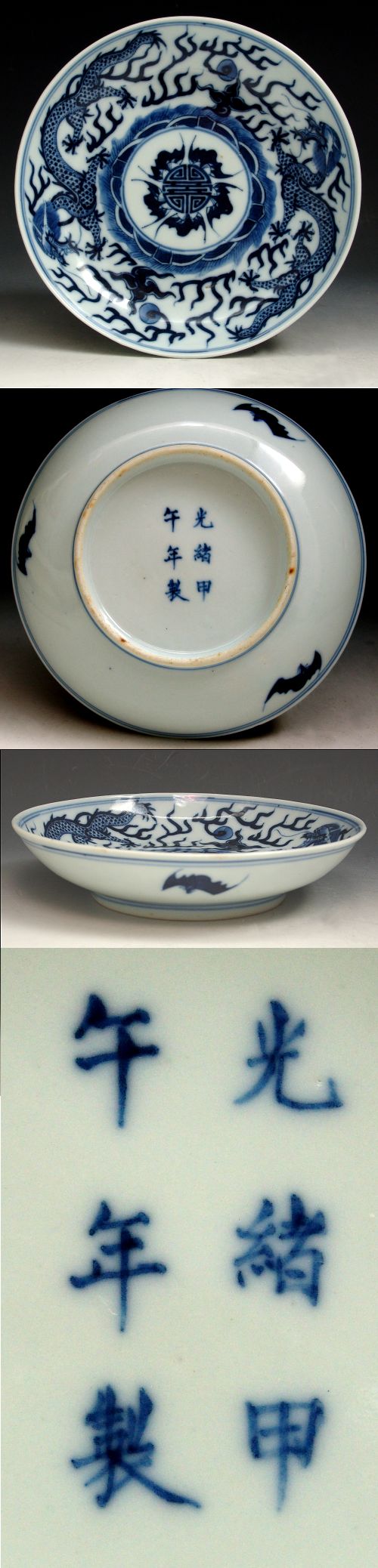 |
1173. Dish. The decoration is of two five clawed dragons around the 'five happinesses' (wu fu) in the center and on the underside of the rim - three happinesses. In Chinese Porcelain of the 20th Century van Oort says that "[in 1894] every high official in the Empire had been invited to contribute twenty-five per cent of his salary as a birthday gift to Her Majesty ... however I have not been able to trace in the history of the Qing dynasty any mention of an official decree ordering porcelain to be made in Jingdezhen for that occasion". The quality of this dish is good and fits well with an actual date of production to the last years of the 19th century Base mark is Guangxu period 'jia wu' (1894) year make. The porcelain made for Cixi for her 50th birthday in 1885 carries the mark Chuxiu Gong zhi and resemble Kangxi wares in design. Aside from the Dayazhai wares are those the only pieces that we know are directly associated with her. She was born November 29th, 1835 and died November 15th, 1908. Why a date of 1894 is indeed her 59th birthday, her Chinese age would be 60. | 1894 | 1173 | Dish | Guangxu Jia Wu Nian Zhi | 371 | ||
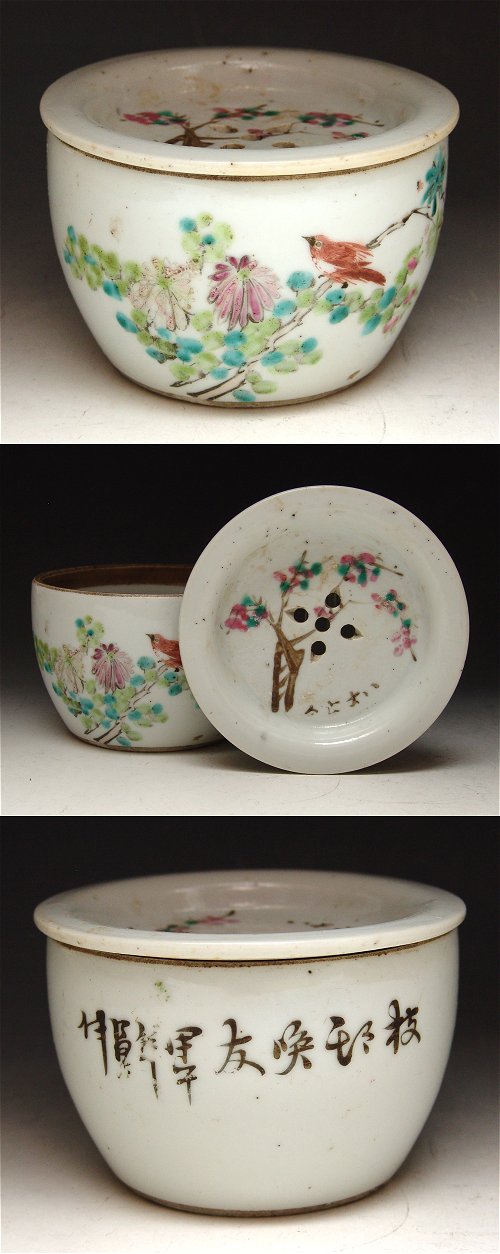 |
1175. Soap box. Dated in the inscription to the jia wu year (1894). | 1894 | 1175 | Soap box | 372 | |||
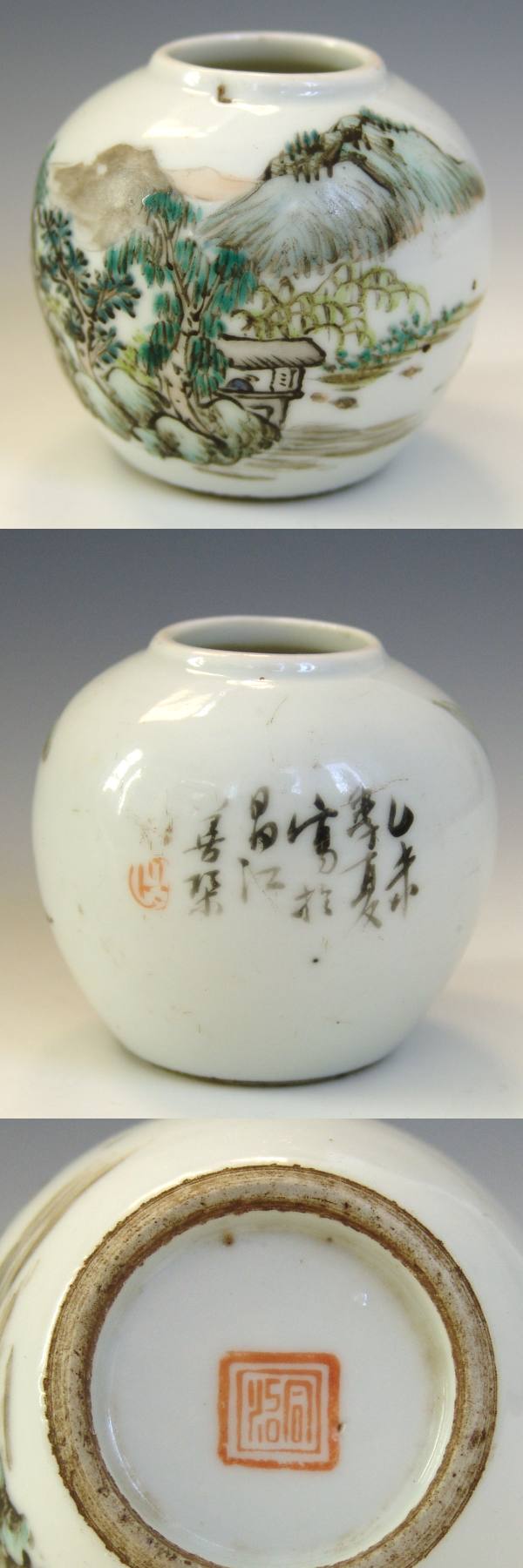 |
825. Mark: Tongzhi - "Tongzhi (Period Made)". Qianjiang enamels, dated the years of Yi Wei = 1895.
|
1895 | 825 | Globular vase | Tongzhi | 373 | ||
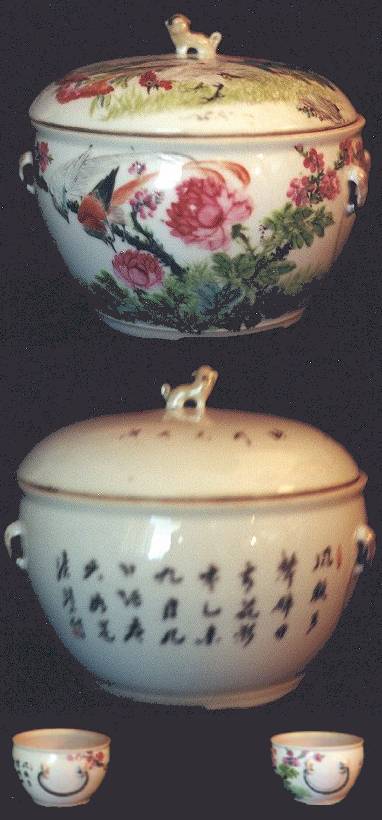 |
604. Kamcheng pot, dated Yi Wei Nian (1895) | 1895 | 604 | Kamcheng | 374 | |||
 |
674. Square vase, dated Yi Wei Nian (1895). On one side a scholar, on the other side a "White head Granny and Peony" decoration, which generally could be translated to a wish for "family success, wealth, prosperity and old age". | 1895 | 674 | Square vase | 375 | |||
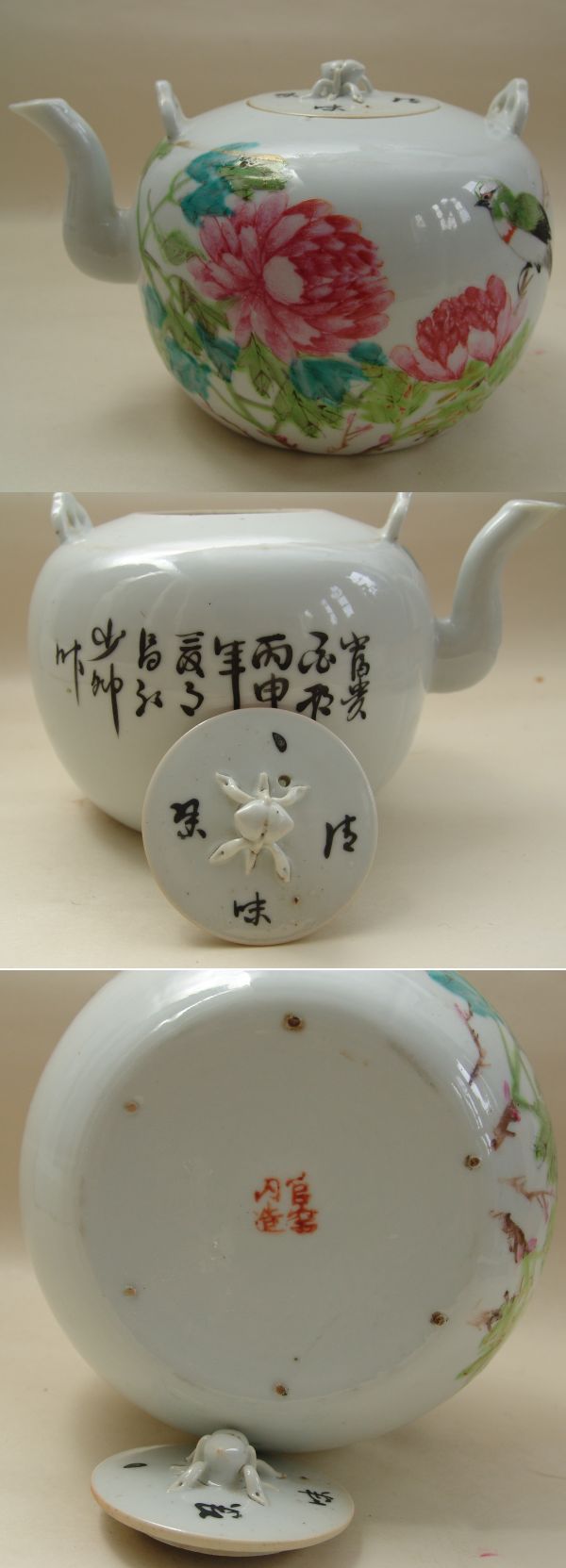 |
1225. Teapot. Signed in the inscription to the bing bhen year, as in 1896. Stamped mark in red enamels: Guan yao nei zao (Imperial Kiln for Inner Palace). | 1896 | 1225 | Tea pot | Guan Yao Nei Zao | 376 | ||
 |
1164. Hat stand, dated wu xu year, in the calligraphy, matching western date is 1898. Red base mark Guan yao nei zao (Imperial Kiln for Inner Palace).
|
1898 | 1164 | hatstand | Guan Yao Nei Zao | 377 | ||
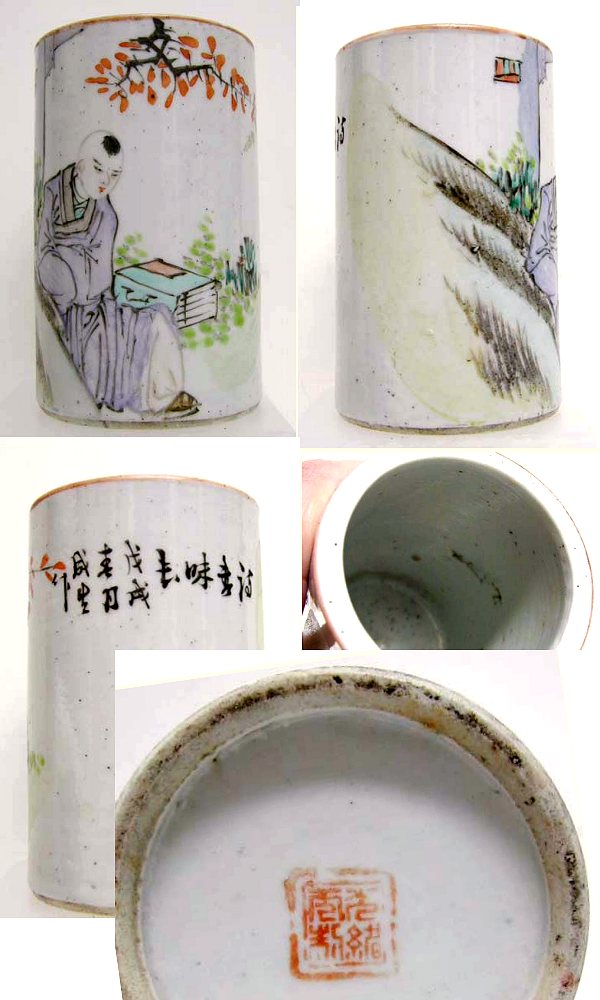 |
1108. Brushpot, dated wu xu year, in the calligraphy, matching western date is 1898. Qianjiang decoration. Red base mark Guangxu Nian Zhi (Guangxu Period Make). | 1898 | 1108 | Brush pot | Guangxu Nian Zhi | 378 | ||
| 1898 | Teapot | 379 | ||||||
| 1898 | Dish | 380 | ||||||
 |
996. Bowl, dated ji hai in the calligraphy, matching western date is 1899. Qianjiang decoration. Red base mark Guan yao nei zao (Imperial Kiln for Inner Palace). | 1899 | 996 | Bowl | Guan Yao Nei Zao | 381 | ||
 |
1161. Hatstand, dated in the calligraphy ji hai year (1899). Stamped red base mark Tongzhi Nian Zhi.
|
1899 | 1161 | Six sided hatstand | Tongzhi Nian Zhi | 382 | ||
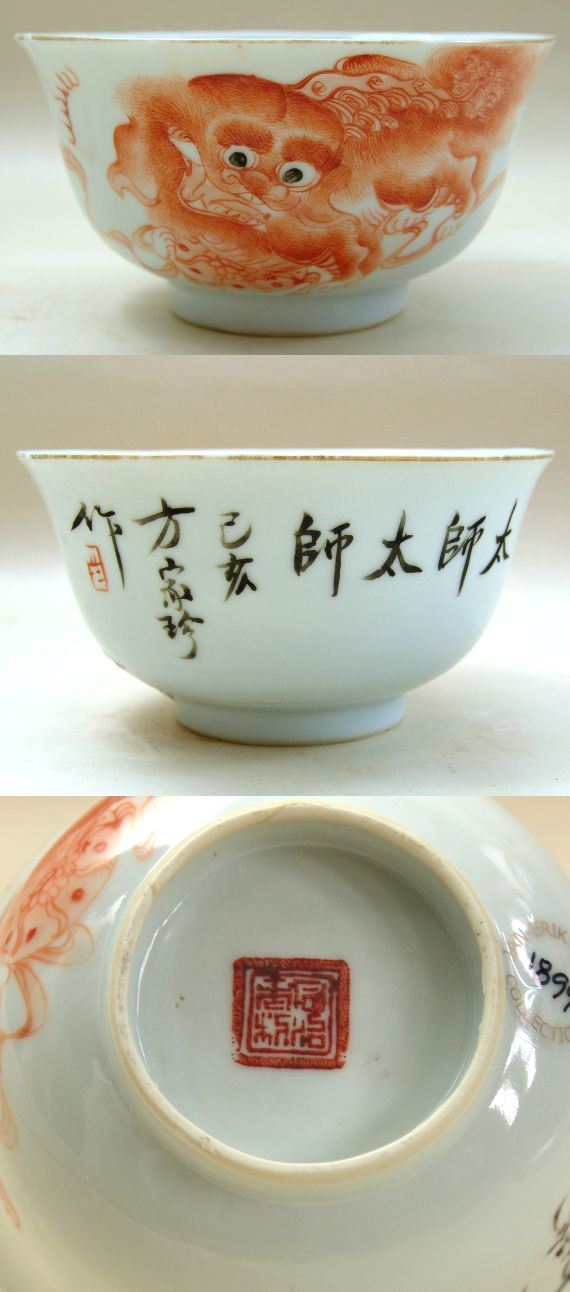 |
1224. Bowl, dated in the calligraphy to the ji hai year (1899). Base mark: stamped dark red mark Tongzhi Nian Zhi. Diameter 4 1/4 inches / 10.8 cm.
|
1899 | 1224 | Bowl | Tongzhi Nian Zhi | 383 | ||
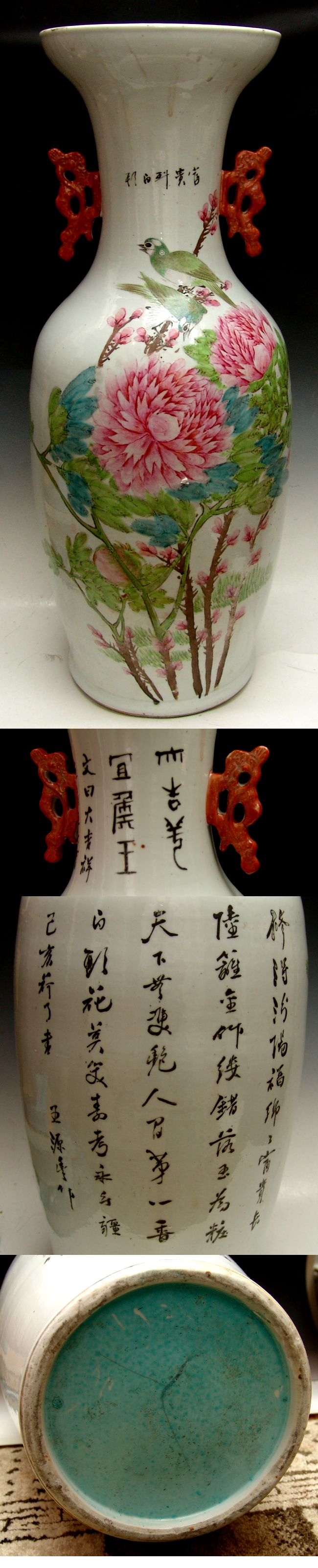 |
1188. Large vase, dated in the calligraphy to the ji hai year (1899). Green enameled base with no mark. Height of vase 24 inches / 61 cm.
|
1899 | 1188 | Vase | 384 | |||
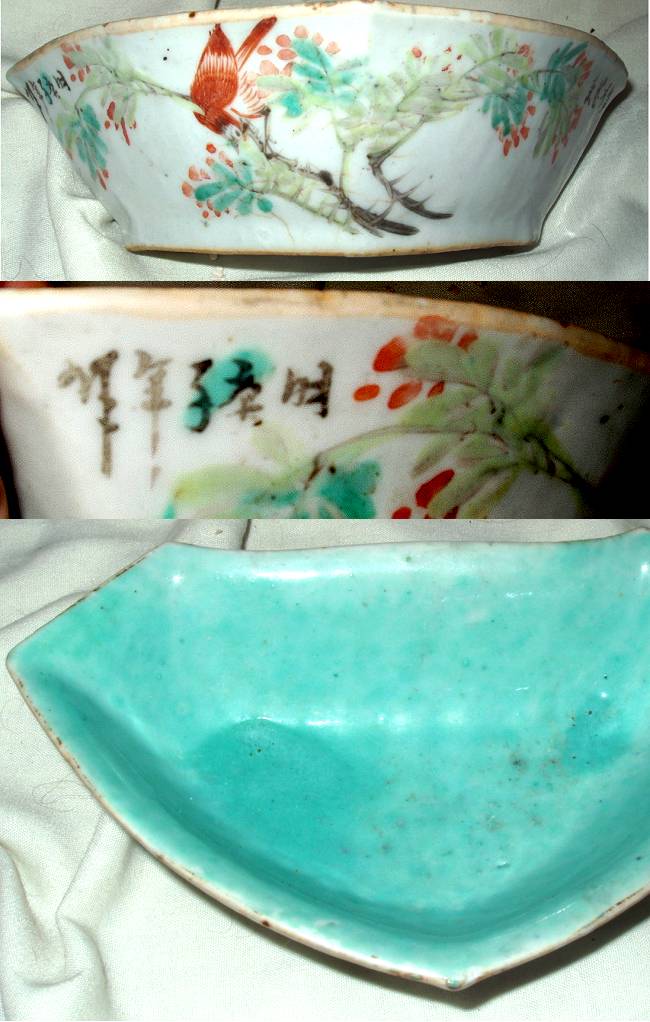 |
1148. Bowl, dated geng xi (1900) in the calligraphy. Qianjiang decoration.
|
1900 | 1148 | Serving bowl | 385 | |||
 |
1006. Lidded jar, dated to the xin chou year in the calligraphy, matching western date is 1901. Red stamped four character Tongzhi Nian Zhi (Tongzhi year make) base mark.
This item is donated to the gotheborg.com reference collection by William Turnbull, Canada, 2004. |
1901 | 1006 | Lidded jar | Tongzhi Nian Zhi | 386 | ||
 |
1176. Teapot, dated to the xin chou year in the calligraphy, matching western date is 1901. Red stamped four character base mark Tongzhi Nian Zhi. | 1901 | 1176 | Tea pot | Tongzhi Nian Zhi | 387 | ||
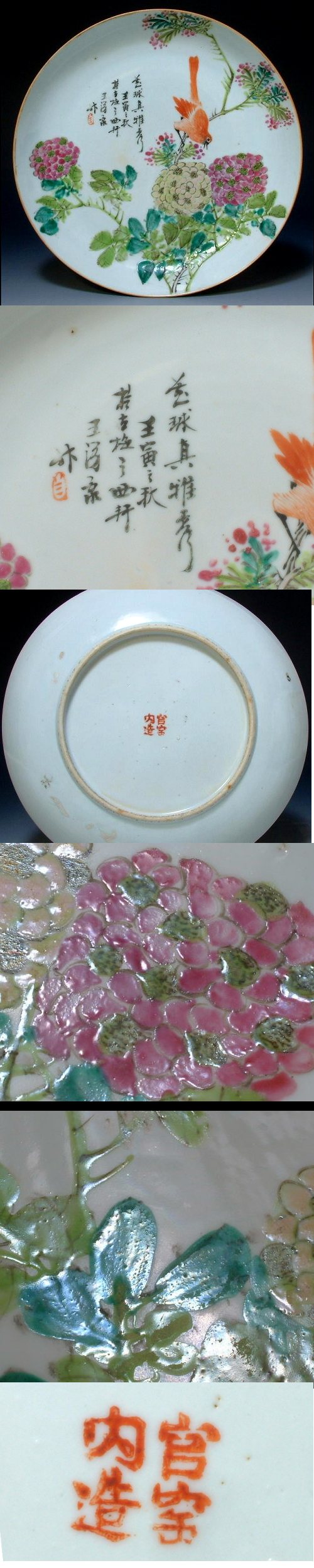 |
1114. Plate with light-brown rim. Thickly applied enamels with a bird perching at the stalk of flowering sprays of hydrangea, inscription with a cyclic date ren yin (1902) year and a red seal. On the undecorated reverse an iron-red four-character mark (Guan yao nei zao Imperial Kiln for Inner Palace) to the base, sand adhesion to the foot rim, pinholes and drops of glaze stuck to the reverse. | 1902 | 1114 | Plate | Guan Yao Nei Zao | 388 | ||
 |
1170. Serving dish. Base mark in red: Guangxu Nian Zhi - "Guangxu (1875-1908) period make". Inscription with a cyclic date ren yin year, (1902).
|
1902 | 1170 | Serving bowl | Guangxu Nian Zhi | 389 | ||
| 1902 | Bowl | LI Yuan Shun | 390 | |||||
| 1902 | Bowl | Red 4 character | 391 | |||||
 |
653. Vase, dated 1902. Red plus green Fu dog. Stamped Tongzhi Nian Zhi mark. White glossy foot rim with brown grit stains. Calligraphy in a grayish black soft enamel. Black enamels of green dog under a clear green glaze. Thin reddish rim border dressing. Putty colored porcelain. | 1902 | 653 | Vase | Tongzhi Nian Zhi | 392 | ||
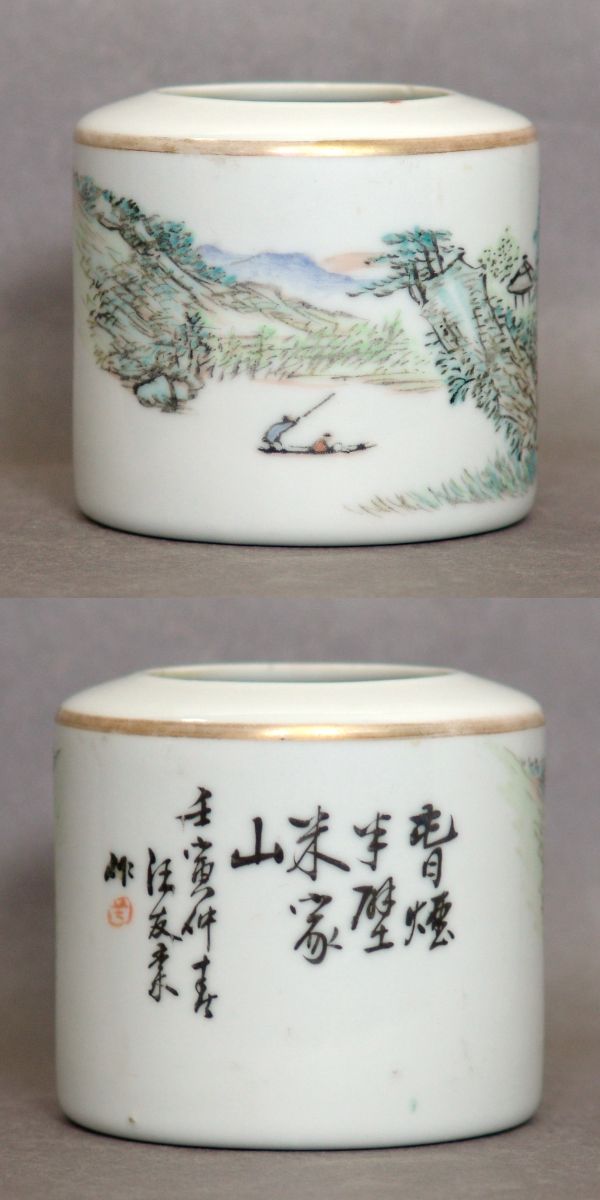 |
1002. Jar. Height 7 cm, diameter 7.5 cm. Fire support marks on the flat base. No base mark. Dated in the decoration as ren yin, representing '1902'. | 1902 | 1002 | Cosmetics jar | 393 | |||
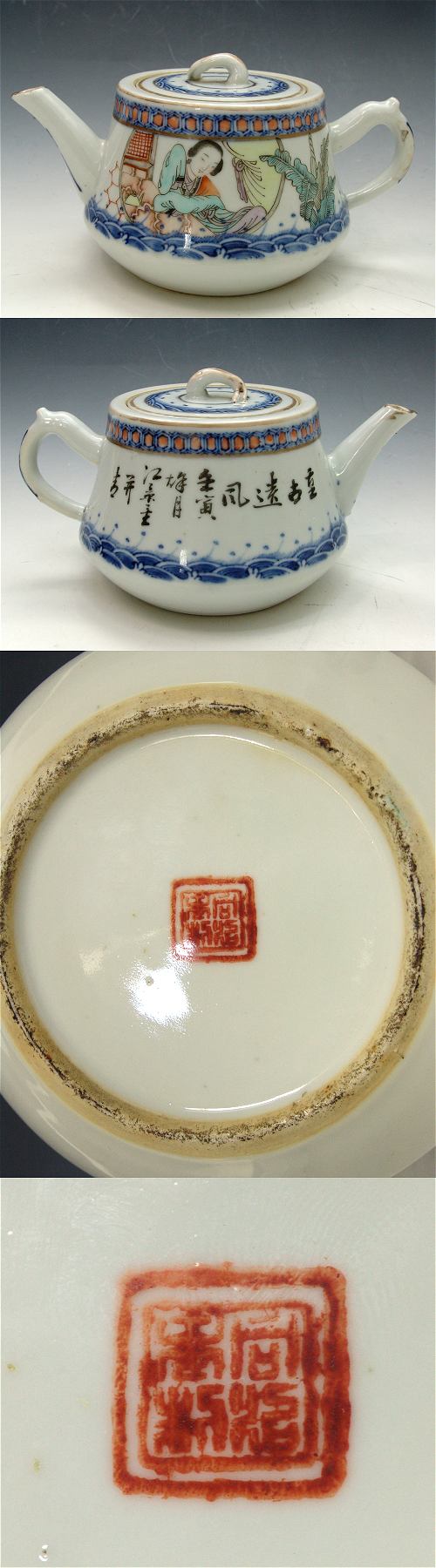 |
1098. Tea pot. Decorated in a combination of underglaze blue and enamels. Dated in the decoration as ren yin, representing '1902'. | 1902 | 1098 | Tea pot | 394 | |||
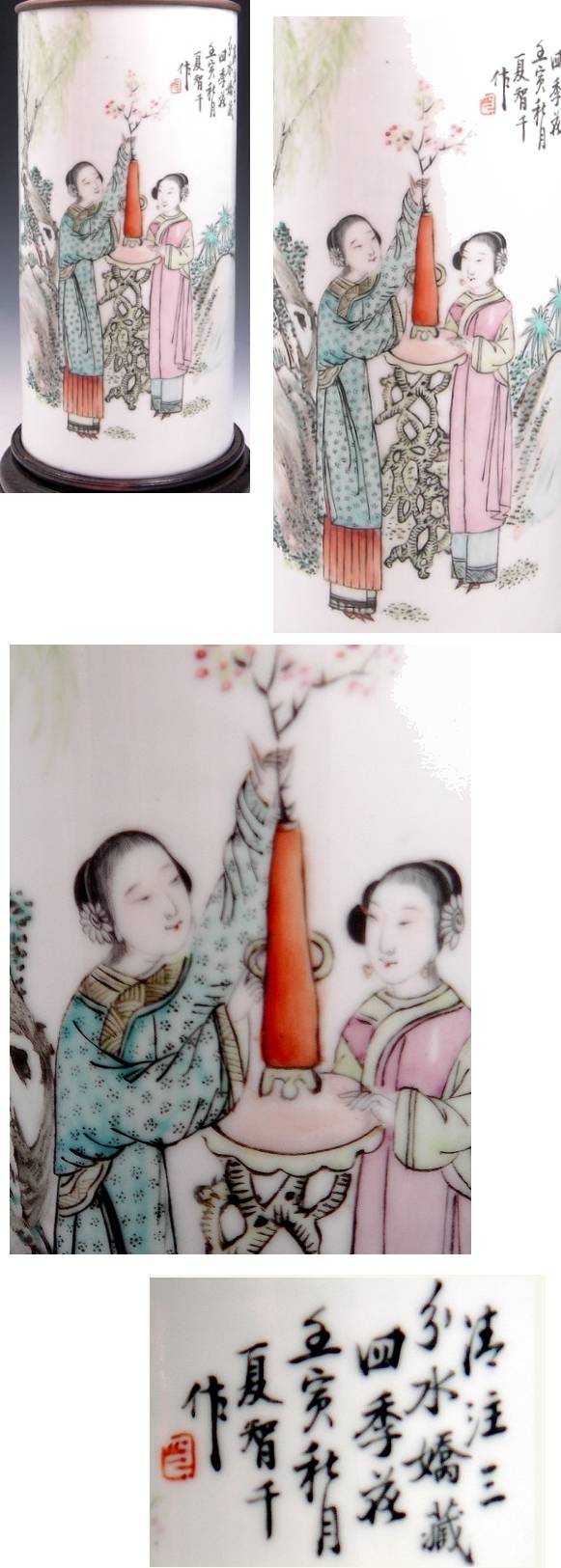 |
1126. Vase. Inscription with a cyclic date ren yin year (1902). | 1902 | 1126 | Vase | 395 | |||
| 1902 | Brush pot | 396 | ||||||
| 1902 | Cup | 397 | ||||||
| 1903 | Jar | 398 | ||||||
| 1903 | Teapot | 399 | ||||||
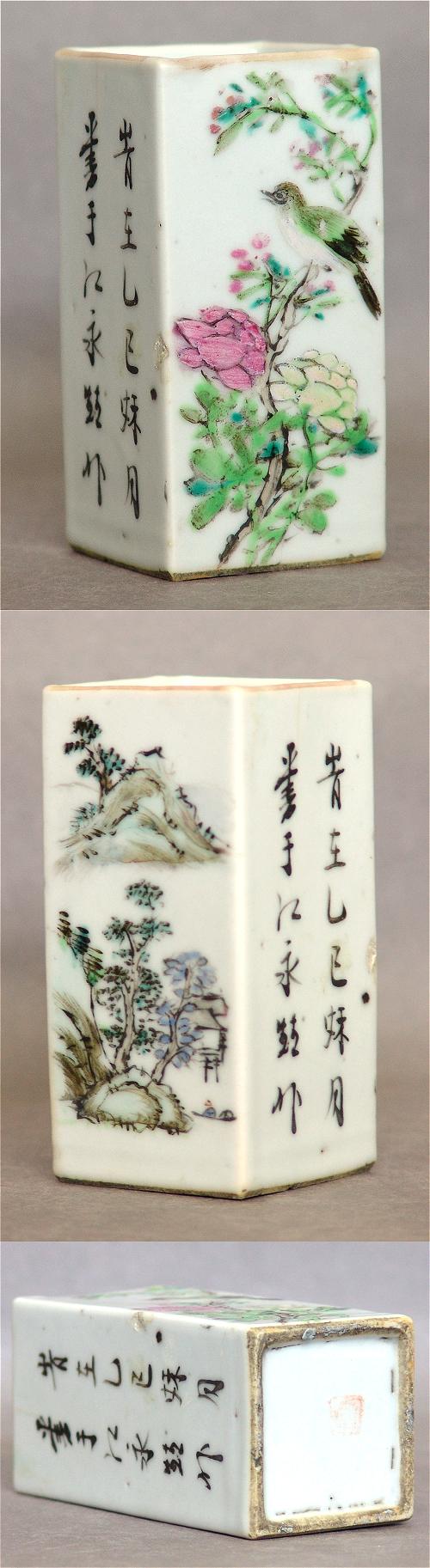 |
1015. Square brush pot, height 9 cm / 3.5". Dated in the inscription to yi si which equals the year 1905. Illegible iron red four character base mark in a square frame. | 1905 | 1015 | Square brush holder | (Blurred) | 400 | ||
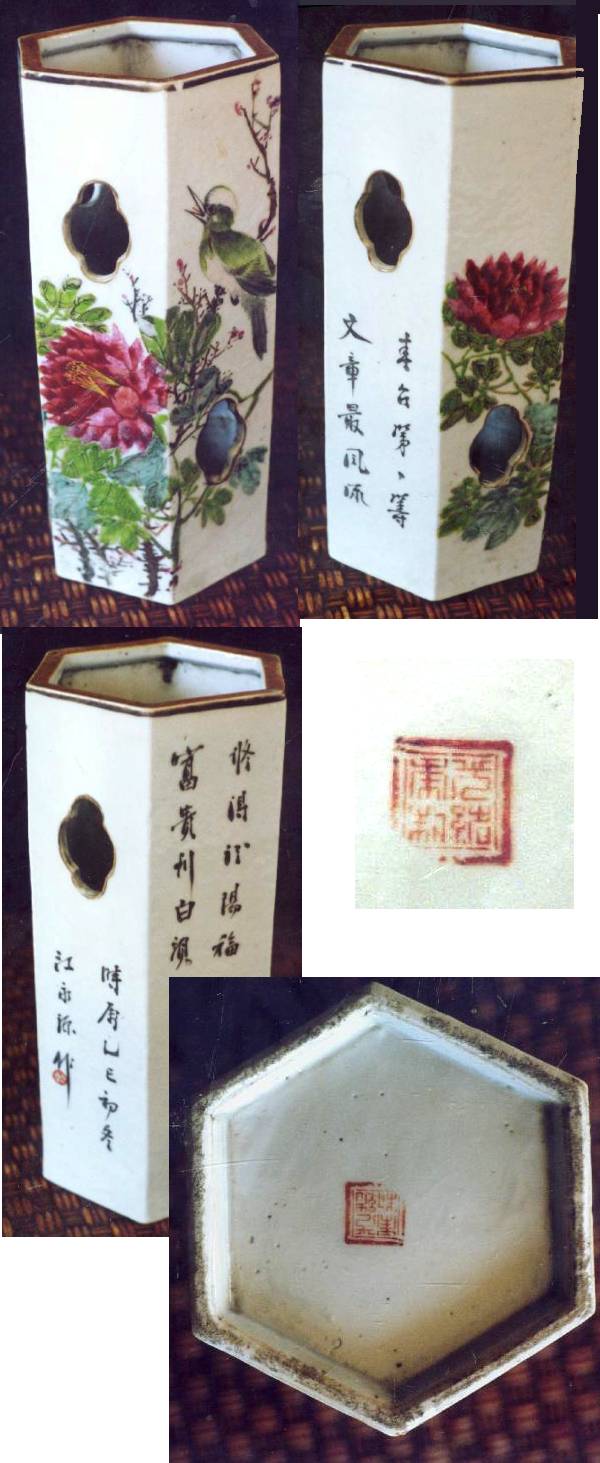 |
47. Vase, dated 1905. Mark: Guangxu Nian Zhi (1875-1908). | 1905 | 47 | Six sided hatstand | Guangxu Nian Zhi | 401 | ||
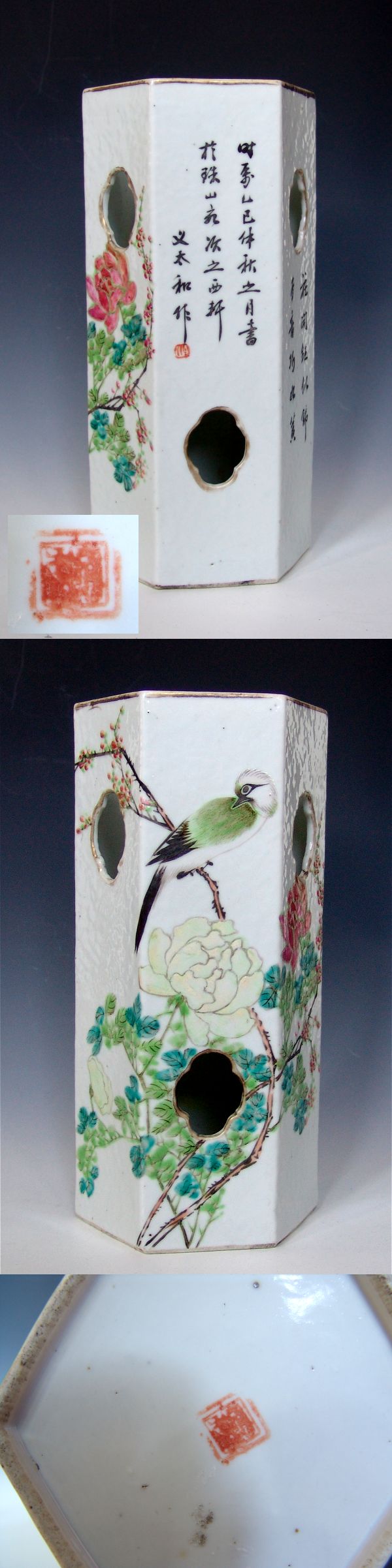 |
957. Vase. Top right third and forth character are yi si which equals the year 1905. Illegible base mark very blurred but possible: Guangxu Nian Zhi (1875-1908). | 1905 | 957 | Six sided hatstand | Guangxu Nian Zhi | 402 | ||
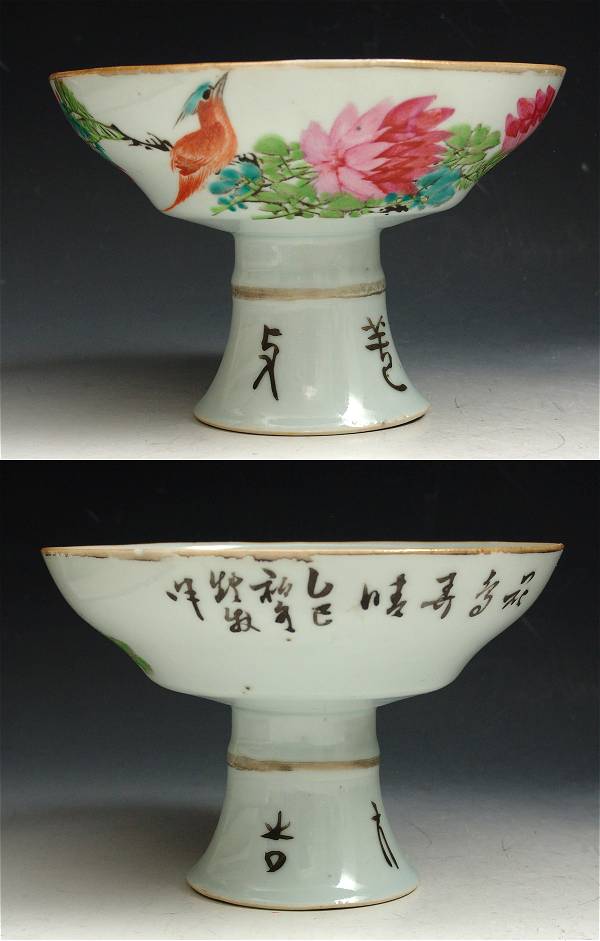 |
1158. Stemcup, dated in the calligraphy Yi Si year (1905). No base mark.
|
1905 | 1158 | Stem cup | 403 | |||
| 1905 | Table screen | 404 | ||||||
| 1905 | Plaque | 405 | ||||||
 |
1906_2. Tea pot with lid, decorated in red, green and black enamels of a Buddhist lion (fu dog), dated in the decorative calligraphy to the bing wu year (1906). Mark: JINGDEZHEN LU' GUANG SHU`N ZA`O meaning: "Jingdezhen Lu Guang Shun Make" | 1906 | 1906_3 | Teapot | Jingdezhen Lu Guang Zhun Zao | 406 | ||
 |
1102. Lidded tea cup set with stand, underglaze blue and white decoration, signed date is Ping Wu Nian, 1906. Mark: meaning: "Precious collection of gold and jade" | 1906 | 1102 | Gaiwan | Precious Collection of Gold and Jade | 407 | ||
| 1906 | Teapot | Red 4 character | 408 | |||||
 |
1103. Large Vase with the year Wu Nian, 1906, in the inscription. No mark: | 1906 | 1103 | Large vase | 409 | |||
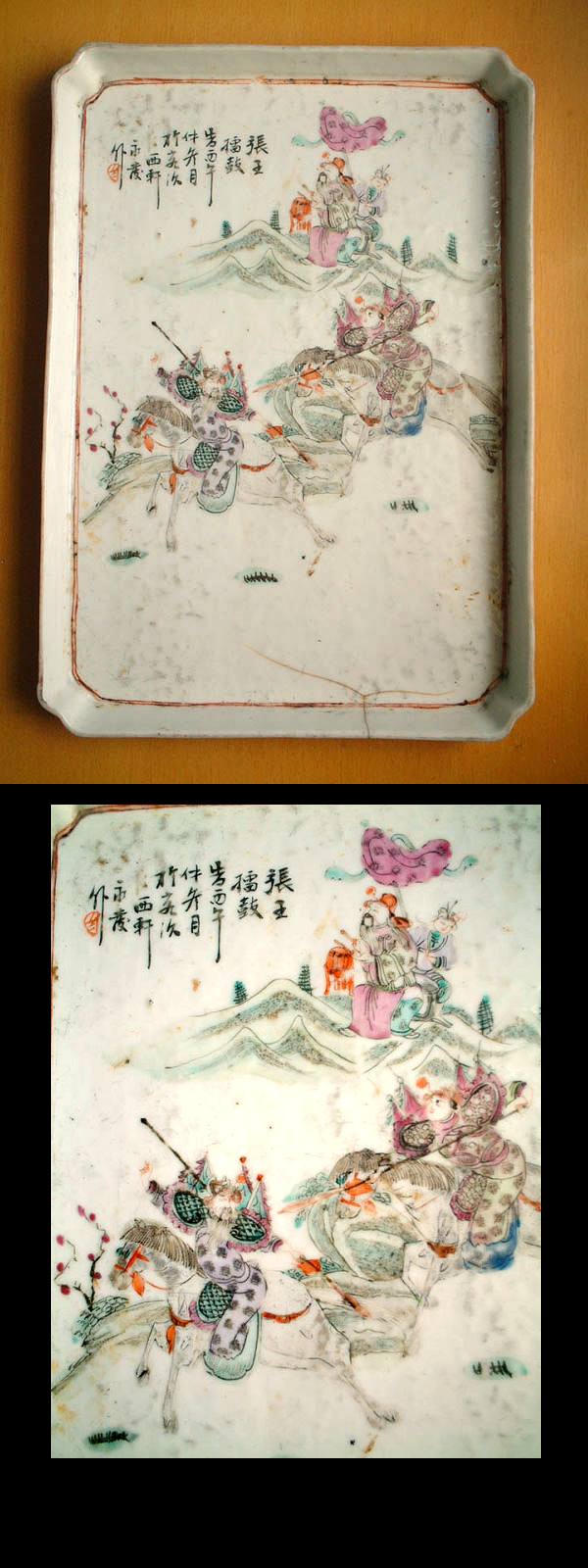 |
1104. Square dish with the year Wu Nian, 1906, in the inscription. No mark. | 1906 | 1104 | Square dish | 410 | |||
| 1907 | Bowl | Da Qing Guangxu Nian Zhi | 411 | |||||
| 1907 | Cup | Guangxu Ding Wei (In the Jade sea hall) | 412 | |||||
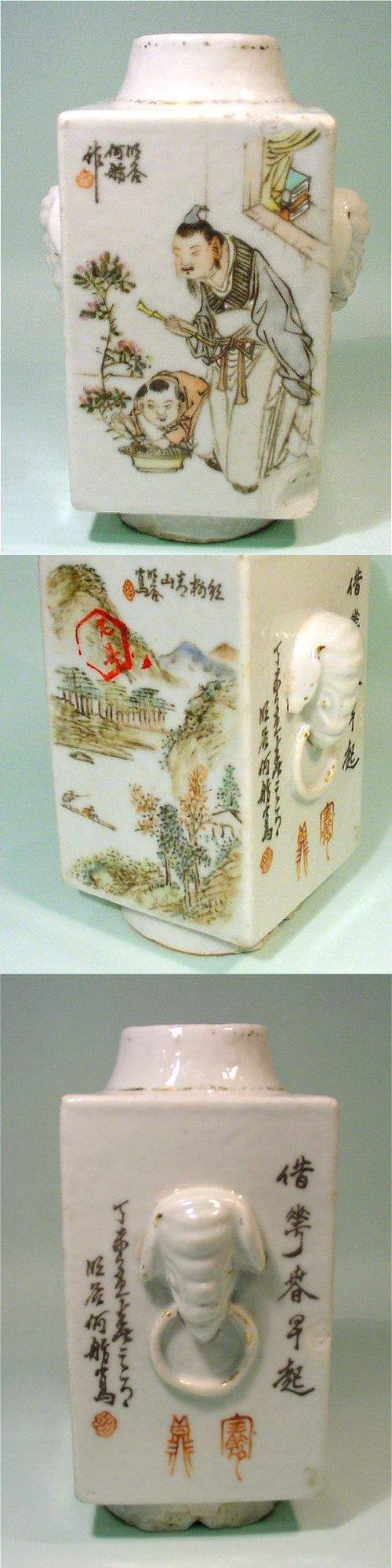 |
531. Vase, dated ding wei 1907. No mark. | 1907 | 531 | Square vase cong shaped | 413 | |||
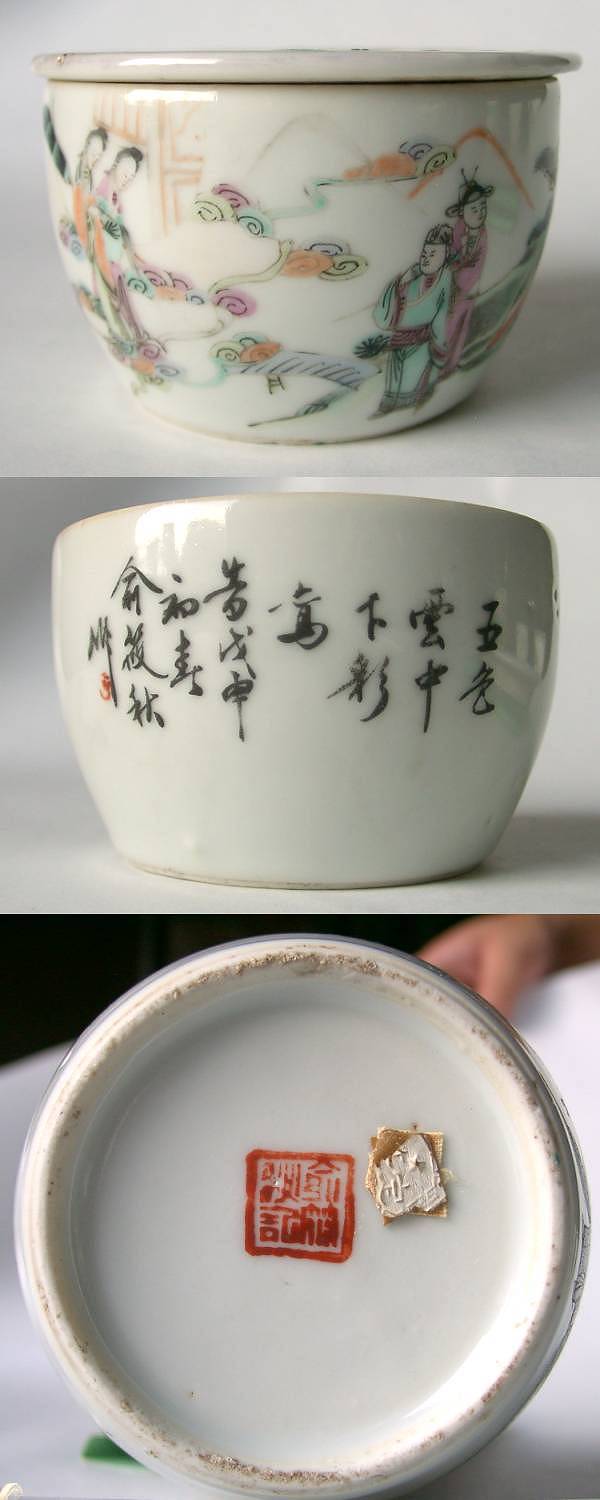 |
663. Hair's oil jar. Dated to the wu shen year, 1908. | 1908 | 663 | Hair's oil jar | (4 character red mark) | 414 | ||
| 1908 | Teapot | ??? Zao | 415 | |||||
| 1908 | hatstand | Guan Yao Nei Zao | 416 | |||||
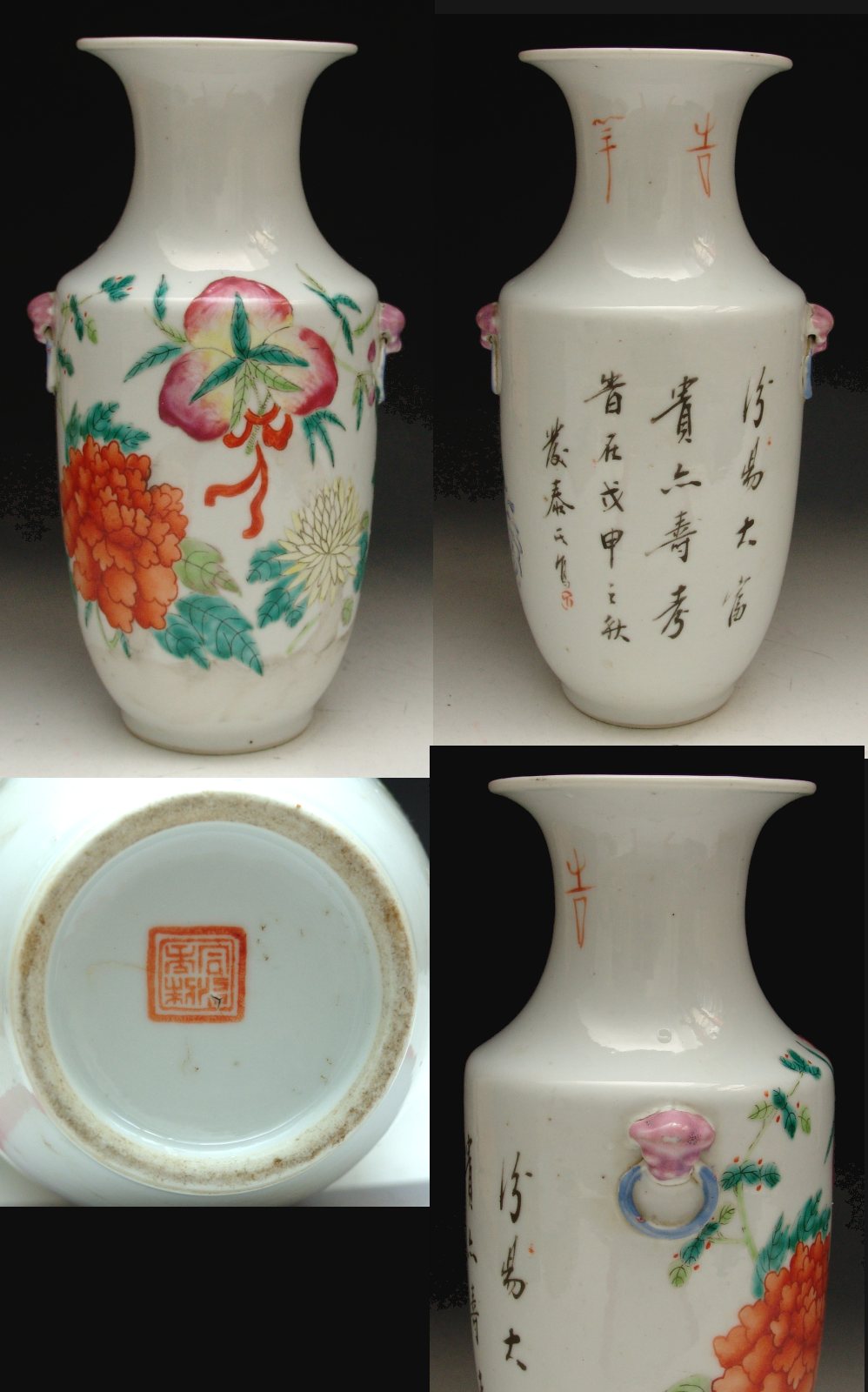 |
1109. Vase. Height 9"/22.6 cm. Dated to the wu shen year, 1908. On the base a square stamped four character mark; Tongxhi Nian Zhi | 1908 | 1109 | Vase | Tongzhi Nian Zhi | 417 | ||
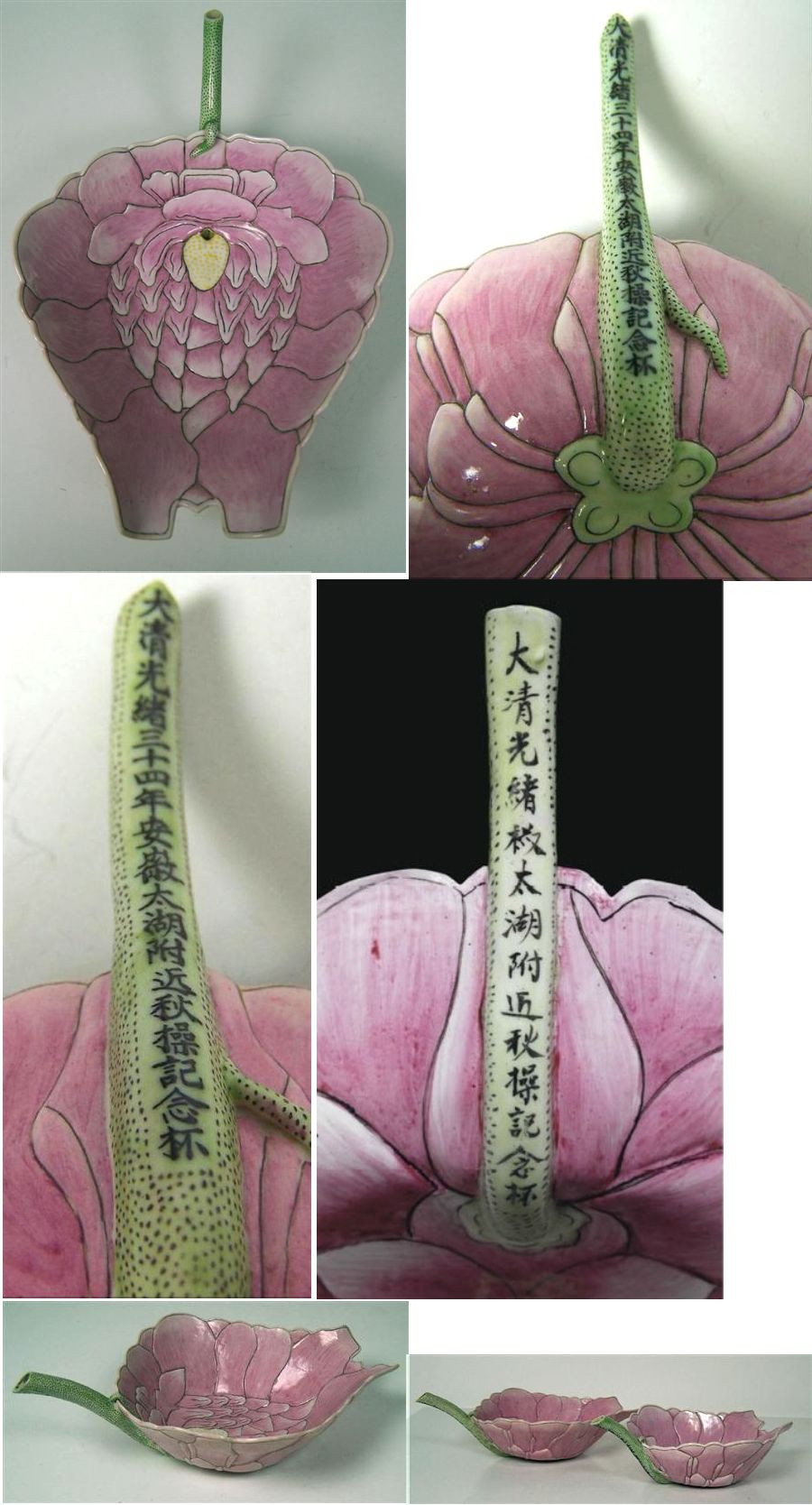 |
1423. Lotus shaped wine cup. Various inscriptions occurs including one that dates it to Guangxu 34th year or 1908. Another variation of the text was on a pair sold by Christie's New York in March 2011. They are inscribed, "Daqing Guangxu Jiaotaihu fujin qiucao jinian bei" (Cup commemorating the autumn military excercises held near Jiaotaihu during the Guangxu reign of the Great Qing) | 1908 | Water dropper | 418 | ||||
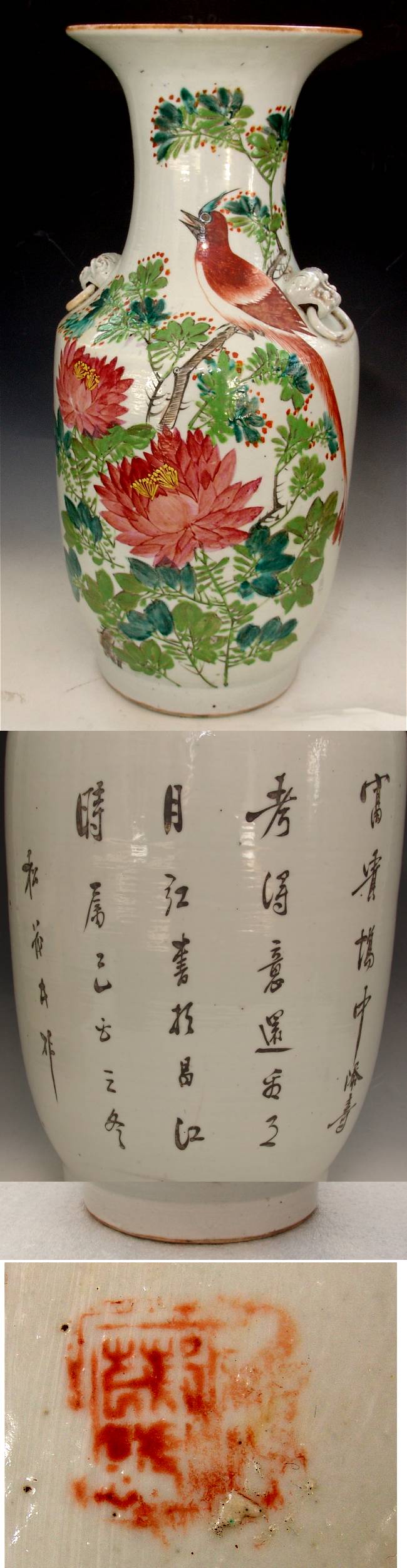 |
1130. Vase. Height 17.25 inches (44 cm). Dated in the inscription to the ji you year (1909). Iron red mark stamp under the base. | 1909 | 1130 | Vase | (illegible 4 character red mark) | 419 | ||
| 1909 | Vase | Red 4 character | 420 | |||||
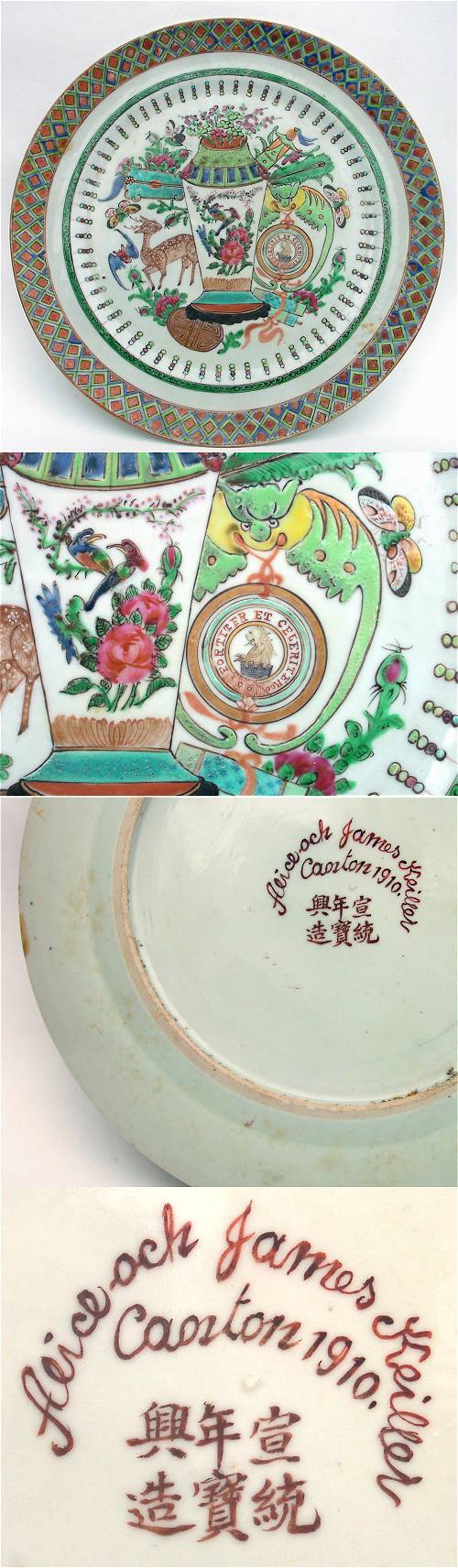 |
640. Alice och James Keiller Canton 1910 Fencai enamels. Dated 1910. | 1910 | 640 | Dish | Hongxian Nien ?? Zao | 421 | ||
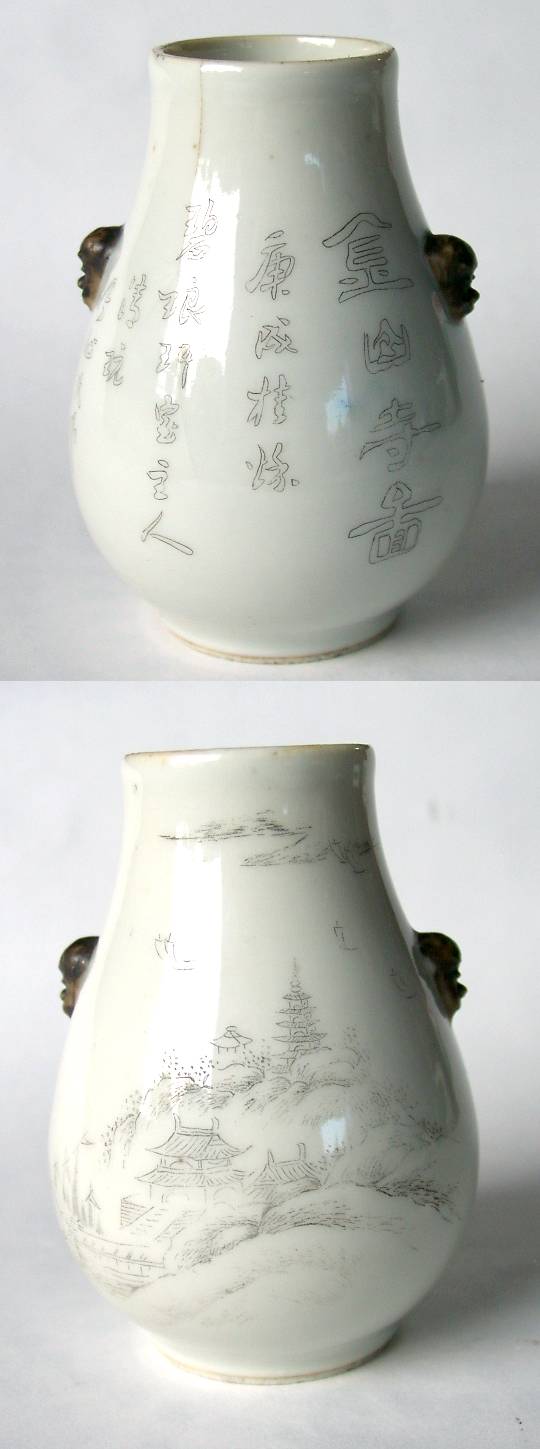 |
659. Vase with engraved decoration. Brown dressed dog's heads handles. Dated 1910. | 1910 | 659 | Vase | 422 | |||
 |
1320. Large dish. Dated to the geng xu year (1910) dong (winter). Diam 14 inches / 34.5 cm. No mark.
|
1910 | 1320 | Large dish | 423 | |||
| 1910 | Collar | 424 | ||||||
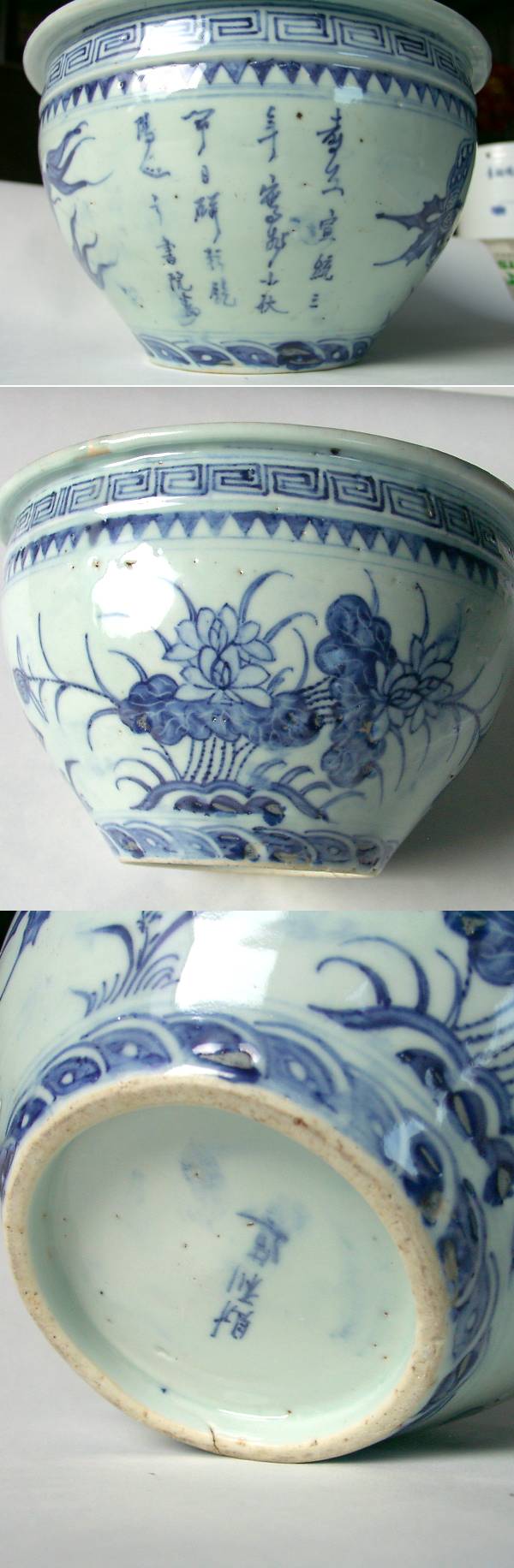 |
652. Blue and white flower pot. Dated to the xin hai year in the calligraphy (1911). | 1911 | 652 | Flower pot | 425 | |||
 |
1183. Large vase or hat stand. Dated in the calligraphy to the ren zi year meaning 1912. Illustrated as a comparison is a undated vase. marked with a stamped red 'Guangxu Nian Zhi' mark, which potting is a little thicker and have more evident rings on the inside of the foot rim. In my opinion the date is correct and the Guangxu mark is applied with a stamp to this vase 4 years after the Guangxu period has ended. | 1912 | 1183 | Vase | Guangxu Nian Zhi | 426 | ||
| 1912 | hatstand | Red 4 character | 427 | |||||
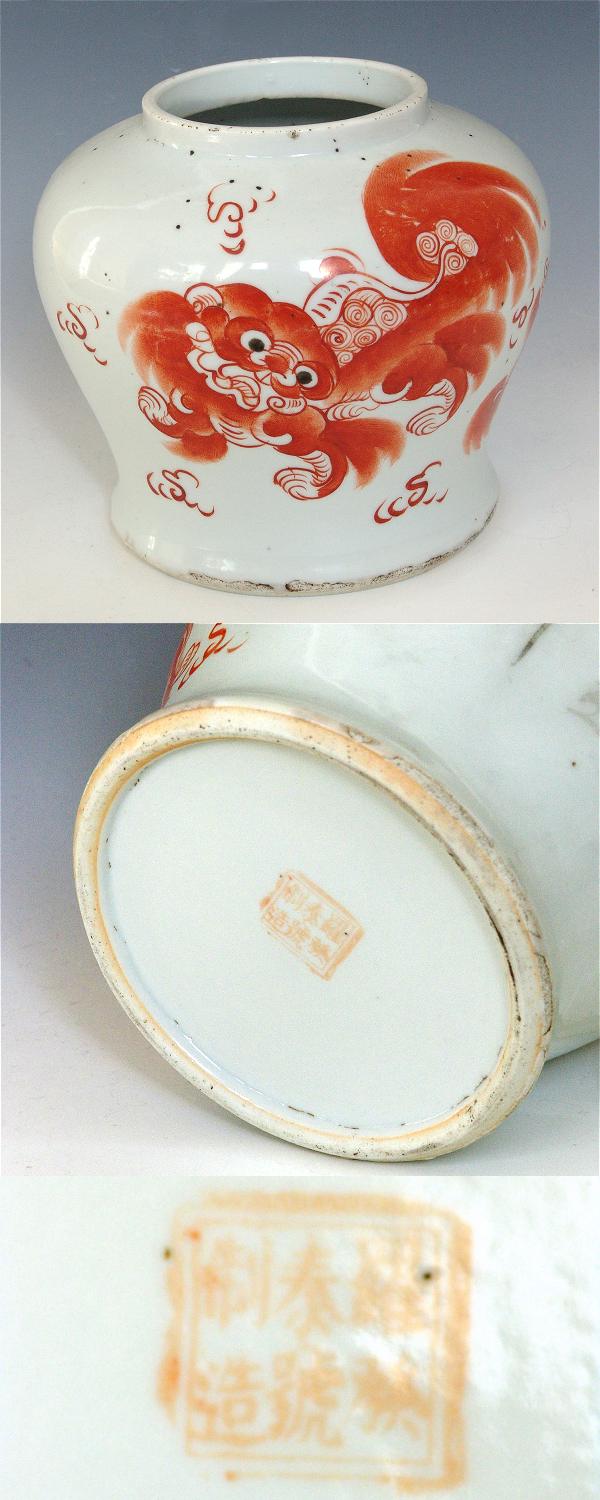 |
1028. Jar. Grayish calligraphi. Burnt red base and foot rim. Dated in the worn calligraphy to the ren zi year i.e. 1912. | 1912 | 1028 | Bulbous vase | Red 6 Characters mark | 428 | ||
 |
654. Lidded food bowl. Soft colored enamels. Grayish calligraphi. Burnt red base and foot rim. Dated 1912. | 1912 | 654 | Congee pot | 429 | |||
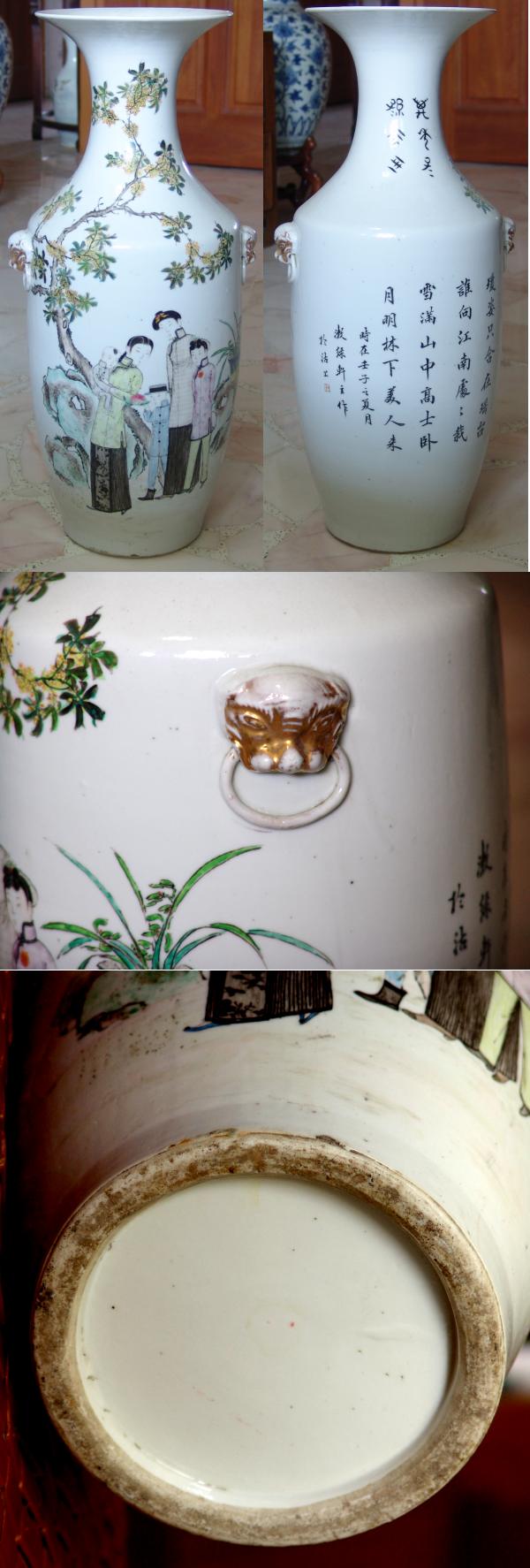 |
1020. Large vase. No base mark. Dated in the calligraphy to the ren zi year meaning 1912. | 1912 | 1020 | Large vase | 430 | |||
| 1913 | Bowl | ?? Bamboo House ? | 431 | |||||
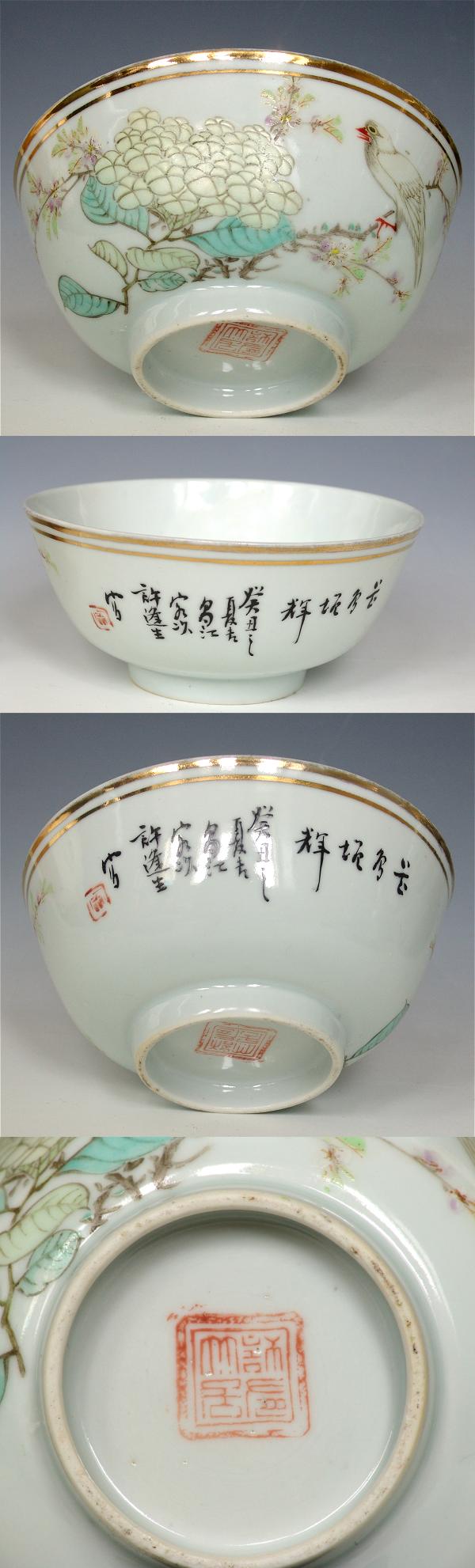 |
1007. Bowl decorated with enamels and gilt. Red base seal mark. Dated in the calligraphy to the 'gui chou' year (1913). | 1913 | 1007 | Bowl | Red 4 character | 432 | ||
| 1913 | Teapot | Tongzhi Nian Zhi | 433 | |||||
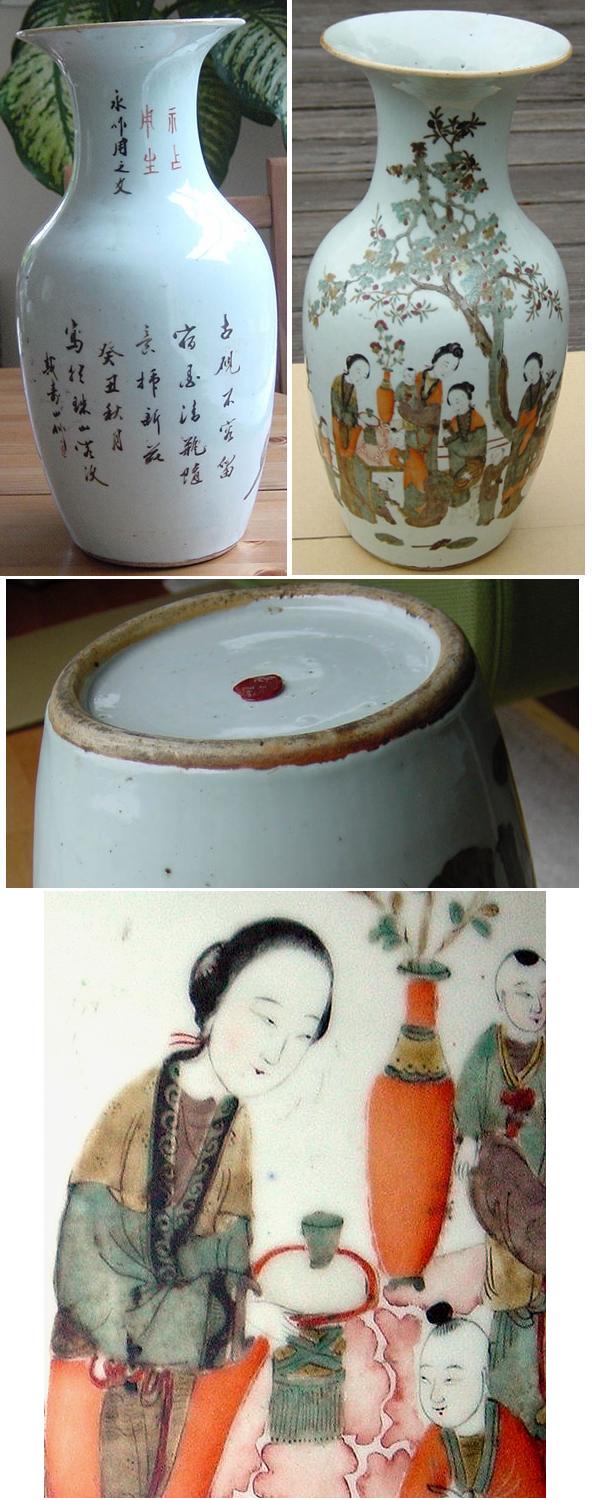 |
1011. Vase decorated with enamels and gilt. No base mark. Dated in the calligraphy to the gui chou year (1913). The poem is a duplet, i.e. made up of two sentences with seven words each, reading: " Gu yan bu rong liu su mo; Meaning The poem is identical with that on the vase #1014. |
1913 | 1011 | Vase | 434 | |||
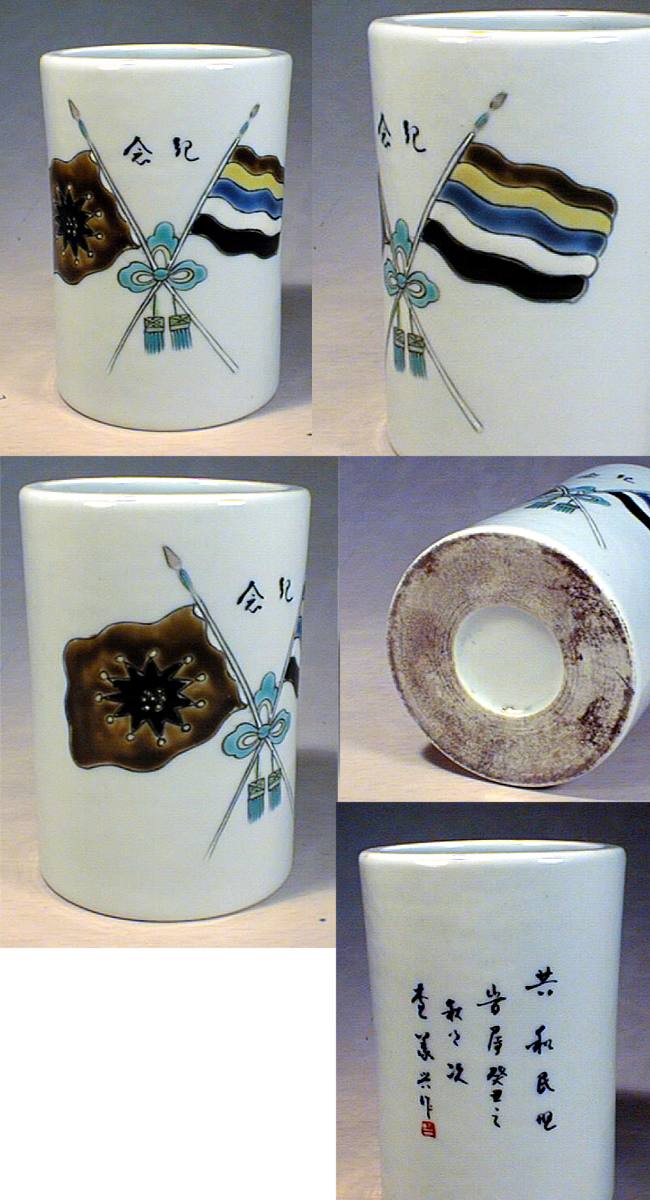 |
1053. Republic of China Anniversary Brush Holder. A Famille rose Brush pot special made for Republic of China’s 2nd year Anniversary, dated year gui chou corresponding to 1913. | 1913 | 1053 | Brush pot | 435 | |||
| 1913 | Vase | 436 | ||||||
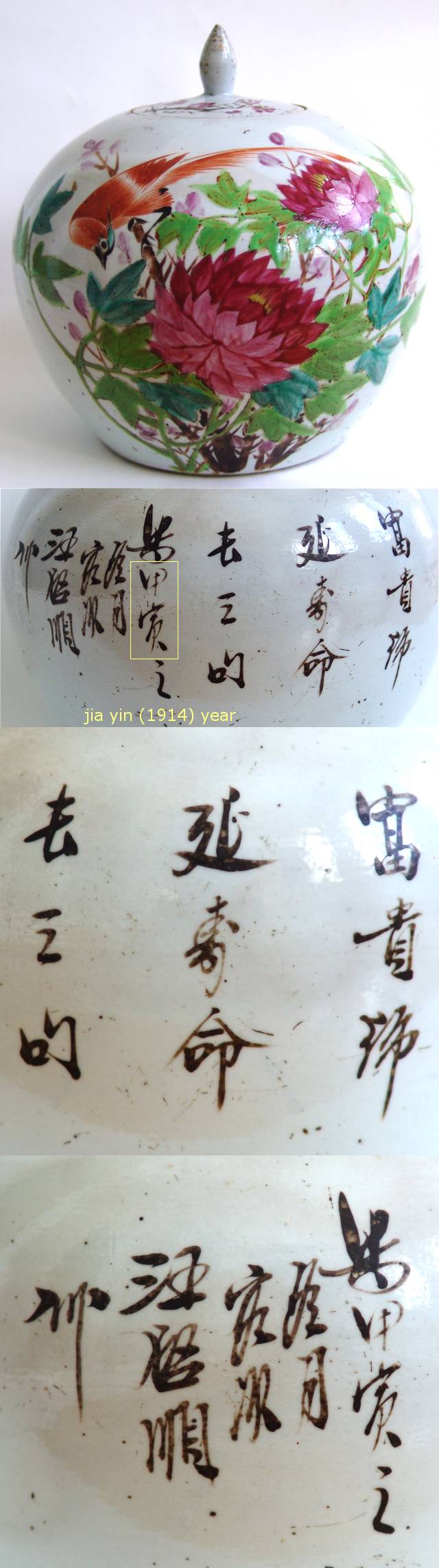 |
1227. Lidded jar. Dated in the inscription to the jia yin year (1914). No mark.
|
1914 | 1227 | 437 | ||||
| 1915 | Teapot | Red 4 character | 438 | |||||
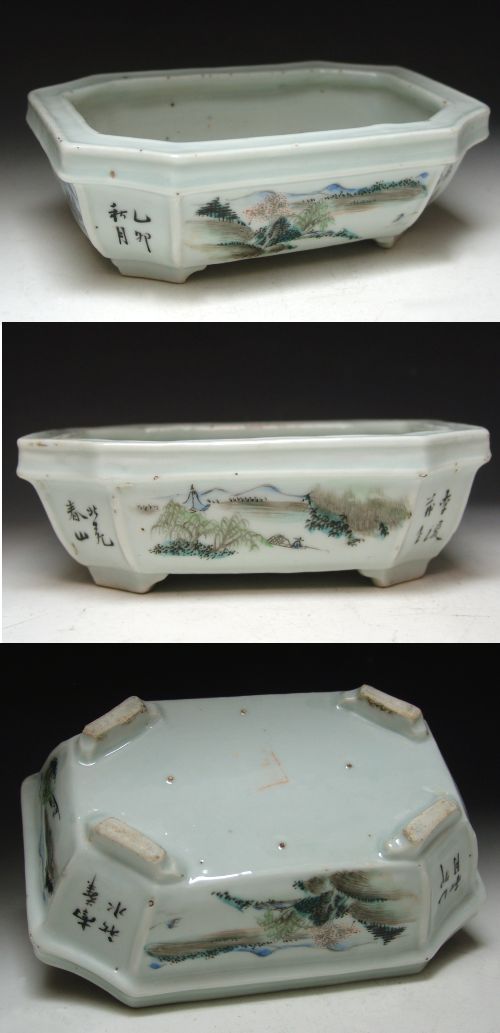 |
1178. Narcissus bowl. Dated in the inscription to the yi mao year (1915). No base mark at all.
|
1915 | 1178 | Low six sided bowl | 440 | |||
| 1916 | Â - - - | Da Qing Kangxi | 441 | |||||
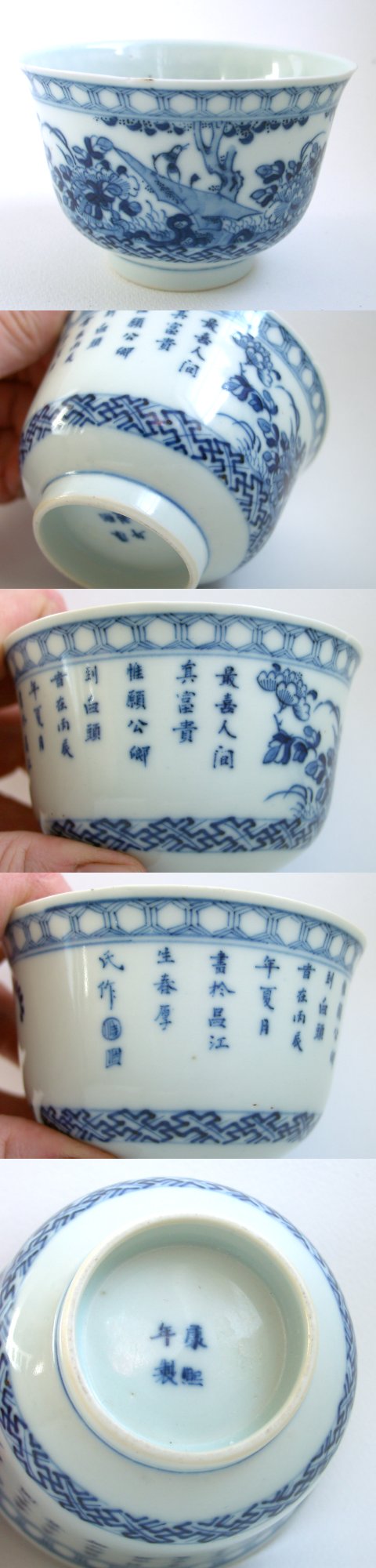 |
774. Small soup bowl. Dated in the inscription as of "1916", Kangxi Nian Zhi mark, very blurred mark. "Hollow line" in the decoration.
|
1916 | 774 | Cup | Kangxi Nian Zhi | 442 | ||
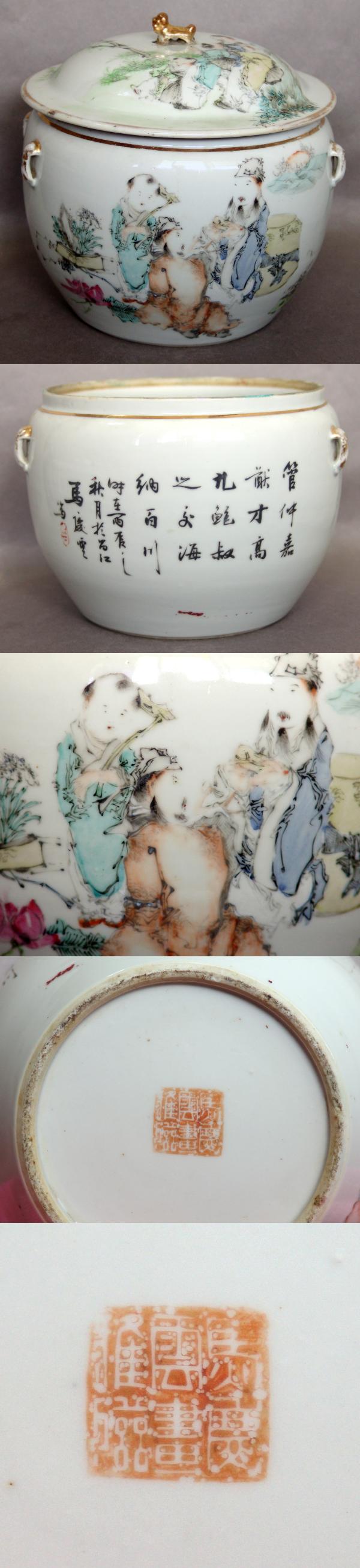 |
1022. Lidded 'Kamcheng' soup bowl. Height with lid 18 cm, diam 19 cm. Dated in the inscription to the bing chen year, meaning "1916". Base mark Ma Qing Yun Hua Ya Chi. | 1916 | 1022 | Kamcheng | Ma Qing Yun Hua Ya Chi | 443 | ||
 |
656. Coffe jug. Dated in the inscription as of "1916", Stamped, very blurred mark. | 1916 | 656 | Coffee pot | Red 4 character | 444 | ||
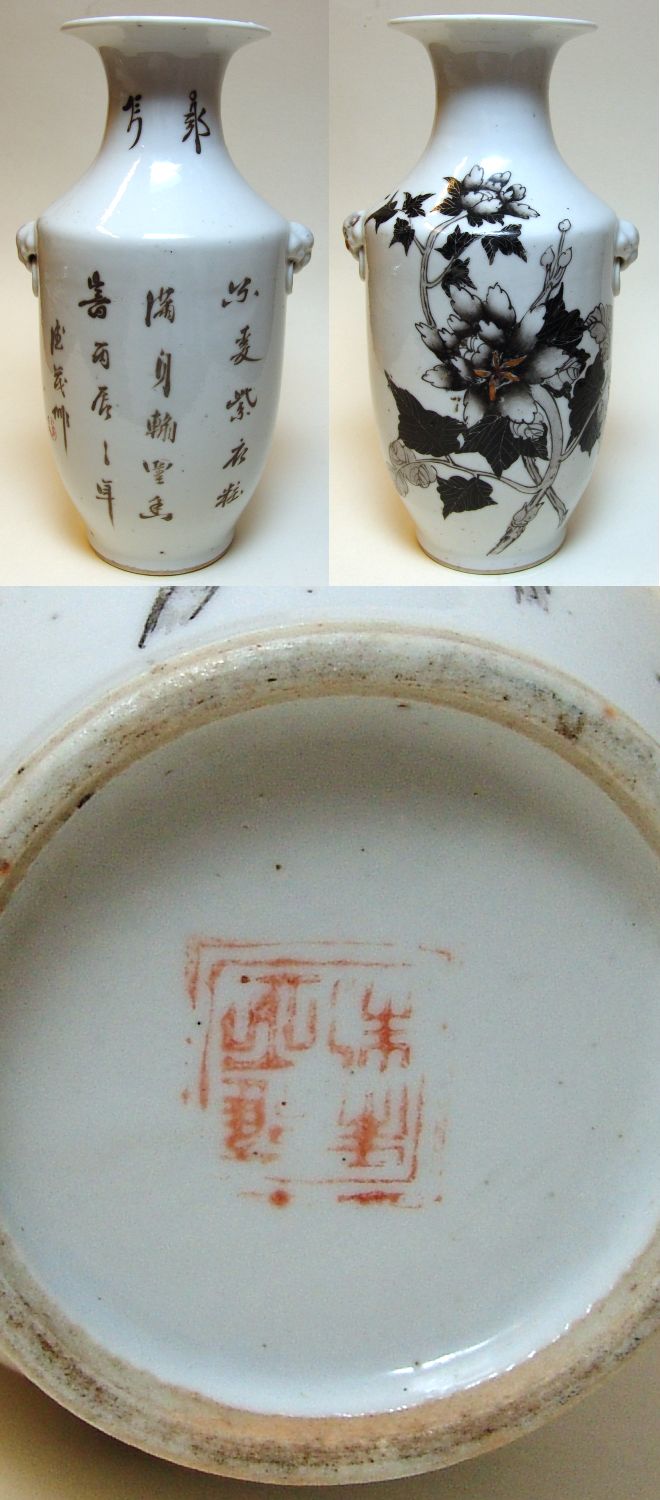 |
1171. Vase. Dated in the inscription to the bing chen year, meaning "1916".
|
1916 | 1171 | Vase | Red 4 character | 445 | ||
| 1916 | Vase | Red 4 character | 446 | |||||
| 1916 | hatstand | Red 4 character | 447 | |||||
| 1916 | Plate | Red 4 character | 448 | |||||
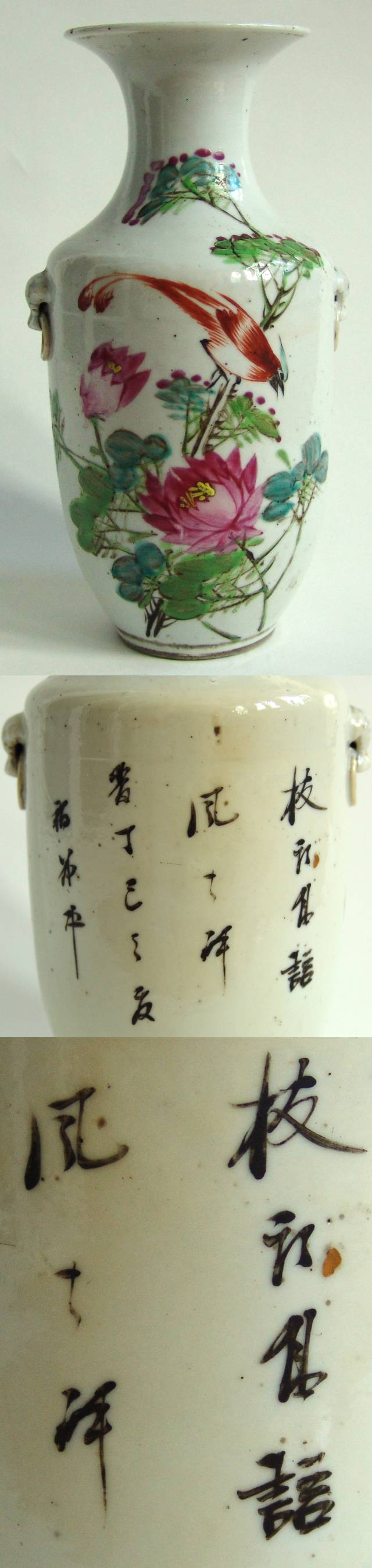 |
1226. Vase. Height 22 cm / 8.75 inches. Marked with a faint square red large, illegible mark. Dated in the inscription to the ding si year (1917).
|
1917 | 1226 | Vase | Ilegible 4 character mark | 449 | ||
| 1917 | Plate | Red 6 characters | 450 | |||||
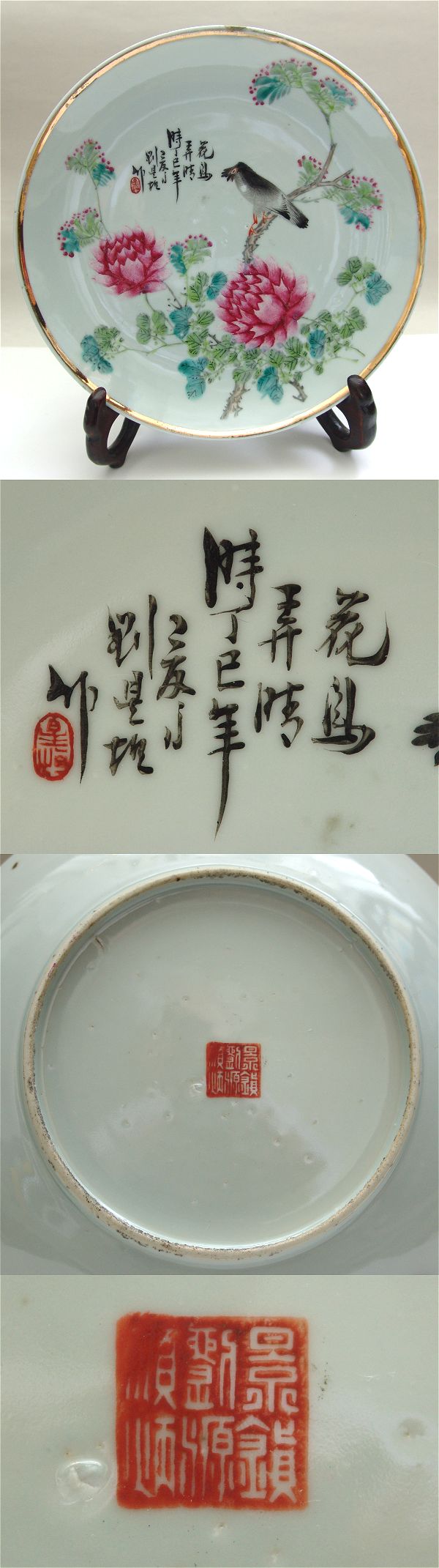 |
1208. Plate. Dated in the inscription to the ding si year (1917). | 1917 | 1208 | Plate | Six character reversed mark | 451 | ||
 |
530. Dated in the inscription to the ding si year (1917), no mark. | 1917 | 530 | Bowl | 452 | |||
 |
658. Square miniature vase. Clear black outlines and calligraphy. Blurred gold. Dated in the inscription to the ding si year (1917). No base mark. | 1917 | 658 | Four sided vase | 453 | |||
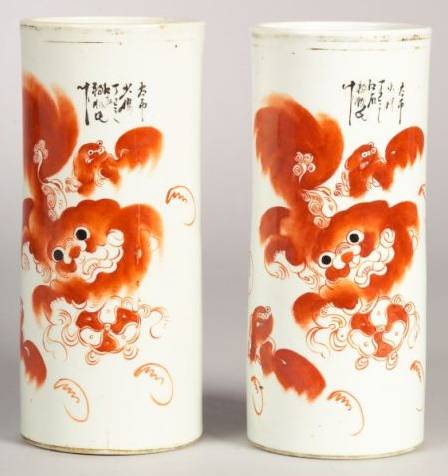 |
1151. Hat stand / vase with fu dog decoration. Dated in the inscription to the ding si year (1917).
|
1917 | 1151 | Vase | 454 | |||
| 1918 | hatstand | Bing Rong Sheng Zao | 455 | |||||
| 1918 | Bowl | Made by Jdz Porceain Co | 456 | |||||
| 1918 | Cup | Red 4 character | 457 | |||||
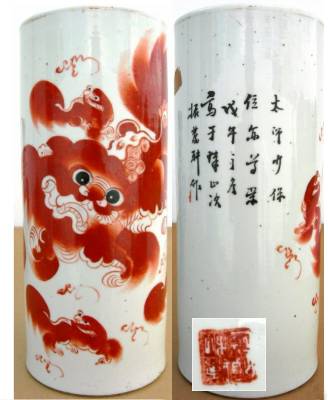 |
1131. Hat stand / vase. Square base mark in red enamel. Dated in the inscription to the wu wu year (1919). | 1918 | 1131 | Vase | 458 | |||
| 1918 | Teapot | 459 | ||||||
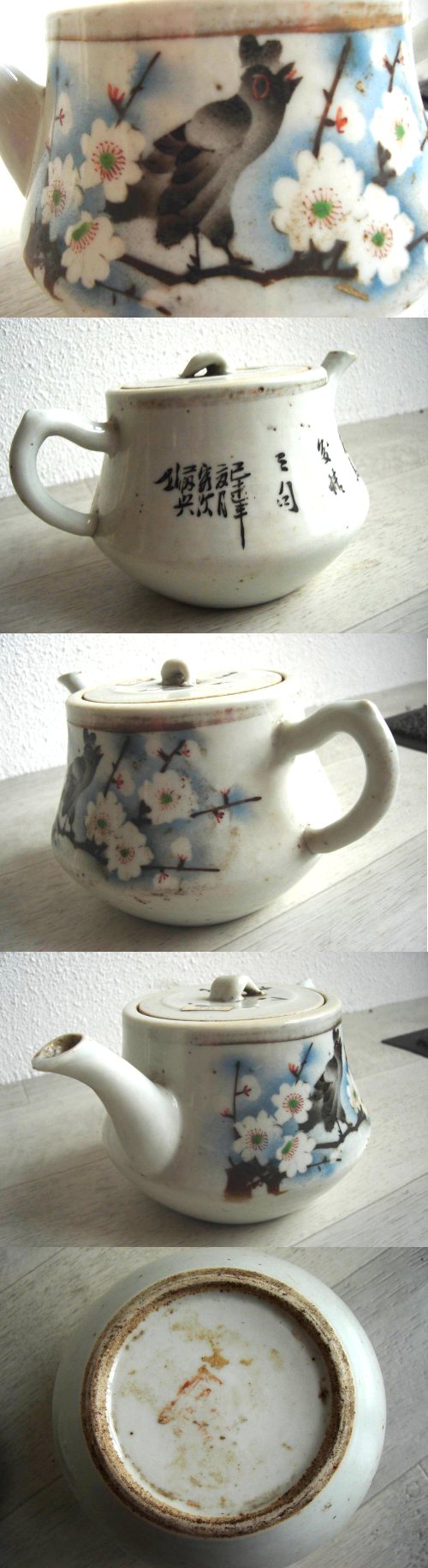 |
1110. Teapot. Illegible stamped iron red mark. Dated in the inscription to the ji wei year, meaning 1919.
|
1919 | 1110 | Tea pot | Illegible red 4 character mark | 460 | ||
| 1919 | Kamcheng | Jing Zhen ??? Zao | 461 | |||||
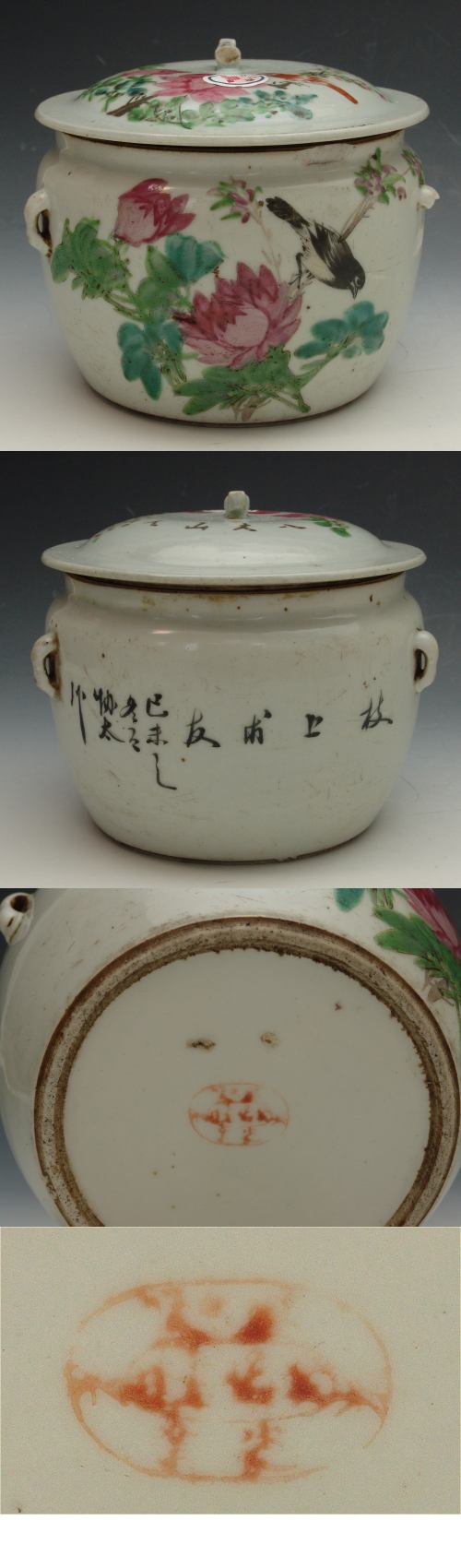 |
1099. Lidded bowl. Illegible stamped iron red mark. Dated in the inscription to the ji wei year, meaning 1919. | 1919 | 1099 | Kamcheng | Oval illegible red mark | 462 | ||
| 1919 | Jar | Red 4 character | 463 | |||||
| 1919 | hatstand | Red 4 character | 464 | |||||
| 1919 | Plaque | Tongzhi Nian Zhi | 465 | |||||
 |
662. Hair's oil jar. Dated 1919. | 1919 | 662 | Hair's oil jar | 466 | |||
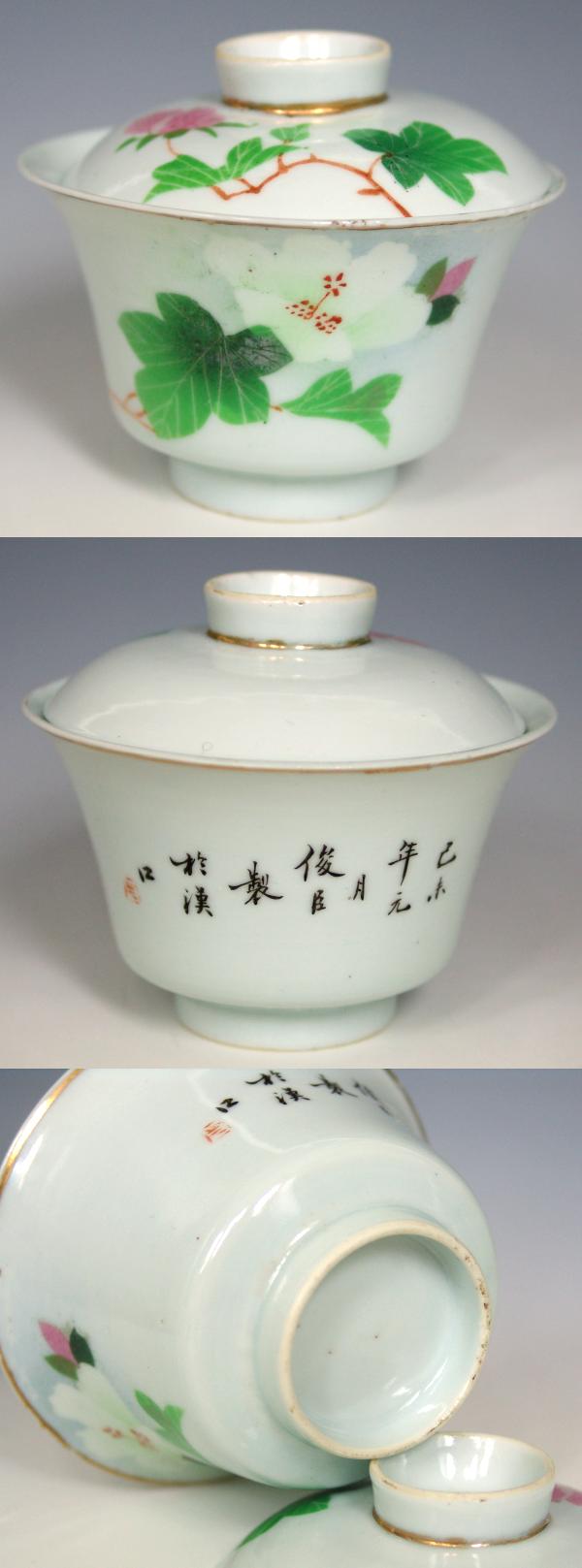 |
1027. Lidded bowl. Dated in the inscription to the ji wei year, meaning 1919.
|
1919 | 1027 | Gaiwan | 467 | |||
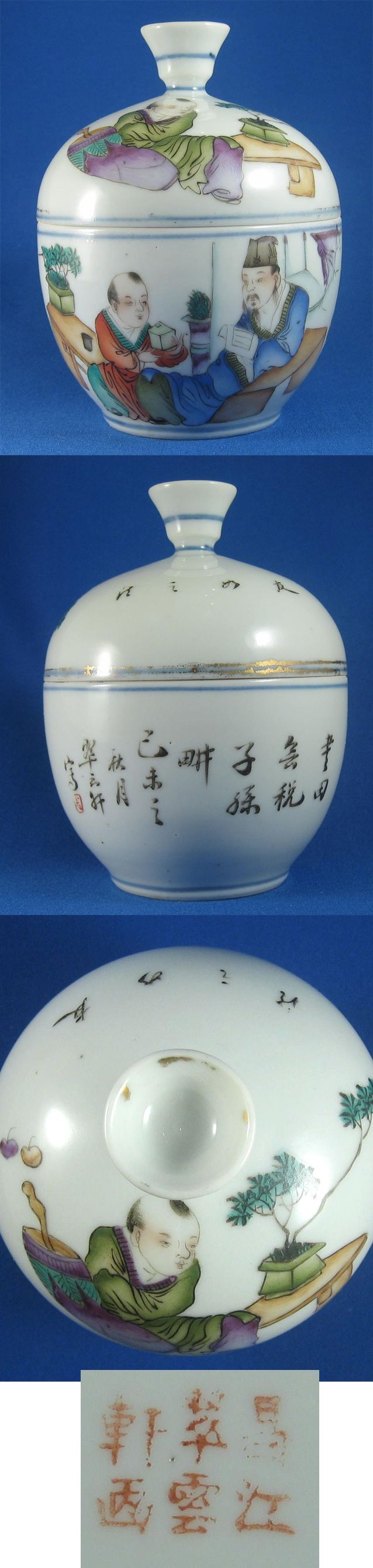 |
1422. Lidded bowl. Stamped iron red mark reads Chang Jiang Cui Yun Xuan Hua (Drawn in the "Green Cloud Balcony" of Chang Jiang). Poem interpretated as "The field of books carries no tax, let our descendants exploit its benefits." Dated in the inscription to the ji wei year (1919). | 1919 | Chupu | 468 | ||||
| 1920 | Cups | Liu Long Xing Zao | 469 | |||||
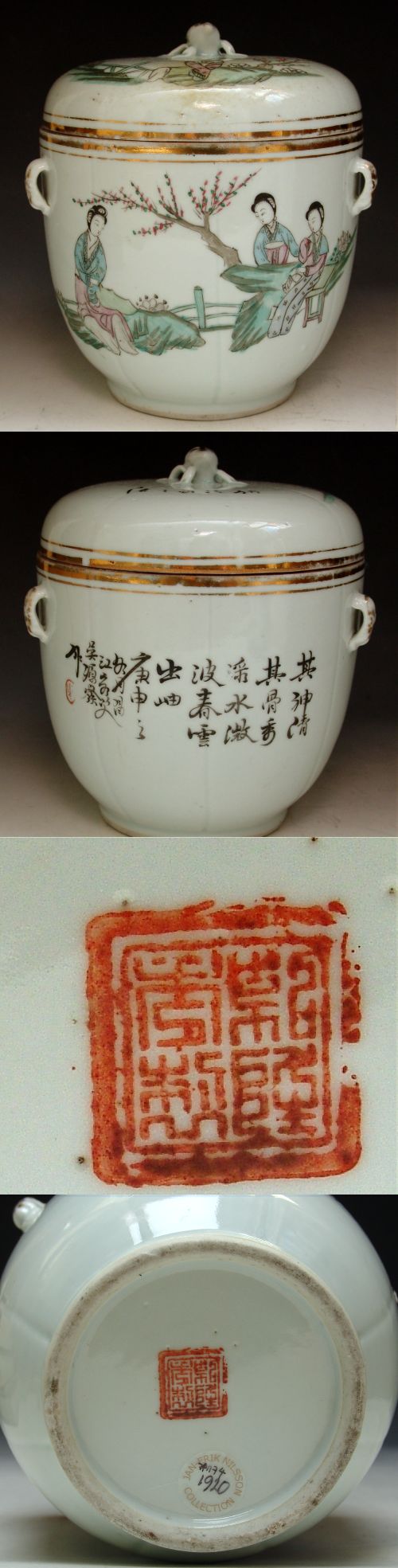 |
1174. Lidded bowl, dated in the inscription to geng shen year (1920). Red stamped seal mark Qianlong Nian Zhi on the base.
|
1920 | 1174 | Lidded pot | Qianlong Nian Zhi | 470 | ||
| 1920 | Kamcheng | Red 4 character | 471 | |||||
 |
51. Dated in the inscription as of "1920", no mark. | 1920 | 51 | Vase | 472 | |||
 |
655. Vase. Republic era clothes. Dated in the inscription as of "1920", no mark. | 1920 | 655 | Vase | 473 | |||
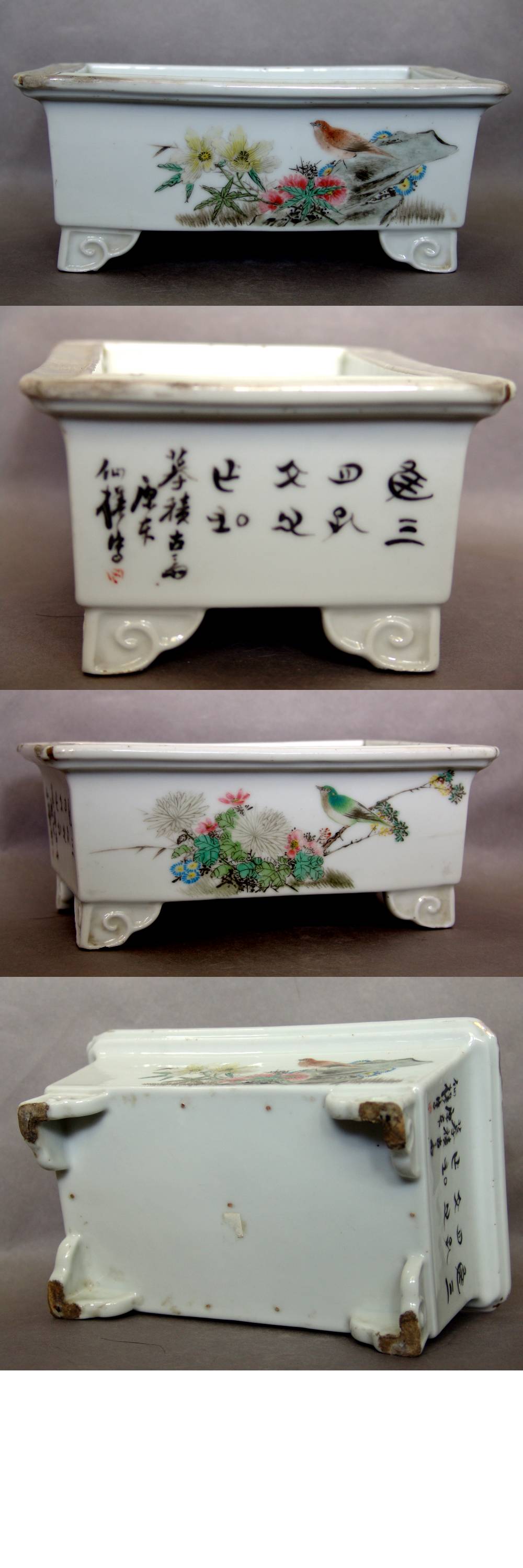 |
989. Narcissus bowl, dated in the inscription to 1920, no mark. | 1920 | 989 | Square low pot | 474 | |||
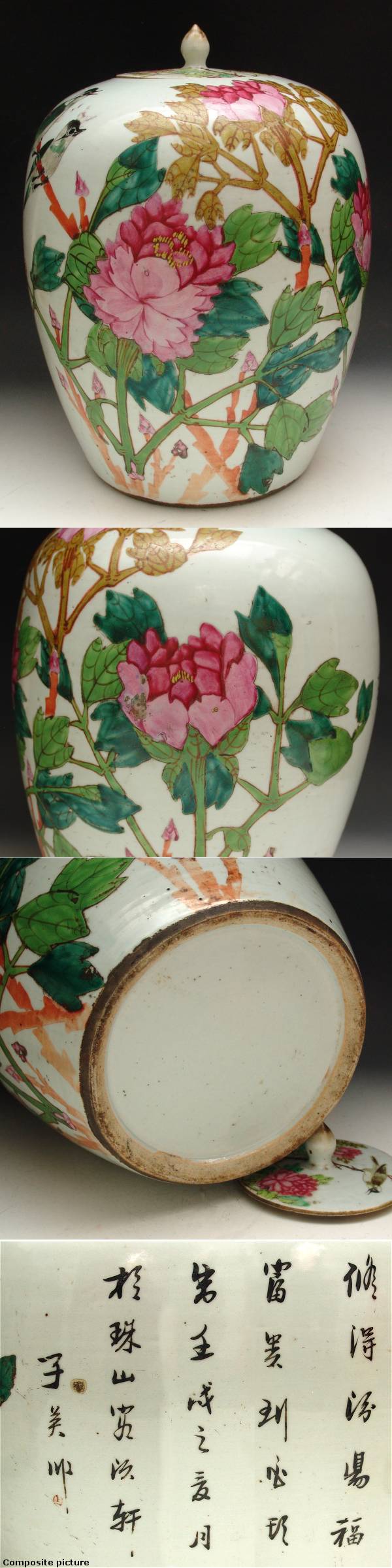 |
1122. Lidded jar. No base mark. Height 12" (30 cm). Dated in the inscription to the ren xu year (1922).
|
1922 | 1122 | Lidded jar | 475 | |||
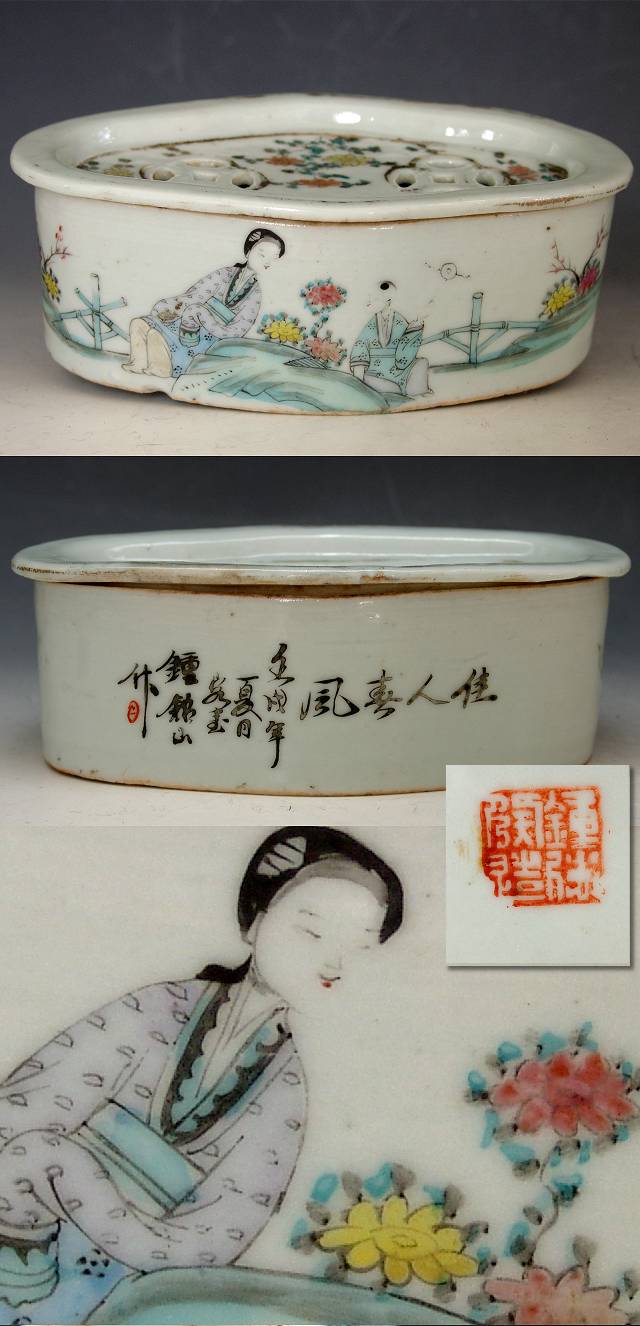 |
1146. Soap box with pierced lid. Length 4.75" (12 cm). Dated in the inscription to the ren xu year (1922).
|
1922 | 1146 | Soap box | 476 | |||
 |
1165. Lidded bowl with ring handles. Length 4.75" (12 cm). Dated in the inscription to the ren xu year (1922).
|
1922 | 1165 | Lidded bowl | 477 | |||
| 1922 | Jar | 478 | ||||||
| 1923 | Cabaret | Jiangxi Ciye Gongsi | 479 | |||||
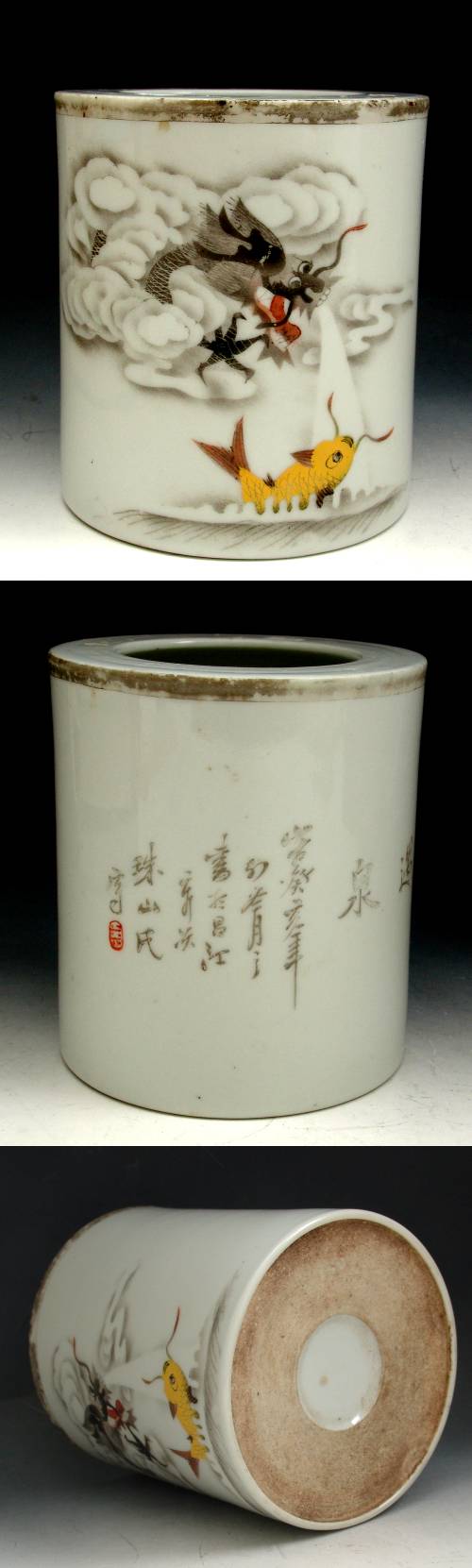 |
1149. Brush pot with "Schcolars graduation decoration" (fish and dragon). No base mark. Height 5" (12.5 cm). Dated in the inscription to the ren hai year (1923).
|
1923 | 1149 | Brush holder | 480 | |||
 |
1123. Large vase. Height 22.5". Iron red mark stamped on the base " ... Zhen Pin" meaning " ... Precious Product". Dated in the inscription to the jia zi year, meaning "1924". | 1924 | 1123 | Large vase | X X Zhen Pin | 481 | ||
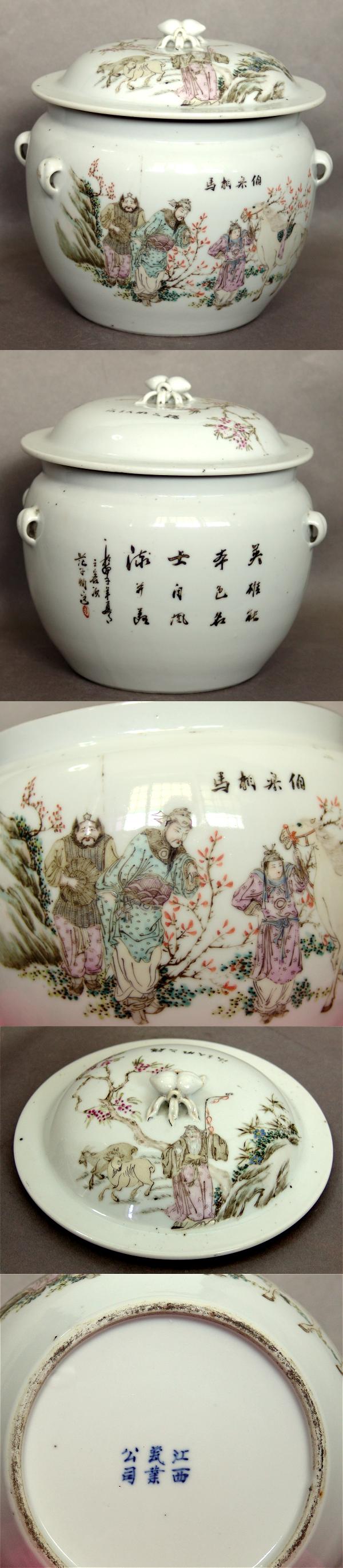 |
1023. Lidded 'Kamcheng' soup bowl. Height with lid 18 cm, diam 19 cm. Underglaze blue mark on the base: Jiangxi Ciye Gongsi (Jiangxi Procelain company). Dated in the decorative inscription to the jia zi year, meaning "1924". | 1924 | 1023 | Kamcheng | Jiangxi Ciye Gongsi | 482 | ||
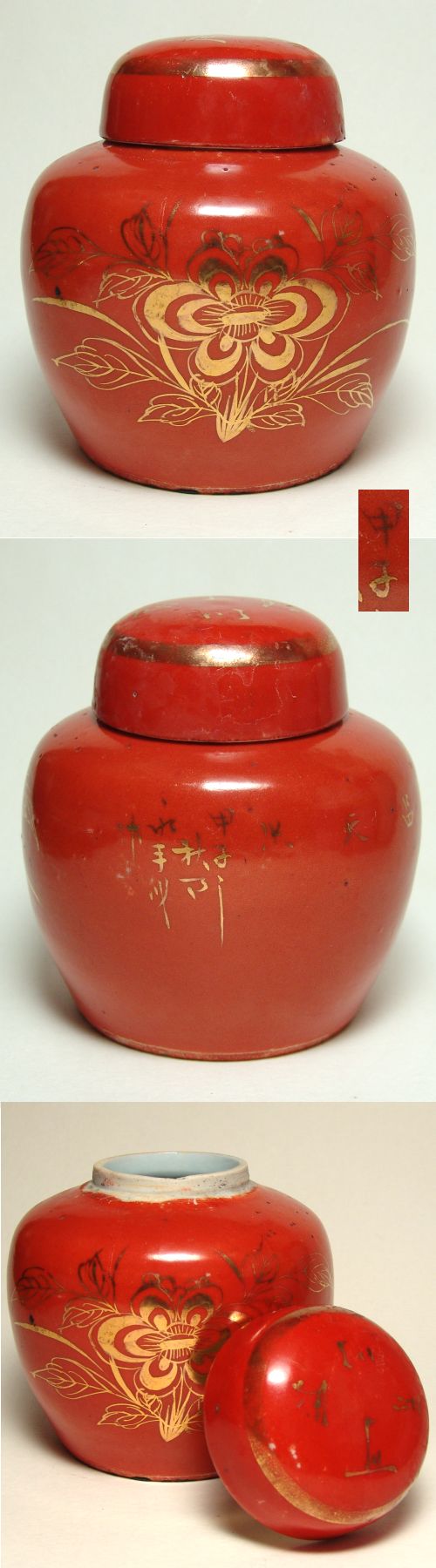 |
1172. Ginger jar, with the Chinese cyclical date jia zi in the inscription, meaning 1924.
|
1924 | 1172 | Ginger jar | 483 | |||
| 1924 | Jar | 484 | ||||||
 |
1128. Hat stand or Vase. Red stamped illeglible base mark. Inscription with a cyclic date Yi chou (1925) zhi (year) Dong (winter) yue (month). | 1925 | 1128 | Vase | Illegible red 4 character mark | 485 | ||
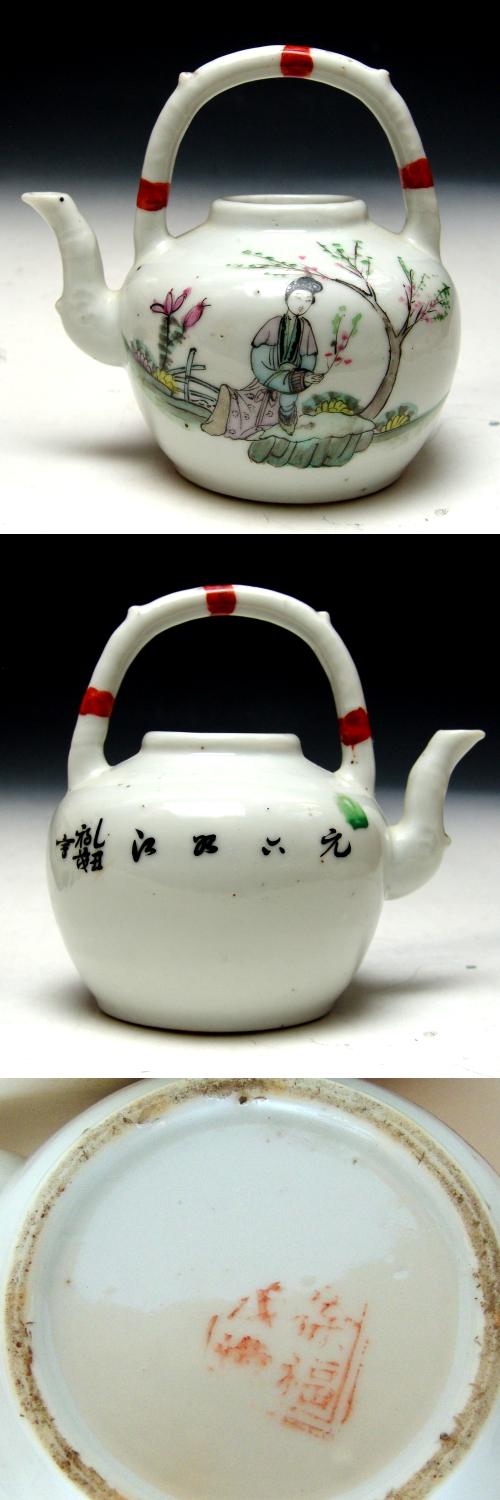 |
1168. Small teapot with upright standing handle. Height 4" (10 cm). Four character iron red stamped mark on the base. Dated in the calligraphy to the yi chou year (1925).
|
1925 | 1168 | Tea pot | Illegible red 4 character mark | 486 | ||
 |
Yu Yuanchang | 1118. Large Kamcheng missing its lid. Height 5 7/8" (15 cm), Width 8 1/4" (21 cm). Six character iron red stamped mark on the base, Jiangxi Yu Yuan Chang Zuo where Jiangxi is the province where most of the Chinese porcelain industry is located, Yu is a name meaning 'gold', Yuan is a name, meaning 'first' or 'primary', Chang, is a name, meaning 'prosperous' and zuo meaning 'workshop'. The base mark which thus could be translated as Jiangxi (province) 'Yu Yuan Chang' (name) Workshop is noticeable a little bit smaller than expected in a way similar to that of the #1112 (1929). Tentative dated in the calligraphy to the yi chou year (1925).
|
1925 | 1118 | Kamcheng | Jiangxi Yu Yuanchang Zuo | 487 | |
| 1925 | Vase | Qianlong Nian Zhi | 488 | |||||
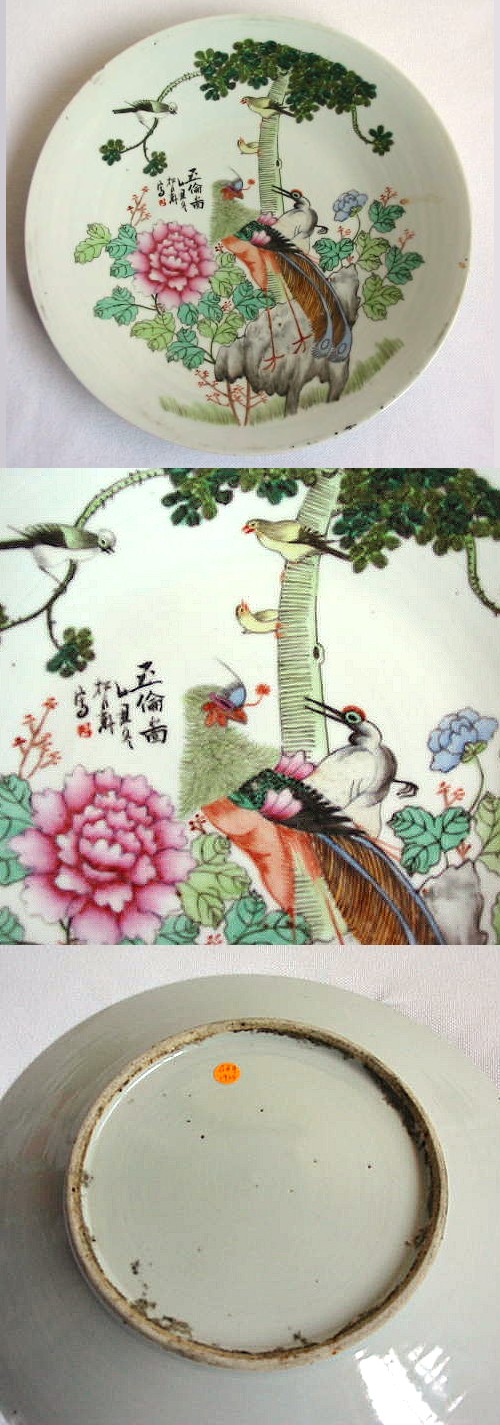 |
628. Wu Lun Tu ("Five Relations" motif). Dated in the inscription as Yi Chou Nian i.e. "1925", no mark. | 1925 | 628 | Dish | 489 | |||
| 1925 | Plaque | 490 | ||||||
| 1925 | Cup | 491 | ||||||
| 1925 | Pot | 492 | ||||||
| 1926 | Cups | CHINA in oval | 493 | |||||
| 1926 | Jars | Jiangxi Ciye Gongsi | 494 | |||||
| 1926 | Dish | Jiangxi Ciye Gongsi | 495 | |||||
| 1926 | Vase | Red 7 characters in oval | 496 | |||||
| 1926 | Vase | Yu Hong Yin Zhi | 497 | |||||
| 1928 | Tea cups | 498 | ||||||
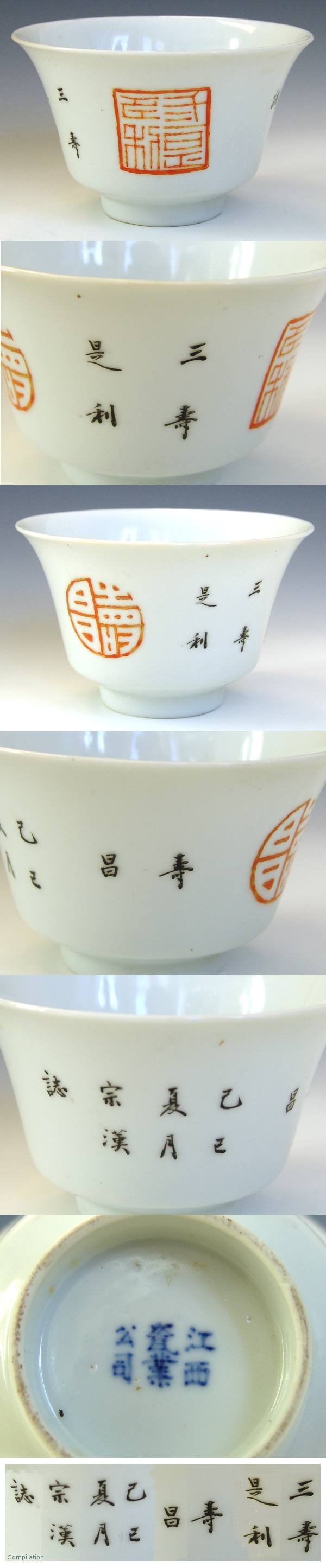 |
828. Bowl. Underglaze blue mark on the base: Jiangxi Ciye Gongsi (Jiangxi Procelain company). Dated in the calligraphy to the year of ji ci (1929).
|
1929 | 828 | Bowl | Jiangxi Ciye Gongsi | 499 | ||
| 1929 | Bowl | Jiangxi Ciye Gongsi | 500 | |||||
| 1931 | Plate | Jiu Jiang Rong Hua Gongsi | 501 | |||||
| 1931 | Bowl | 502 | ||||||
| 1932 | Plaque | 503 | ||||||
| 1933 | Box | Jurentang zhi | 504 | |||||
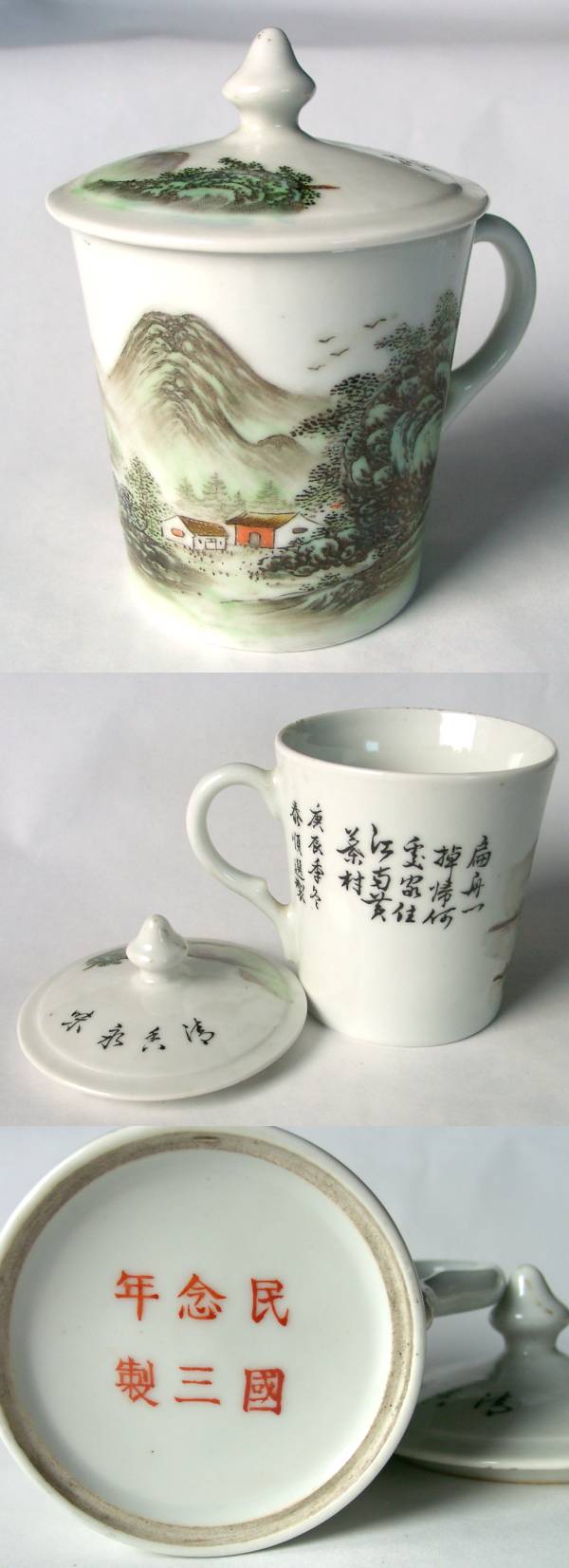 |
649. Covered tea mug with handle. Red base mark "Min Guo Nian San Nian Zhi" meaning "Chinese Republic twenty three year Make". The 23rd year is 1911+23=1934. Double foot rim. Soft enamels with a metallic sheen. Glossy black calligrahy. | 1934 | 649 | Covered mug | Min Guo Nian San Nian Zhi | 505 | ||
| 1934 | Bowl | Red 6 characters | 506 | |||||
| 1935 | Vase | 507 | ||||||
 |
631. Dated in the inscription to 1936. Mark: Made in China | 1936 | 631 | Dish | Made in China, in oval | 508 | ||
| 1936 | Vase | Red 3 characters | 509 | |||||
| 1937 | Bowl / Spoon | Hankow Mountain Precious vessel | 510 | |||||
| 1938 | Plaque | 511 | ||||||
 |
1050. Brush holder with figure. Mark Jiangxi Zhen Pin meaning "Jiangxi Precious Product". Dated '1943' in the inscription. | 1942 | 1050 | Brush holder | Jiangxi Zhen Ping | 512 | ||
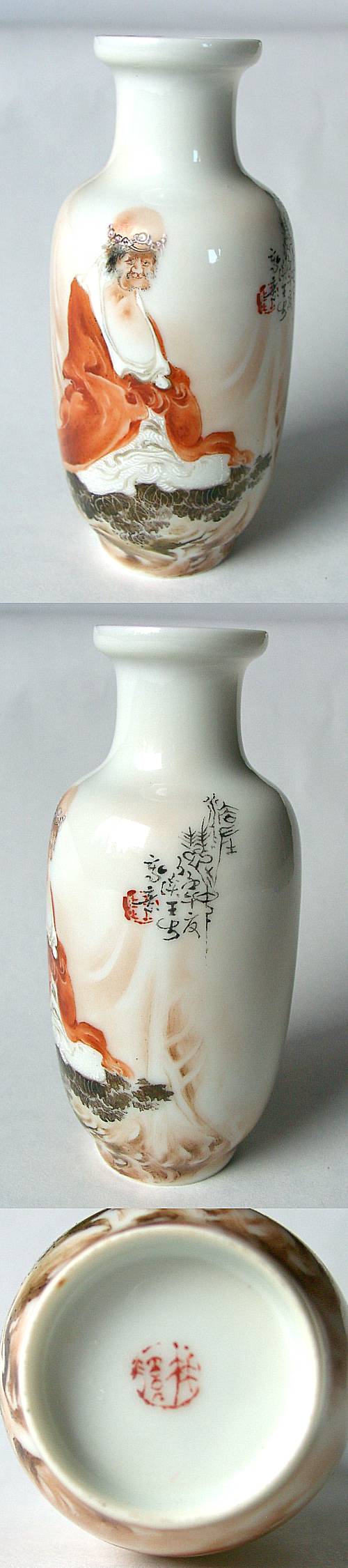 |
650. Vase with red figure, painted by one of the Eight Friends of Shushan. Dated 1942 in the inscription. | 1942 | 650 | Vase | 513 | |||
| 1946 | Vase | Da Qing Qianlong Nian Zhi | 514 | |||||
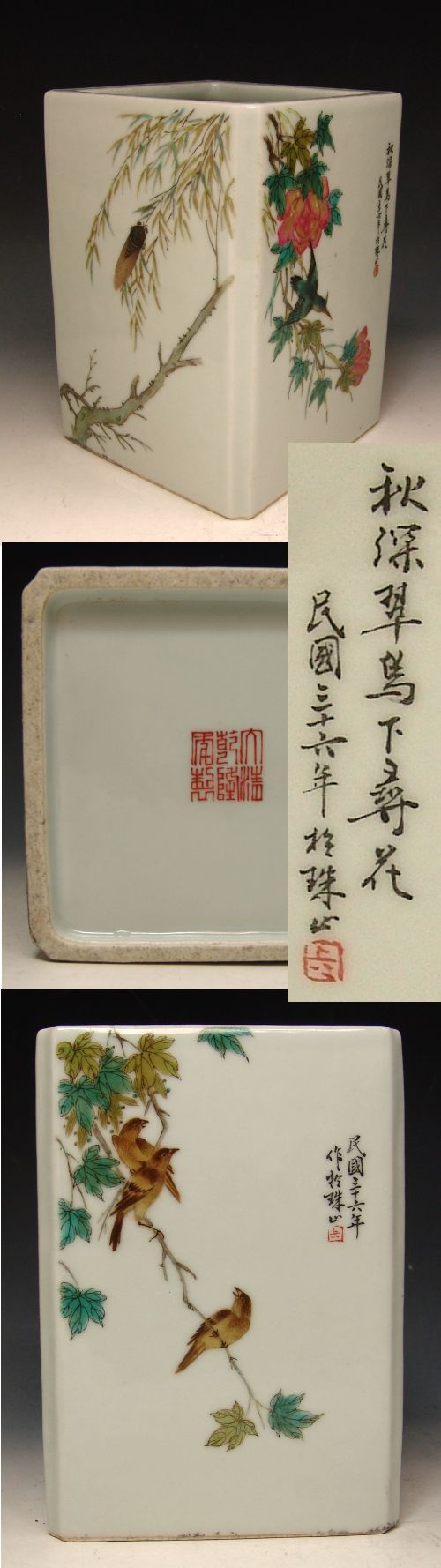 |
1169. Square brush pot. Hand written iron red base mark: Da Qing Qianlong Nian Zhi "Great Qing dynasty, Qianlong Period Make". Height 6 inches / 15.5 cm. The inscription reads qiu (autumn) shen (deep) cui (blue green/kingfisher) niao (bird) xia (descends) xun (seeking) hua (flowers); (xunhua also means 'seeking sex') minguo (Peples Republic) 36 nian (year) yu (at) Zhushan; Year corresponding to 1947. The painted red seal is meant to read shangpin (superior object). The other panel repeats the latter: made in 1947 at Zhushan. The entire poem could be translated: The blue green Kingfisher descends in his search for flowers in the late autumn
|
1947 | 1169 | Square brush holder | Da Qing Qianlong Nian Zhi | 515 | ||
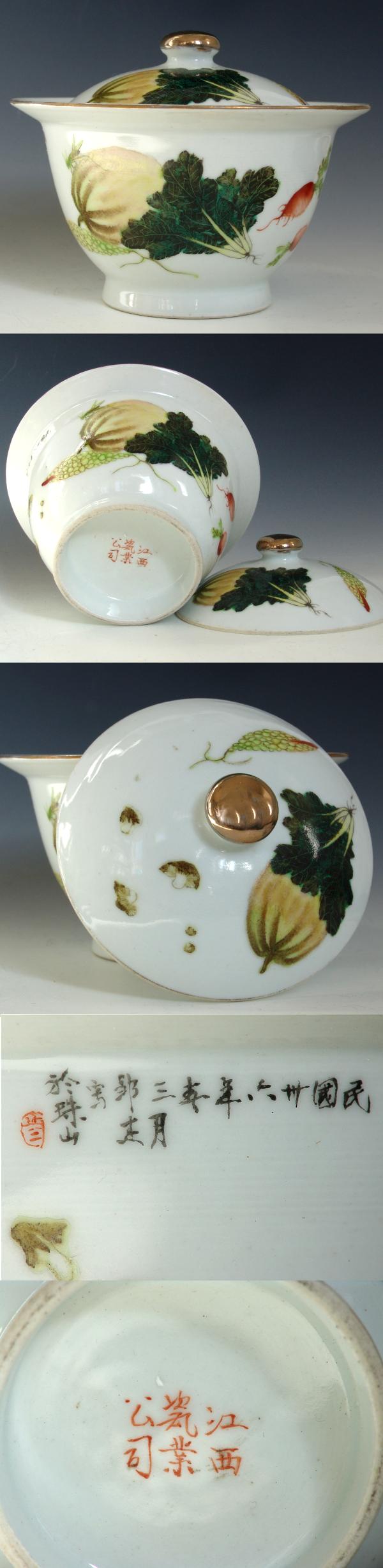 |
991. Bowl, Hand written iron red base mark: Jiangxi Ciye Gongsi meaning "Jiangxi Procelain company". Diameter 12 cm. Dated in the inscription to the 36th year of the Chinese republic (1912+35), meaning 1947.
|
1947 | 991 | Gaiwan | Jiangxi Ciye Gongsi | 516 | ||
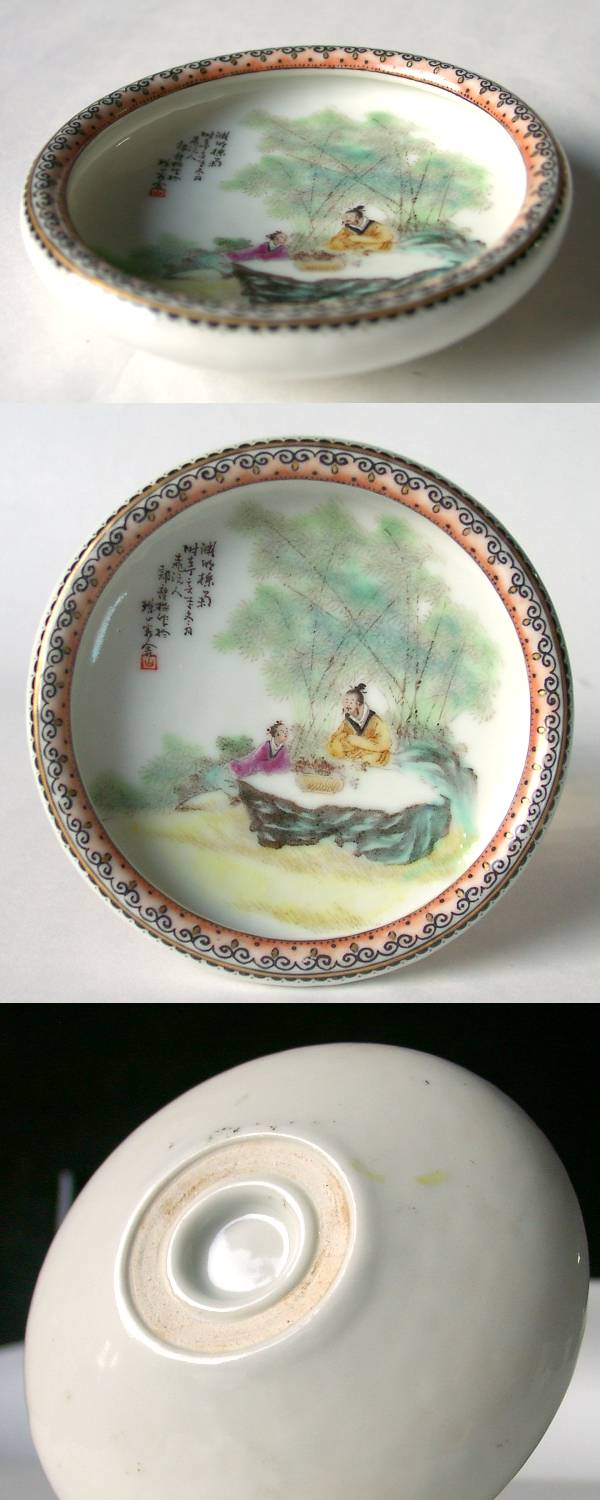 |
657. Dish. Double foot rim. Redish border over black decoration. Multi colored and freely blended enamels. No base mark. | 1947 | 657 | Dish | 517 | |||
| Wash basin, dated 1955. Decorated in underglaze green. One option Liling kiln, Henan province. Another suggestion Cizhou White Ware. The inscription says Bao Wei Guo Jia - "Defend the Country, possibly war with Russia at the border in 1955" Shi Jie Hu He - "Peace To The World". Diameter 29 cm. | 1955 | Basin | 518 | |||||
| 1956 | Brush pot | X X Tang Zhi | 519 | |||||
| 1957 | Tea pot | Ban Tao Jian Zhi | 520 | |||||
| Diao Yu Tai Guo Bin Guan and Tao Ci Yan Jiu Suo. "Diao Yu Tai" is where all the foreign important people are treated and met. Guo Bin Guan means "State Guests Lodge" and Tao Ci Yan Jiu Suo means "Ceramics Research Institute". Dated 1962. | 1962 | Tea set | Tao Ci Yan Jiu Suo | 521 | ||||
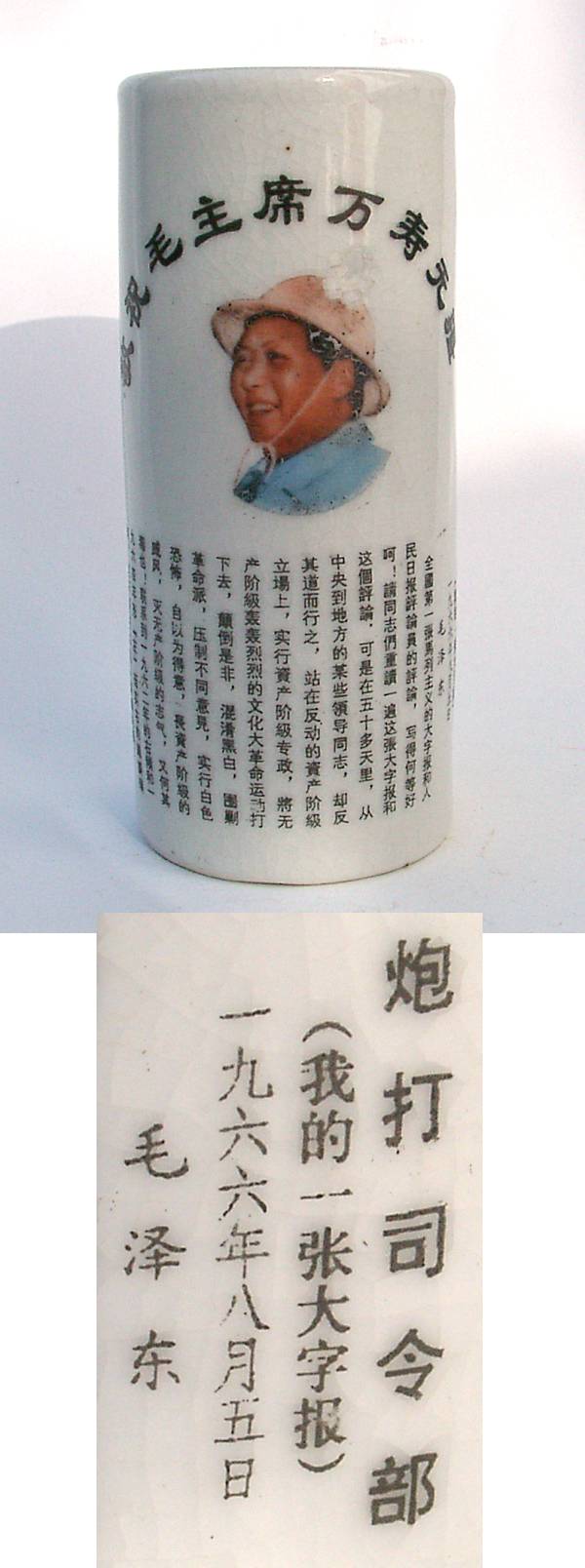 |
665. Straight sided vase. Transfer printed decoration on a crackled porcelain body. Date in the text; 5th August 1966. | 1966 | Plaque | 546 | ||||
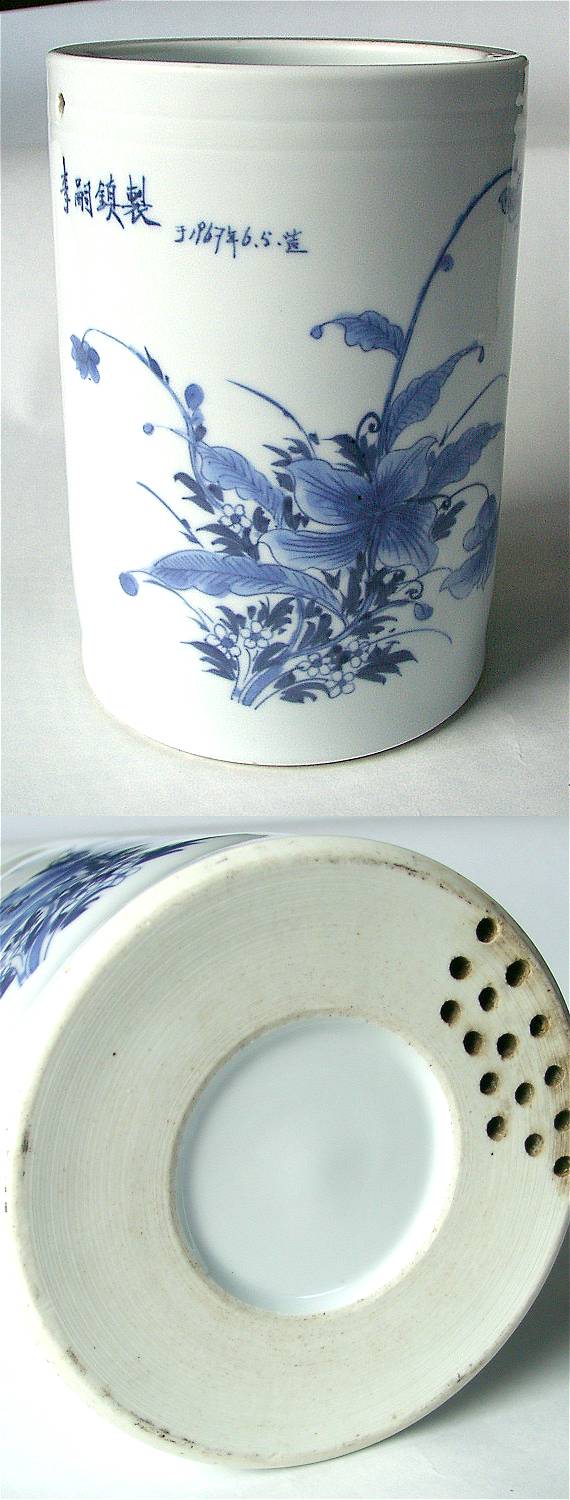 |
651. Blue and white decorated chopstick dryer. Dated in western numbers to '1965'. | 1965 | Chopstick dryer | 547 | ||||
 |
567. Tian'anmen Rostrum. Vase made in "Jingdezhen" to celebrate the Chinese Cultural Revolution. Decorated with Tian-An-Men Square and Hua Biao surrounded by sunflowers. Text on balloons with ribbons are "Long Live Chairman Mao", "Long Live the Communist Party" and Mao Zhu Xi Wan Sui "Chairman Mao's revolutionary route have success and live long life". Date in the text; 1968. This vase is the next largest in a set of four, height 24-36 cm. | 1968 | Vase | 548 | ||||
 |
1100. Straight sided vase / brush pot. Transfer printed decoration on a crackled ivory porcelainous body. The date "1968 Year" is on the base. The printed inscription is dated; November 17, 1957. | 1968 | Vase | 1968 Year | 549 | |||
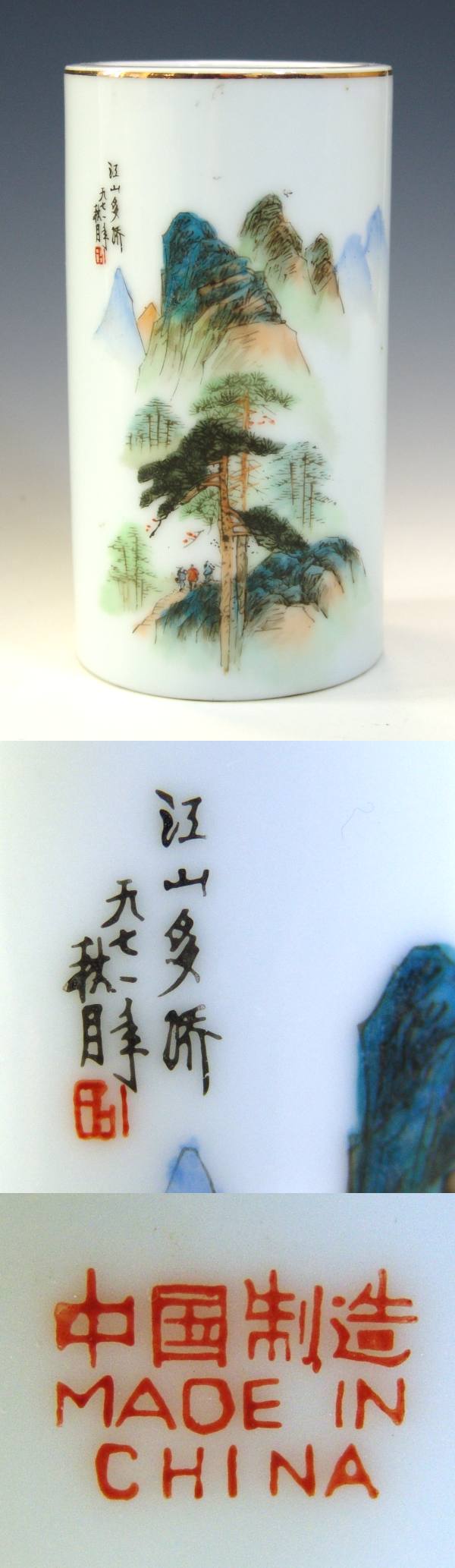 |
827. Brush pot. Text reading: "How beautiful is the landscape (country/nation), 1971, autum month" | 1971 | Brushpot | 550 | ||||
 |
666. Straight sided small vase or brushpot. Transfer printed decoration on a glossy white porcelain body. On the base "In memory of Manufacturing Company's Revolution Committee, October 1967". The front side motif is duplicating a propaganda poster; text: Chairman Mao and his close comrade-in-arms Comrade Lin Biao reviewing the Great Army of the Cultural Revolution, Long Live Chairman Mao. Lin is seen holding "Mao's Little Red Book" to which he was the initiator. Lin was a famous comrade to Mao who in 1969 was named Mao's successor until he in 1971 was accused of having planned an armed coup against Mao upon which Lin fled in a plane that crashed over Mongolia. In August 1973, two years later, a huge Criticize Lin Baio and Confucius campaign was initiated by Jiang Qing, Mao's wife, which continued until 1975. The passage printed on the back of this brush pot comes from the 2 September 1973 issue of the People's Daily (name and date within brackets). The text is a parable of sorts on the subject of class education along the lines of "don't try to be something that you are not". Given the close dates, this pot may have been part of the campaign. Tentative date 1973 however there is an earlier date on the base. | 1973 | Brushpot | '1967 Year 10 month' | 551 | |||
| 1973 | Â - - - | 19 red characters | 523 | |||||
| 1974 | Tea set | 524 | ||||||
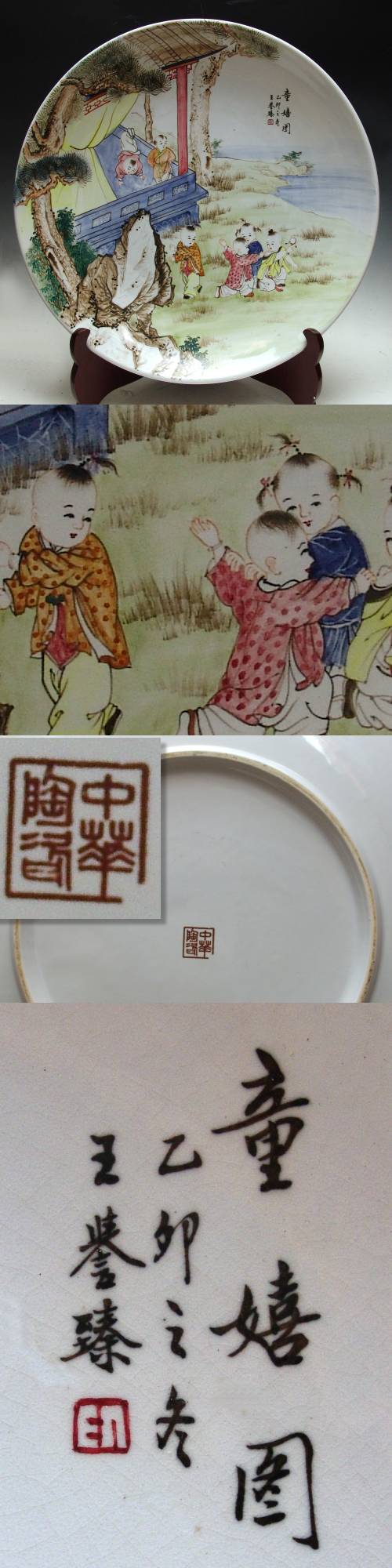 |
1198. Large dish on crackled soft ceramic ware. Polychrome enamel decoration applied under the glaze. Dated in the inscription to the yi mao year (1975). Printed mark on the base Zhongguo Taoci or "China Ceramics". Origin; made in Taiwan. | 1975 | Dish | Zhongguo Taoci | 553 | |||
| 1978 | Vases | Qianlong Nian Zhi | 525 | |||||
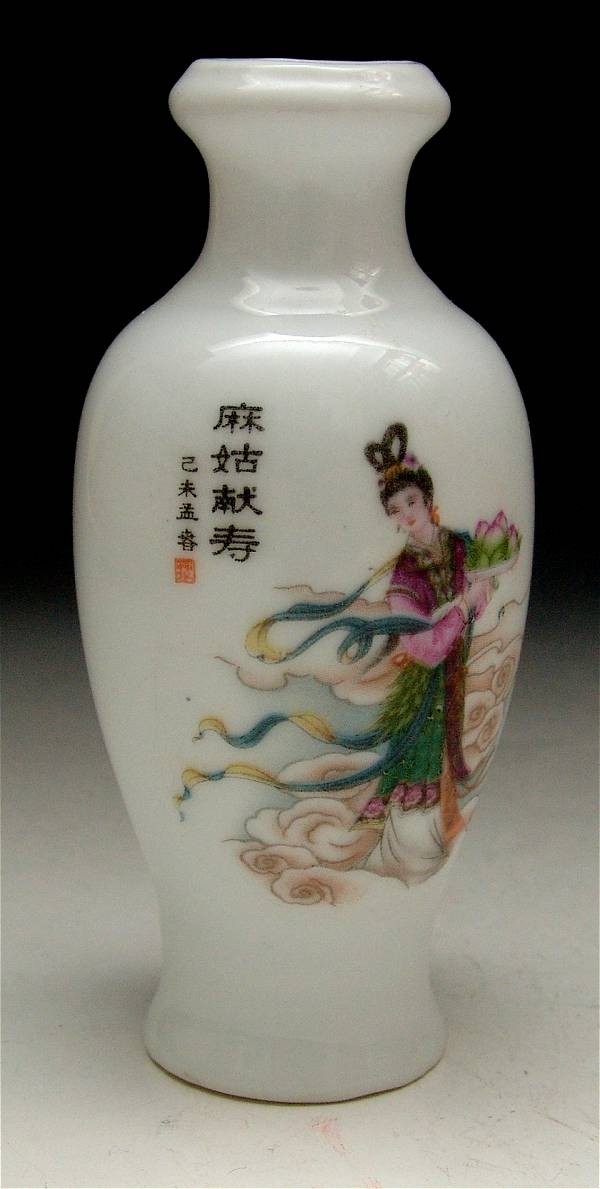 |
1124. Miniature eggshell porcelain vase with transfer printed decoration. Dated to ji wei (1979) in the decoration. No base mark. Height c. 4 inch (10 cm). | 1979 | Vase | 552 | ||||
| 1980 | Plaque | 526 | ||||||
| 1982 | Vase | Zhonggou taoci | 527 | |||||
| 1984 | Plaque | 528 | ||||||
| 1988 | Plaque | 529 | ||||||
| 1992 | Vase | Jingdezhen Zhi | 530 | |||||
| 2000 | Wine cups | X X Zhen Pin | 531 | |||||
| 2000 | Table top | 532 | ||||||
| 2001 | Vase | 7 red characters (Jdz Zhi) ? | 533 | |||||
| 2004 | Tea pot | 6 black (Jia Shen X X ?) | 534 | |||||
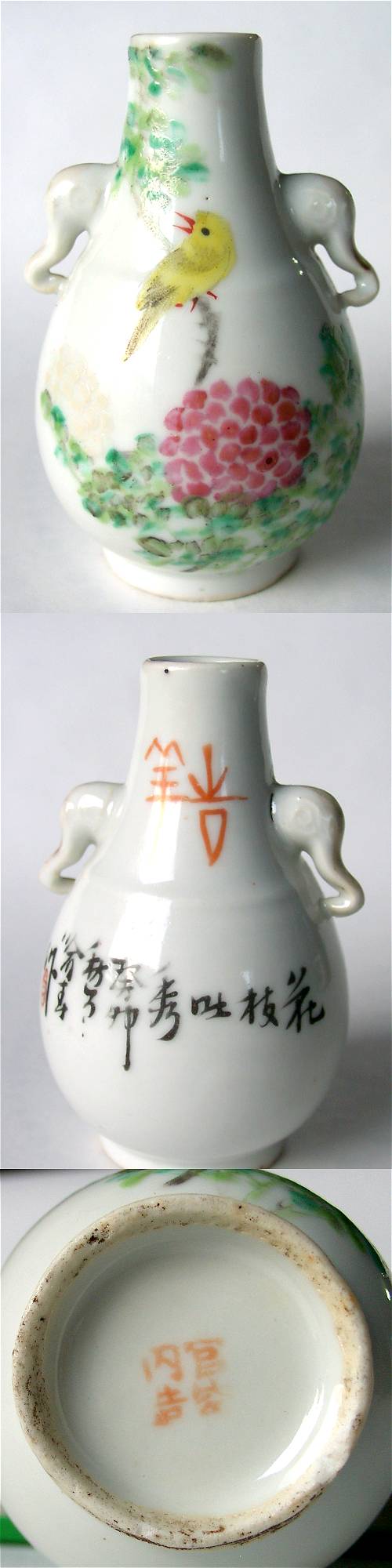 |
660. Small vase with elephant handles, with long snoozles. Calligraphy in dull black enamel, dated 1903. The yellow bird is probably "The Great Spring Scholar" which singing signals the arrival of Spring. Red base mark Guan yao nei zao (Imperial Kiln for Inner Palace) same as #671 ; | 1903 | 660 | Vase w elephant handles | Guan Yao Nei Zao | 535 | ||
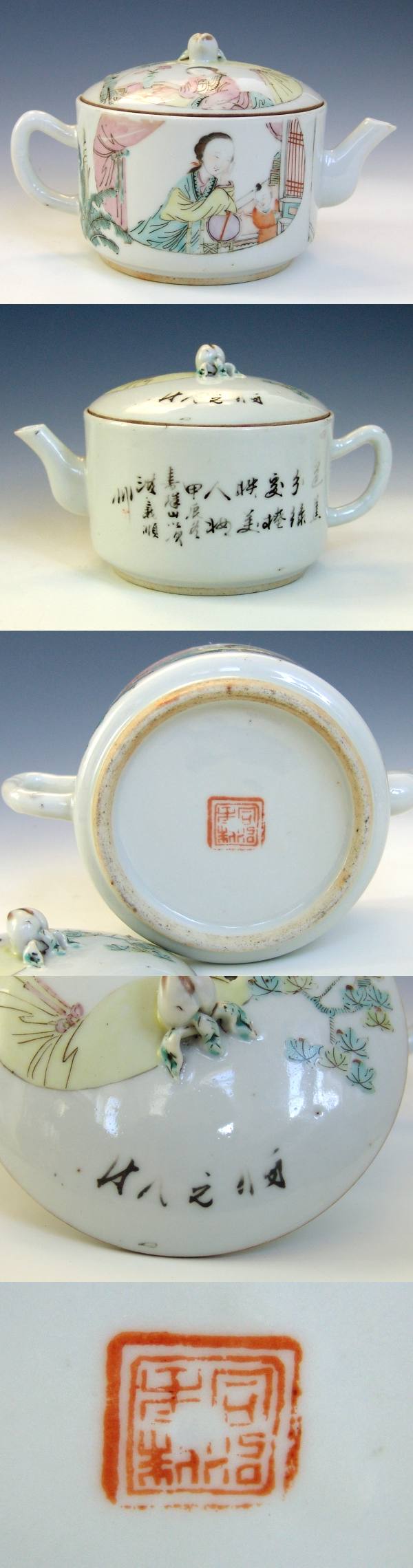 |
829. Teapot. Poetry "the blinds (curtains) reflects the Beauty's face", Red seal mark on the base Tongzhi Nian Zhi. Dated to the :jia chen year meaning 1904. | 1904 | 829 | Tea pot | Tongzhi Nian Zhi | 536 | ||
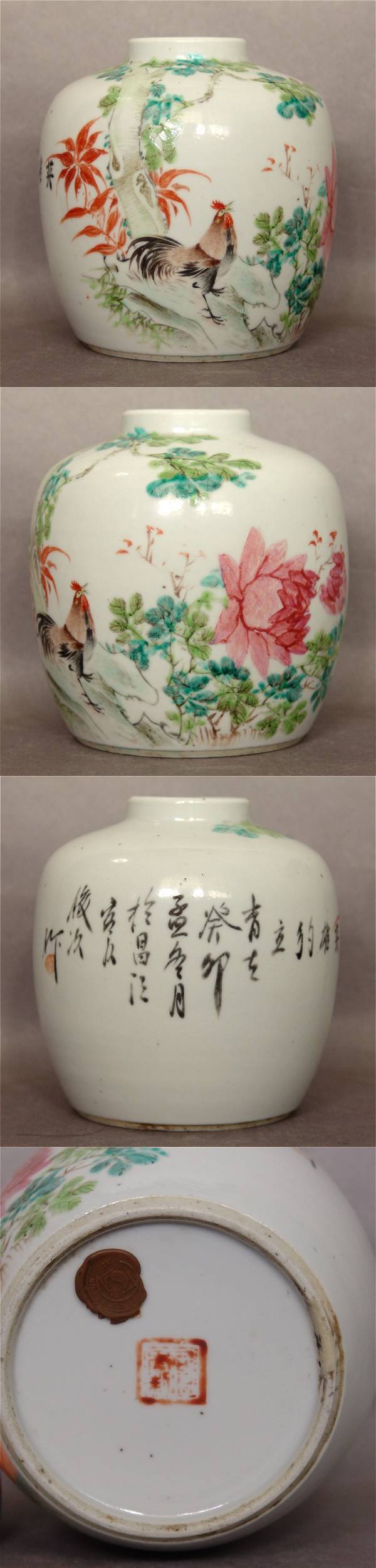 |
995. Ginger jar with glazed opening. Height 13 cm. Red seal mark on the base Tongzhi Nian Zhi. Dated in the decoration to the gui mao year (1903). | 1903 | 995 | Globular vase | Tongzhi Nian Zhi | 537 | ||
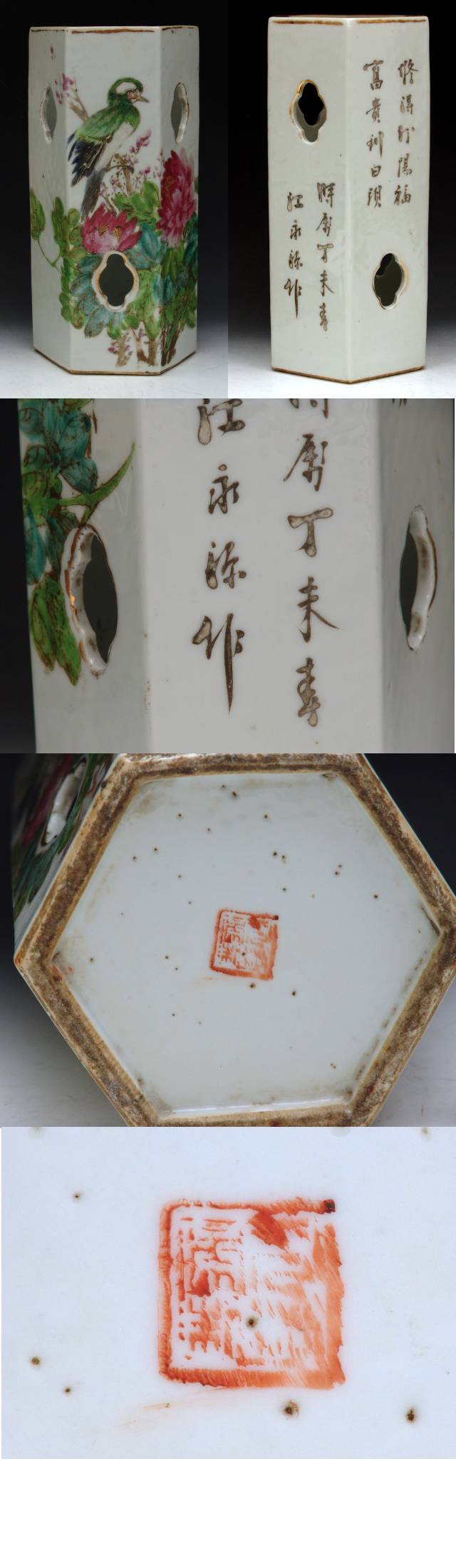 |
1156. Six sided hatstand, dated to the ding wei year (1907) in the inscription. Blurred red seal mark on the base, probably Tongzhi Nian Zhi "Tongzhi period make". | 1907 | 1156 | Six sided hatstand | Tongzhi Nian Zhi | 538 | ||
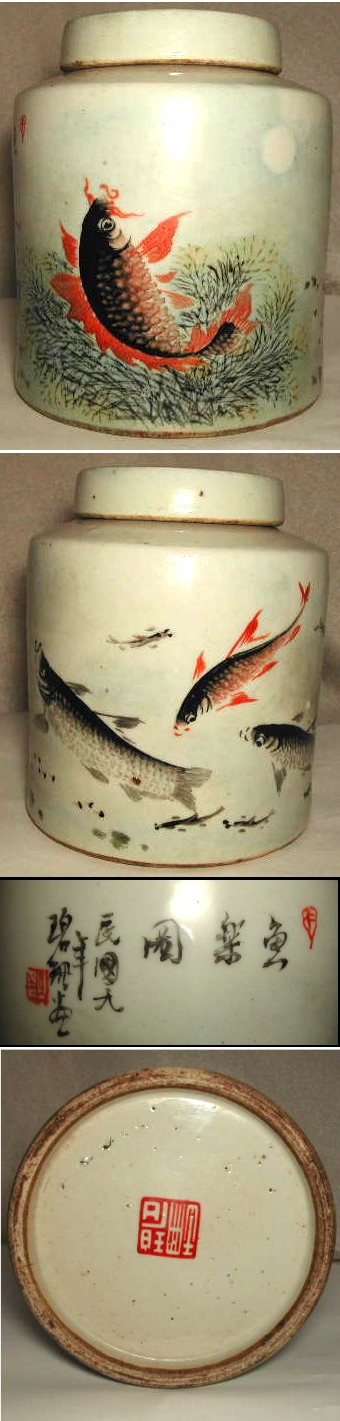 |
981. Lidded jar. Questioned authenticity.
|
1921 | 981 | Lidded jar | 539 | |||
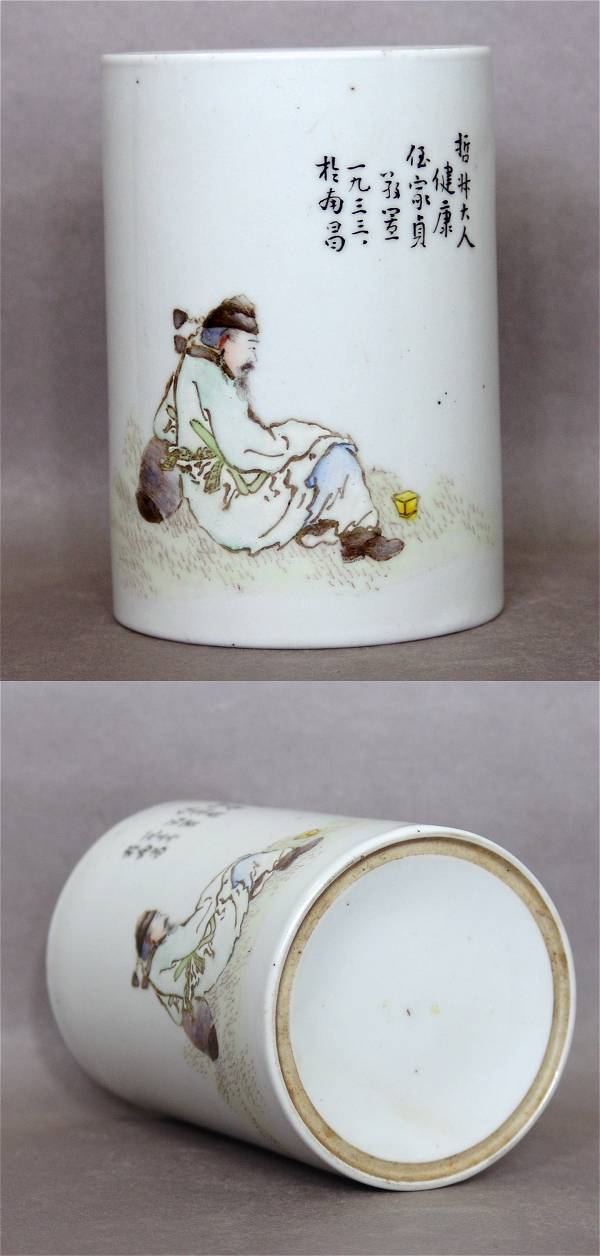 |
994. Dated in the inscription "1933". | 1933 | 994 | Brush pot | 540 | |||
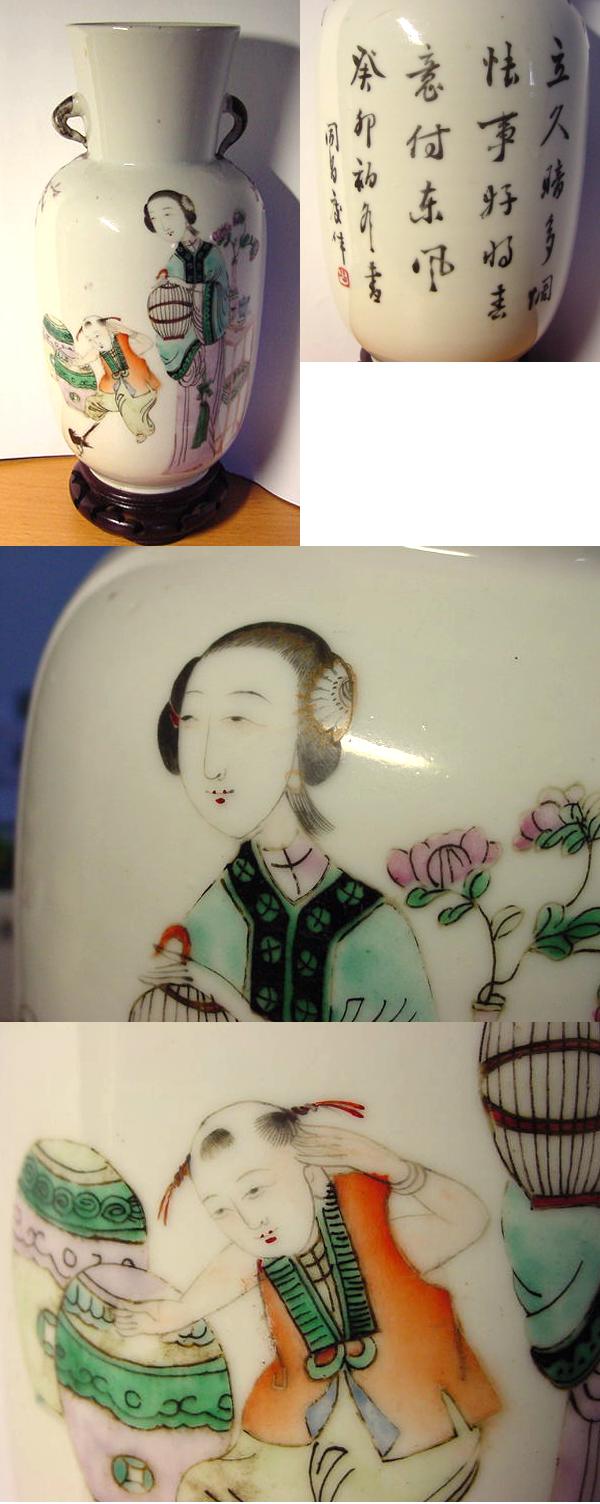 |
1017. Vase. Dated in the decoration to the gui mao year (1903). | 1903 | 1017 | Vase | 541 | |||
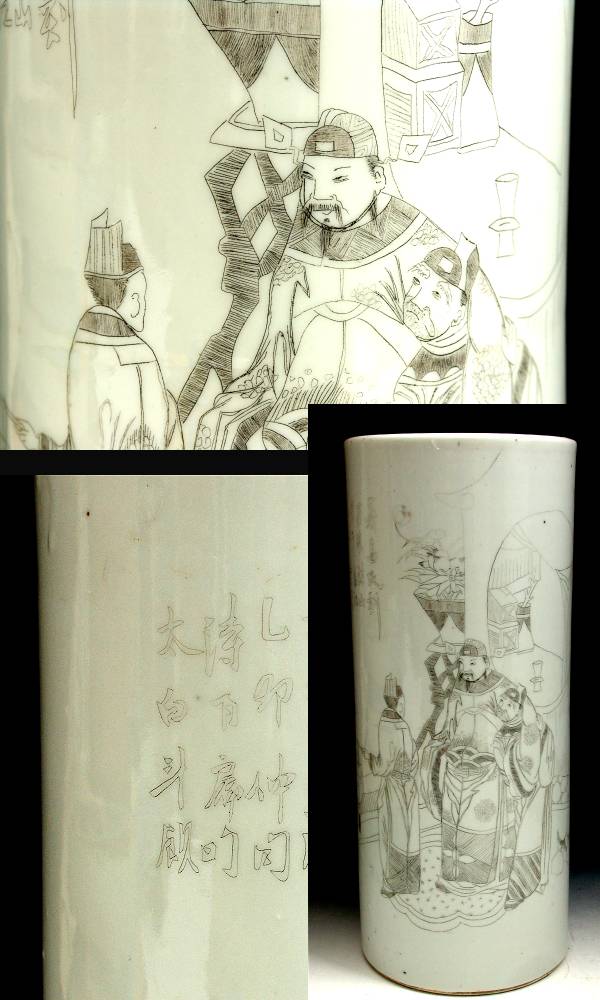 |
1159. Vase with engraved decoration. Dated in the inscription to the yi mao year (1915). No base mark at all.
|
1915 | 1159 | Vase | 542 | |||
 |
966. Vase. Export porcelain. Dated 1942 in the inscription. Documented to have been in the family, at least as early as 1957. | 1942 | 966 | Vase | 543 | |||
 |
1138. Wash basin, dated 1955. Decorated in underglaze green. One option Liling kiln, Henan province. Another suggestion Cizhou White Ware. The inscription says Bao Wei Guo Jia - "Defend the Country, possibly war with Russia at the border in 1955" Shi Jie Hu He - "Peace To The World". Diameter 29 cm. | 1955 | 1138 | Vase | 544 | |||
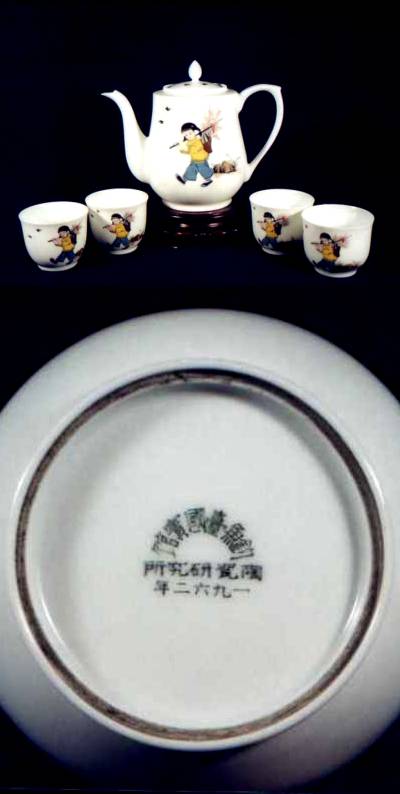 |
570. Diao Yu Tai Guo Bin Guan and Tao Ci Yan Jiu Suo. "Diao Yu Tai" is where all the foreign important people are treated and met. Guo Bin Guan means "State Guests Lodge" and Tao Ci Yan Jiu Suo means "Ceramics Research Institute". Dated 1962. | 1962 | 1138 | Vase | Diao Yu Tai Guo Bin Guan and Tao Ci Yan Jiu Suo | 545 |
The marks section of Gotheborg.com was initially established in May 2000 thanks to a generous donation of approximately one hundred images of Japanese porcelain marks, by Karl-Hans Schneider from Euskirchen, Germany. This contribution provided a modest yet substantial beginning of the Marks Section. It was a kind gesture that I really appreciated.
Of the many later contributors, I would especially want to mention Albert Becker, Somerset, UK, who was the first to help with some translations and comments on the Japanese marks. His work was then greatly extended by Ms. Gloria S. Garaventa, after which Mr. John Avery looked into and corrected some of the dates. Most of the Satsuma marks were originally submitted by Ms. Michaela Russell, Brisbane, Australia. A section which was then greatly extended by Ian & Mary Heriot, a large amount of information from which still awaits publication.
A warm thank you also goes to John R. Skeens, Florida, U.S.A., and Toru Yoshikawa for the Kitagawa Togei section, and to Susan Eades for her help and encouragement towards the creation of the Moriyama section. For the last full overhaul of the Satsuma and Kutani sections, thank you to Howard Reed, Australia. The most recent larger contribution was made by Lisa M. Surowiec, New Jersey, USA.
In 2004 and from then on, my warm thank you goes to John Wocher and Howard Reed, whose knowledge and interest have sparked new life into this section and given reason for a new overhaul. Thank you again and thank you to all I have not mentioned here, for all help and interest in and contributions to our knowledge of 20th-century Japanese porcelain.
The Chinese marks section would not have been possible without the dedicated help of Mr. Simon Ng, City University of Hong Kong, whose translations and personal efforts in researching the origin and dates of the different marks have been an invaluable resource. It has since been greatly extended by several contributors such as Cordelia Bay, USA, Walt Brygier, USA, Bonnie Hoffmann, Harmen Lensink, 'Tony' Yalin Zhang, Beijing, 'ScottLoar', Shanghai, Mike Harty, and many more expert members of the Gotheborg Discussion Board.
A number of reference pieces have also been donated by Simon Ng, N K Koh, Singapore, Hans Mueller, USA, Hans Slager, Belgium, William Turnbull, Canada, and Tony Jalin Zhang, Beijing.
All images and text submitted by visitors and published anywhere on this site are and remain the copyrighted property of the submitter and appears here by permission of the owners which can be revoked at any time. All information on this site, that are not specifically referenced to peer reviewed sources, are the personal opinions given in good faith by me, my friends and fellow experts, based on photos and the owners' submitted descriptions. They are not to be used for any financial or commercial decisions, but for educational and personal interest only, and can and will be changed as further information merits.
For further studies, Encyclopedia Britannica is to be recommended in preference to Wikipedia, which, not being peer-reviewed, might contain misleading information.
Web design and content as it appears here © Jan-Erik Nilsson 1996-.
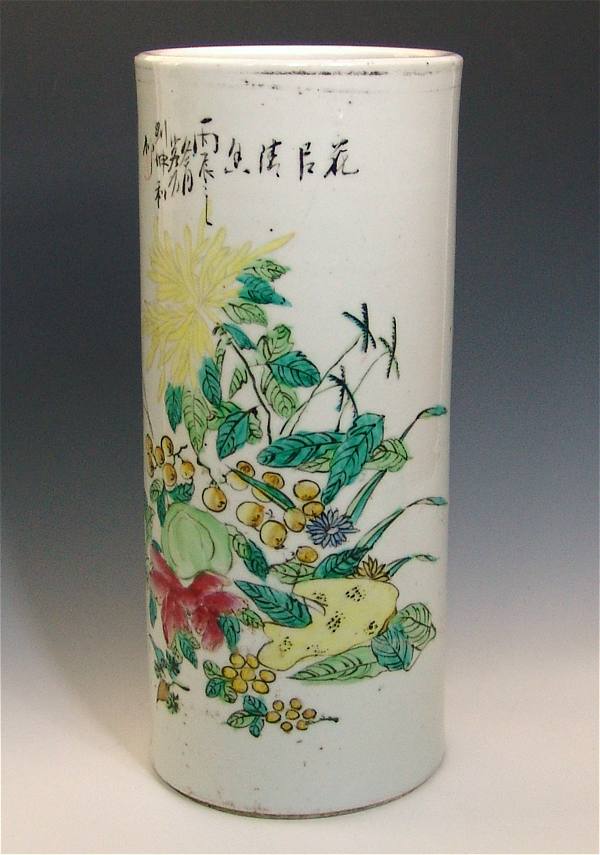 Click here to see large picture, vase
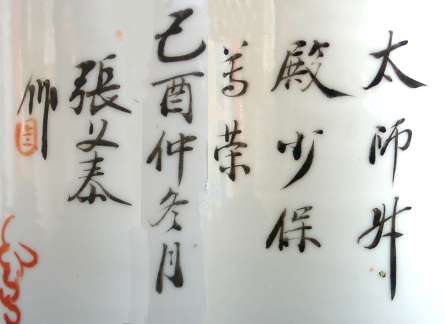 Click here for a close-up of the calligraphy