
Description of the Twenty
Illustrations of the Manufacture of Porcelain
By Tang Ying, Director of the Imperial Factory at Jingdechen,
in obedience to an Imperial edict... (1743)
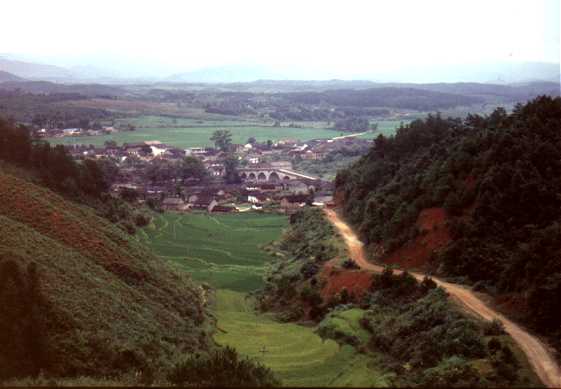
The village of Gaoling (Kao-ling) seen from the "high ridge" where the kaolin clay was quarried up until the late Ming dynasty.
Photo © Jan-Erik Nilsson, 1992
1. Mining for the Stone and Preparation of the Paste
"In the manufacture of porcelain the body is formed of molded earth. This earth is prepared from stone, which must be mined and purified for the purpose. The stone is found in the province of Kiangnan, within the prefecture Hui-chou Fu, at Ch'i-men-hsien, which is two hundred li distant from the porcelain manufactory.
The two mountains called P'ing-li and K'u-k'ou, in this district, both produce the white stone. It is obtained by mining, and when broken exhibits black veins branching like the deer's-horn seaweed.
The natives take advantage of the mountain torrents to erect wheels provided with crushers. Having been finely pulverized, it is then purified by washing and levigation, and made up in the form of bricks, which are called pai-tun or "white bricks" (petuntse). When the color is uniform and the texture perfectly fine, it is used for the making of the round pieces and vases of eggshell and of pure white porcelain, and of similar objects decorated in blue.
Besides this there are several other kinds of earth called Kao-ling, Yu-hung, and Ch'ien-t'an, after their different places of production, which are all situated in the province of Kiangsi, within the bounds of the prefecture Jao-chou Fu. They are dug out and prepared in the same way as the petuntse, and can only be used for mixing with this last, or in the making of coarser and thicker ware.
The picture shows the different processes of mining, of pounding, and of washing, which are comprised in the heading, "Mining for the stone and preparation of the paste," and it is not necessary to describe them more fully."
This page is based on an original translation from Chinese by S.W. Bushell, 1899, of a text written on Imperial command in 1743 by Tang Ying, the celebrated superintendent of the porcelain manufacture in the province of Jiangxi. It is widely reprinted. The version most likely to be authentic is the version found in the official annals of the province of Jianxi, Book XCIII, folio 19-23. The first draft seems to have been written in 1735. The version above was added to a set of 'twenty illustrations of the manufacture of porcelain' in 1743. The actual illustrations have never been identified. The text as it appears here is illustrated with photos taken on location by Jan-Erik Nilsson in 1991 and 1992.