
Description of the Twenty
Illustrations of the Manufacture of Porcelain
By Tang Ying, Director of the Imperial Factory at Jingdechen,
in obedience to an Imperial edict... (1743)
19. Wrapping in Straw and Packing in Cases
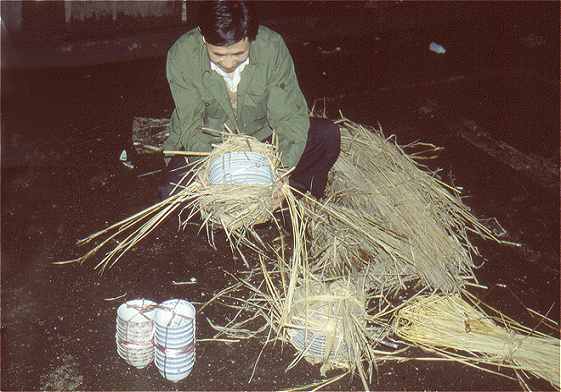
A modern "mat man".
Photo © Jan-Erik Nilsson, 1992
"After the porcelain has been taken out of the furnace it is arranged into four separate classes, which are known by the names of first-class color, second-class color, third-class color, and inferior ware, and the price is fixed accordingly at a high or low rate.
The porcelain of third-class color and the inferior ware are kept back for local sale.
The round ware of first-class color and the vases and sacrificial vessels of the first and second class are all wrapped up in paper and packed in round cases, there being packers whose duty it is to attend only to this work.
With regard to the round ware of second-class color, the dishes and bowls are tied together in bundles, each composed of ten pieces, which are wrapped round with straw and packed in round cases, for convenience of carriage to distant parts.
The coarser porcelain intended for ordinary use, which is distributed throughout the different provinces, is not packed in cases with straw, but only tied up in bundles with reeds and matting. From thirty or forty pieces up to sixty make a 'load' sufficient for a man to carry at each end of his yoke.
The 'loads' are packed inside with reeds and matting and bound round outside with strips of bamboo, ready to be conveyed either by water or by land as may be more convenient.
The workmen who do the packing are generally known by the name of mat-men. "
This page is based on an original translation from Chinese by S.W. Bushell, 1899, of a text written on Imperial command in 1743 by Tang Ying, the celebrated superintendent of the porcelain manufacture in the province of Jiangxi. It is widely reprinted. The version most likely to be authentic is the version found in the official annals of the province of Jianxi, Book XCIII, folio 19-23. The first draft seems to have been written in 1735. The version above was added to a set of 'twenty illustrations of the manufacture of porcelain' in 1743. The actual illustrations have never been identified. The text as it appears here is illustrated with photos taken on location by Jan-Erik Nilsson in 1991 and 1992.