
Description of the Twenty
Illustrations of the Manufacture of Porcelain
By Tang Ying, Director of the Imperial Factory at Jingdechen,
in obedience to an Imperial edict... (1743)
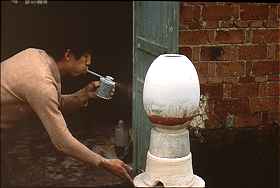
Applying glaze onto a newly decorated vase by blowing, was demonstrated for me at the Arts Porcelain Factory.
Photo: Jan-Erik Nilsson © 1991, 1992
13. Dipping into the Glaze and, Blowing on the Glaze
"All the different kinds of round ware and vases, including the pieces decorated in blue, as well as the copies of Kuan, Ko, and Ju porcelain, must have the glaze applied before they are fired.
The ancient method of putting on the glaze was to apply it to the surface of the vase, whether square, tall, fluted, or ribbed, with a goat's-hair brush filled with the liquid glaze, but it was difficult to distribute it evenly in this way.
The round ware, both large and small, and the plain round vases and sacrificial vessels used all to be dipped into the large jar which held the glaze, but they failed by being either too thickly or too thinly covered, and, besides, so many were broken that it was difficult to produce perfect specimens.
In the present day the small round pieces are still dipped into the large jar of glaze liquid, but the vases and sacrificial vessels and the larger round pieces are glazed by the soufflé process. A bamboo tube one inch in diameter and some seven inches long has one of its ends bound round with a fine gauze, which is dipped repeatedly into the glaze and blown through from the other end. The number of times that this process has to be repeated depends partly on the size of the piece, partly on the nature of the glaze, varying from three or four times up to seventeen or eighteen.
These are the two distinct methods of glazing: by immersion and insufflation."
This page is based on an original translation from Chinese by S.W. Bushell, 1899, of a text written on Imperial command in 1743 by Tang Ying, the celebrated superintendent of the porcelain manufacture in the province of Jiangxi. It is widely reprinted. The version most likely to be authentic is the version found in the official annals of the province of Jianxi, Book XCIII, folio 19-23. The first draft seems to have been written in 1735. The version above was added to a set of 'twenty illustrations of the manufacture of porcelain' in 1743. The actual illustrations have never been identified. The text as it appears here is illustrated with photos taken on location by Jan-Erik Nilsson in 1991 and 1992.