
Description of the Twenty
Illustrations of the Manufacture of Porcelain
By Tang Ying, Director of the Imperial Factory at Jingdechen,
in obedience to an Imperial edict... (1743)
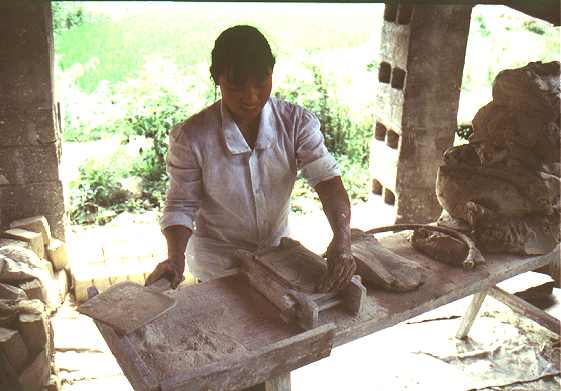
Shaping "petuntse" clay bricks out of half dry porcelain clay near Sanbaopeng, south of Jingdezhen.
Photo © Jan-Erik Nilsson, 1992
2. Washing and Purification of the Paste
In porcelain-making the first requisite is that of washing and purifying the materials of the paste, so as to make it of fine homogeneous texture. The presence of "stars" or of fragments of stone would cause flaws in the porcelain. Foreign particles or loose paste would lead to cracks.
The method of purifying the paste is to mix the materials with water in large earthenware jars, and to stir the mixture with wooden prongs, so that it remains suspended in the water while the impurities sink to the bottom.
The paste is then passed through a fine horsehair sieve, and next strained through a bag made of a double layer of silk. It is then poured into a series of earthenware jars, from which the water is run off, and the paste is left to become solidified. A wooden box with no bottom having been placed upon a pile composed of several tiers of new bricks, a large cloth of fine cotton is spread inside, and the solidified paste is poured in, wrapped round with the cloth and pressed with more bricks, which absorb all the water.
The prepared paste, freed from the superfluous water, is then thrown on to large stone slabs and worked with iron spades until it has become perfectly compact and ductile, and fit for the manufacture of porcelain.
All the different kinds of paste are prepared in the same way, the various materials having been mixed in definite proportions according to their different properties. The picture contains in detail the various utensils and the different processes of work comprised in this department of preparation of the paste.
This page is based on an original translation from Chinese by S.W. Bushell, 1899, of a text written on Imperial command in 1743 by Tang Ying, the celebrated superintendent of the porcelain manufacture in the province of Jiangxi. It is widely reprinted. The version most likely to be authentic is the version found in the official annals of the province of Jianxi, Book XCIII, folio 19-23. The first draft seems to have been written in 1735. The version above was added to a set of 'twenty illustrations of the manufacture of porcelain' in 1743. The actual illustrations have never been identified. The text as it appears here is illustrated with photos taken on location by Jan-Erik Nilsson in 1991 and 1992.