
Description of the Twenty
Illustrations of the Manufacture of Porcelain
By Tang Ying, Director of the Imperial Factory at Jingdechen,
in obedience to an Imperial edict... (1743)
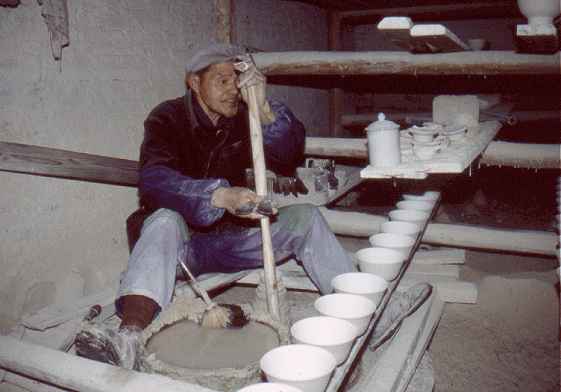
"The potter sits upon the border of the framework and turns the wheel with a bamboo staff."
Photo © Jan-Erik Nilsson, 1992
6. Fashioning the Round Ware on the Wheel
"There are several different processes of work in the manufacture of this round ware. The square, polygonal, and ribbed pieces, and those with projecting corners, have to be carved, engraved, molded, and finished with the polishing knife, all of which are different branches of work.
The plain round pieces are turned on the wheel, being distributed according to their size between two classes of workmen. The first take the large pieces and fashion the round dishes (p'an), the bowls (wan), the cups (chung), and the saucer-plates (tieh), from one up to two or three feet in diameter; the second make on the wheel the same kind of pieces which measure less than a foot across.
The wheel consists of a disk of wood mounted below upon a perpendicular axle, so as to revolve continuously for a long time, during which the piece must be properly turned, without becoming too thick, too thin, flattened, or otherwise misshapen. There is a carpenter at hand to repair it when necessary.
Beside the wheel is an attendant workman, who kneads the paste to a proper consistency and puts it on the table. The potter sits upon the border of the framework and turns the wheel with a bamboo staff.
While the wheel is spinning round he works the paste with both hands; it follows the hands, lengthening or shortening, contracting or widening, in a succession of shapes.
It is in this way that the round ware is fashioned so that it varies not a hair's breadth in size."
This page is based on an original translation from Chinese by S.W. Bushell, 1899, of a text written on Imperial command in 1743 by Tang Ying, the celebrated superintendent of the porcelain manufacture in the province of Jiangxi. It is widely reprinted. The version most likely to be authentic is the version found in the official annals of the province of Jianxi, Book XCIII, folio 19-23. The first draft seems to have been written in 1735. The version above was added to a set of 'twenty illustrations of the manufacture of porcelain' in 1743. The actual illustrations have never been identified. The text as it appears here is illustrated with photos taken on location by Jan-Erik Nilsson in 1991 and 1992.