
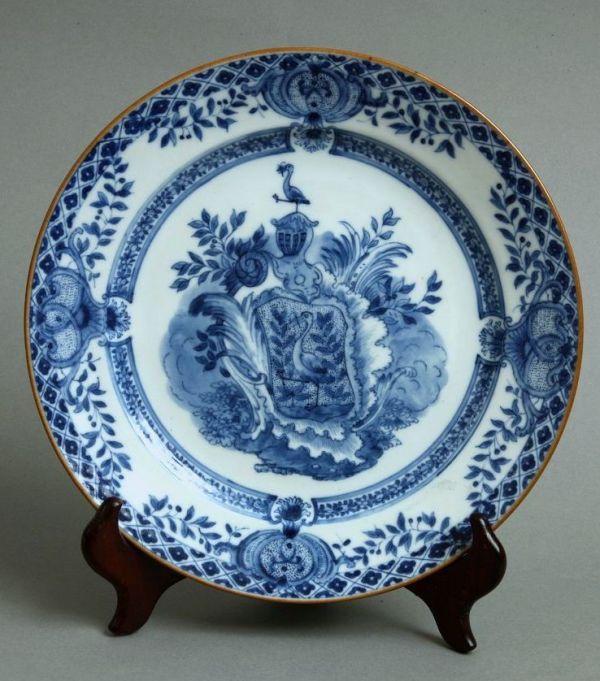
Grill family armorial porcelain. Ordered by Anthony Grill & Sons in Amsterdam through the mediation of Jean Abraham Grill, who bringing this order and its design left from Gothenburg for Canton, sailing as a 1st Assistant, the 5th of January 1755 on board the Swedish East Indiaman Sophia Albertina. Qing dynasty, Qianlong period (1736-95), c. 1755, Size: 8 12/16 inches / 22.4 cm
Term used to describe porcelain decorated with heraldic motifs but particularly 18th century porcelain produced in China for European families and bearing the family's coat of arms.
European crests on Chinese porcelain can be found as early as the 16th century.
Around 1700 the demand for Chinese porcelain made to order and decorated with the family coat of arms increased. During the 18th century thousands of services were ordered. Drawings of individual coat-of-arms were dispatched to China to be copied as faithfully as possible and the resulting wares were shipped back to Europe and, from the late 18th century, to North America.
Some were lavishly painted in polychrome enamels and gilding, covering much of the surface, while others, particularly those toward the end of the century, might simply incorporate a small crest or monogram. Coat of arms occurred on European pottery from the Renaissance with examples seen on Italian majolica, slipware, English and Dutch delft ware, and on porcelain from the 18th century onward.
Armorial porcelain and other porcelain decorated with European subjects was an important part of the private trade that was made by the officials on board the East Indiaman, where the value compared to the restricted available space was a concern. It is estimated that around 3,000 armorial services, consisting up upwards of about 1,000 pieces each, could have been brought to England during the 18th century. In a similar estimate maybe 300 services was brought to Sweden during the same time span. In average three services would thus have been on board each and every ship that sailed to China and back under Swedish flag. Considering porcelain with other special decorations the private trade was considerable.
The Swedish Grill family porcelain
The Swedish noble family Grill were during the 18th century among the leading finance and trade families in Sweden and throughout Europe, that also had extensive interests in the Swedish East India Company as directors, supercargos, shareholders and as merchants in the cargoes brought home and exported.
It is impossible to think of the Swedish East India company without also thinking about the family of Grill, who were deeply involved in the International trade of the time, and whose business contacts worldwide no doubt were sharing the foremost places of importance to the Swedish East India Company with that of the founding fathers Nicklas Sahlgren and Colin Campbell, and the International finance family of de Proli to mention just a few.
This particular service was ordered by Anthony Grill & Sons in Amsterdam through the mediation of Jean Abraham Grill, who bringing this order and its design left from Gothenburg for Canton, sailing as a 1st Assistant, the 5th of January 1755 on board the Swedish East Indiaman Sophia Albertina.
The order was negotiated with the Chinese Hong merchant Conscientia Gyqua in Canton with the help of the Second Supercargo on board, Vigneaulx, a dutch Supercargo and an interpreter. They spent one day discussing the order and to compare the Dutch and the Chinese measurements and finally sealed the contract and the design.
Since the Chinese needed between ten to eighteen months to deliver an underglaze blue and white service that needed to be drawn and fired in Jingdezhen, this service was not ready by the time of the return of J A Grill, but instead arrived to Gothenburg in July 1757 with the ship Prins Friedrich Adolph.
The total cost for the service was 300 Spanish Piasters. It originally seems to have been made up of 882 pieces of which in the year 1951 some 394 pieces could be tracked to various relatives and museums. It is possible that all pieces originally ordered was never delivered.
The design is thought to be a blue and white version of an earlier design made entirely in enamels that generally is thought to have been designed by Christian Precht (1706-1779) who pioneered rococo designs in Sweden. Who was responsible for reworking and finalizing this underglaze blue set has been debated but no agreement has been reached.
A

Back to Gotheborg.com Home Page