
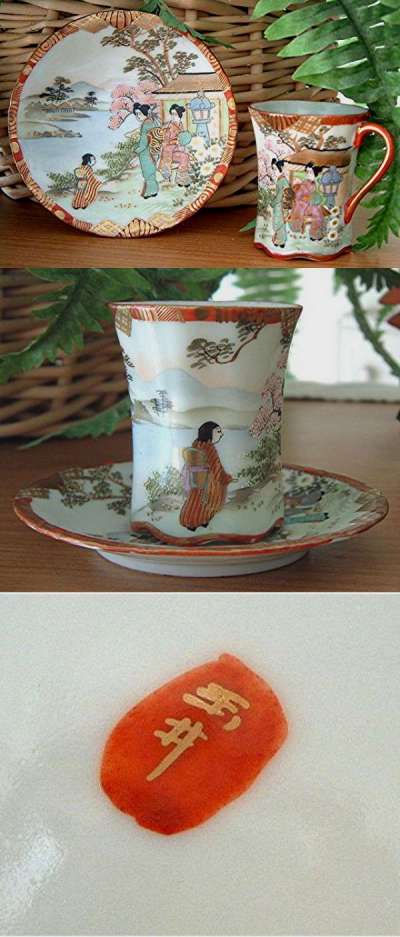
Japanese porcelain decorated with Geisha Girls. The mark could be read as Giokusei. Mid-Japan Seto/Nagoya/Kutani area, possible Nagoya ware. Date: early 20th century. This is not a typical Geisha Girl decoration as defined by Elyce Litts, with printed outlines, but a more elaborate and hand painted version.
The name refer to Japanese Porcelain with Overglaze Printed decoration of Japanese ladies in kimonos, but is usually extended also to wares where the decoration is similar but entirely hand painted.
Printing was done most often in red, but some geisha girl porcelain has the primary design printed in black or dark brown (Litts 1988:16). The primary red printed motifs are usually embellished with detailing in overglaze enamels in blues, gold, reds, greens and yellows. Gold gilt is sometimes used to decorate handles and rims. Around 1910 to 1915, white and yellow enamel dots, lines, stars and zigzags began to be used as a less expensive alternative to gold enamelling.
These wares began production in the last quarter of the 19th century and continued to be manufactured into the early 1950s (Litts 1988:8, 11). Most were produced prior to the beginning of World War II, although they continued to be made during the period of Japan's occupation by Allied forces (1945-1952). The printed Geisha Girl porcelain was inexpensive and during its earlier period often sold in 'dime stores' and used as free premiums. Cups and saucers were often "free" give-aways inside large containers of Japanese tea. In its better versions, it were a popular gift.
The marks varies between the names of the maker, such as Kutani, or the exporting company, the buyer, the marks of a store while some are just marked 'JAPAN'. A general rule of thumb to follow for marked pieces of geisha girl porcelain is as follows: vessels marked “Nippon” dated between 1891 and 1921, items marked “Japan” or “Made in Japan” post-date 1921 (Litts 1988:58). Porcelain marked “Made in Occupied Japan” date between 1945 and 1952.
The Collector's Encyclopedia of Geisha Girl Porcelain by Elyce Litts, 1988, catalogues over 200 different patterns of these collectible wares. The patterns have remained so popular that some are still in production today. At the turn of the century there were over 1,300 potters making these wares in Kaga province of Japan, employing some 2700 people.
During the first few decades of the 20th century when the production increased, large porcelain decorating centers opened in Tokyo, Nagoya, Kobe and Yokohama. Many were 'cottage businesses' with extended families - parents, grandparents, children - all participating in the creation of the porcelain.
The Western markets at this time had a great interest in oriental designs, Japanese and other oriental styles of artwork, furnishings and accessories for the home. The wares were presented in catalogs and newspapers by several Western companies dating to around 1910-1915, describing Geisha Girl wares as "Jap China," or "Seto Ware decorated in Kobe," etc. See for example 'Vantines' and 'Liberty'.
The more sought-after patterns have hand-painted designs with a lot of gold on them while the mass-produced type have stencilled designs, rather than hand-painted, but they are still very nice and I think Japanese green tea tastes wonderful when served in these collectible, thin cups. The stencil-design pieces may not fetch high prices, but they are colorful and fun to collect.
A

Back to Gotheborg.com Home Page