
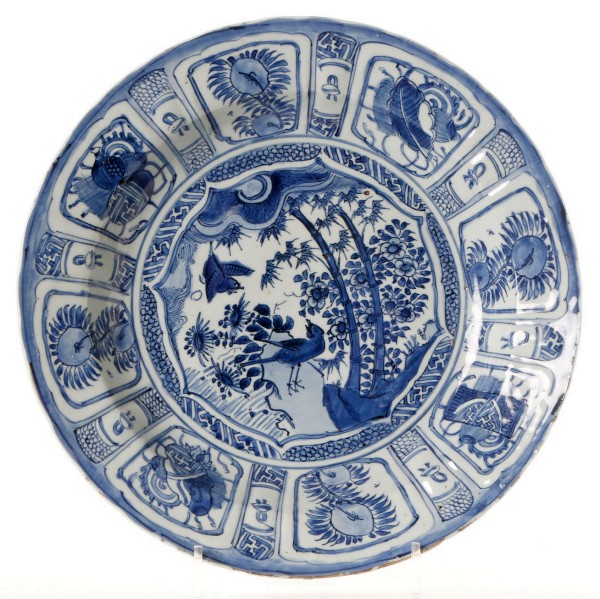
Kraak ware dish with its decoration typically divided into a number of panels. Characterized by its thinness of the body, fritted rims, roughly cut footrim, crisp glaze grit and firing flaws. Chinese export porcelain of the late Ming dynasty for the Portuguese market, Wanli period (1573-1619).
Diameter 36 cm / 14 inch. Jan-Erik Nilsson coll.
The earliest Chinese export porcelain made and exported to the west at the end of the Ming dynasty, from the Wanli period (1573-1619) until the end of the Ming dynasty in 1644. The term Kraak ware was established around the year 1675 apparently to distinguish the older late Ming dynasty Portuguese market porcelain from the new and modern Chinese export porcelain that now begun to arrive in Holland during the early Qing dynasty.
End of the Ming dynasty (1368-1644)
During the Wanli period (1573-1620) the Imperial kilns in Jingdezhen suffered hard times, and orders from the court were greatly reduced. Rising tensions provoked riots at the imperial workshops in 1597 and again in 1604. Ultimately, the imperial kiln was officially forced to close in 1608 and as a result many of the most skilled porcelain potters in the world were suddenly available for employment and private orders.
This was of course good news for the private traders and from about 1614 and onwards we can find in the VOC archives that special orders for specific shapes intended for the western market, now appears regularly on the porcelain order lists. To facilitate trade, in 1625, the Dutch established a trading post on the island of Formosa.
The amounts of porcelain imported to the Netherlands could now be increased dramatically since this new trading post allowed the Dutch to order porcelain directly from China instead of depending on the unreliable junk trade. The invoices of 'return ships' list vast amounts of porcelain, such as 100,000 to 250,000 pieces per ship.
In 1657, trade with China vanes
However, in the mid-17th century trade is reduced due to the fall of the Ming dynasty, and by 1657 internal struggles in China caused trade with the Chinese to cease. At this point, traders switched to importing from Japan.
The name 'Kraak porcelain', from 1638
The earliest known written reference to kraak porcelain dates from 1638. It is a memorandum sent on 12 April by the Director of the VOC in Amsterdam to the Hoge Regering (the Dutch govemment in Batavia) specifying which porcelain assortments were most in demand in the Netherlands. In this document the terms craek and caraek, referring to kraak porcelain bowls and plates, are mentioned only once, nevertheless they appear to have constituted a major part of this order. This memorandum is of particular importance because it proves that kraak porcelain was being produced and ordered at the same time as "Transitional" porcelain.
The following year, on 2 May 1639, a second reference to kraak porcelain appears in an order sent by the VOC Director in Batavia to the Dutch merchants in Port Zeelandia. In this order, however, the term craecqporceleijn (kraak porcelain) is used. A later reference outside of the VOC appears in the 1673 inventory of the porcelains of Amalia van Solms, countess of Solms-Braunfels (1602-1675), wife of Frederick Henry, Prince of Orange (1584-1647), the leading soldier in the Dutch wars against Spain, in which the terms kraeckwerck and craeckcommen are mentioned several times.
The origin of the name 'Kraak'
The origin of the name 'Kraak' was most likely the large Portuguese ships that was used for their trade with Asia, that was called carracks and could well have been specifically related to an instance in 1602 and 1604 when the capture and following auctions of the cargoes of the two captured Portuguese ships (Carracks) São Tiago and the Santa Catarina by the Dutch introduced Chinese export porcelain into Amsterdam in a grand scale. The auctioning of their captured cargoes that included thousands of items of porcelain - at that time only referred to as 'porceleyn' - attracted the interest if all wealthy nobility of Northern Europe including the Kings of England and France, and the auctioning of these large, hard ringing and shining treasures ignited a mania for porcelain in Europe that would last for two centuries.
In 1602 VOC is established
This was considered as an act of piracy by many, and in 1602 the Dutch now organized themselves into one company, the Dutch East India Company or VOC, to organize their efforts to engage in the spice trade from Indonesia they had been cut off from due to their war with Spain.
The Portuguese had their center of trade at Macao, near Canton (Guangzhou) in the Pearl River delta. The Dutch set up their base at Batavia (Djakarta) on the island of Java. The trade with China continued until the mid-17th century when civil wars caused the fall of the Ming dynasty in 1644. The Dutch who at this time had established a trade entrepot at Deshima Island in Japan, could benefit from this and the European import of porcelain became dominated by red, blue and gilt decorated Japanese Imari porcelain, decorated in an imitation of the colorful Chinese wucai palette.
Western trade with Japan had begun in 1543
Western trade with Japan had begun in 1543 through the arrival of a Portuguese ship to the island of Tanegashima. Their first trade base was established in Hirado but was moved to Nagasaki in 1570. In 1609 the old Portuguese trading position on Hirado was taken over by the Dutch who traded there quite freely until the end of the 1640s when they too were relocated to Nagasaki.
The years around 1640 and the time of the collapse of the Chinese Ming dynasty, and the following trade disruption, thus saw a mixed colony of Spanish-Portuguese and Dutch tradesmen in the Japanese port of Nagasaki. Eventually the Spanish-Portuguese, who through their Jesuit connection had had a mixed political and religious agenda together with their trade efforts, was banned from working in Japan and in 1639, after that the last Portuguese had been expelled, this left the Dutch with a de facto trade monopoly with Japan.
From 1641 on, only Chinese and Dutch ships were allowed to come to Japan, and Nagasaki was the only harbor to which their entry was permitted.
At the time of the falling of the Ming dynasty in 1644 the Dutch had thus established a trade monopoly with the Japanese that gave them access to an alternative source of porcelain from the Arita region of Japan. The colorful Japanese Imari porcelain, a decoration that was based on the Chinese Wanli period wucai decoration, became popular however also blue and white Arita porcelain was exported.
Under the Kangxi reign (1662–1722) the Chinese porcelain industry at Jingdezhen was reorganized and the export trade was soon flourishing again.
The term Kraak porcelain ('craeckwerk' and 'craeckcommen') is first found in Dutch house inventories in 1673 and becomes commonly accepted in or around 1675. From then and onwards words such as 'kraeckgoet' (kraakware) and similar with various spellings are found in other inventories, often combined with the term 'old'.
From this it appears as if the term kraak ware is introduced to distinguish the oldest Chinese export porcelain from the late Ming dynasty from the now modern Early Qing dynasty wares of the Kangxi period and also the Japanese porcelain Arita porcelain that during the mid 17th century had been imported to make up the balance from the lost export from China.
The typical late Ming Kraak ware porcelains share some common characteristics in their shapes that seemingly is related to metal shapes, and by its busy decoration, mostly organized in radiating panels.
Porcelain in Kraak style remains being made well into the 1700's during which period the Chinese wucai palette, having been popularized via the Japanese Imari enamels, is developed further into the Chinese famille verte, which is now further simplified by the devfelopment of overglaze blue enamels that now replaces the underglaze blue of the wucai.
The special character of the late Ming Kraak porcelain makes them attractive to many collectors. During the 19th and 20th century very good copies of mostly deep dishes was made in Japan for practical use, since this old blue and white ko sometsuke was much appreciated due to its rough and erratic and seemingly random defects appealed to the Japanese sense of esthetics.
Recently also very modern Chinese copies have begun to occur on the antiques market. There are no easy and straightforward way to identify these modern copies but, too thick paste, soft and dull rather than glassy and shiny glaze, lack of firing flaws, fake or no chatter marks, are all warning signs of a later make, while grit, flaws, pitting, cracks, discoloring, blisters, skewed shapes and radiating "chatter" marks on the flat portion of he base, plus kiln grit stuck in a convincing way to the foot rim, are all good signs. The edges are usually also thin and "mouse nibbled" on genuine pieces. The blisters under the glaze which causes this, was a manufacturing fault of that time. Still, some genuine Kraak dishes do have perfect edges.
A

Back to Gotheborg.com Home Page