
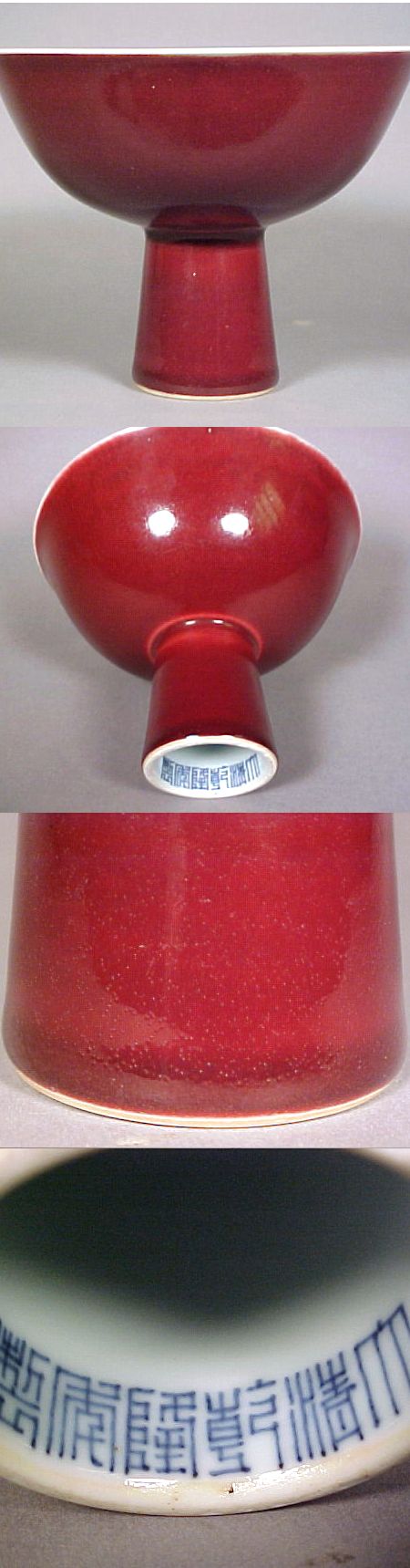
A very rare stem cup (gaozu bei) glazed inside and out with jihong glaze, also referred to as fresh red imitating Ming sacrificial red, xianhong. The rim and the base of the interior of the foot are glazed white. Qing Dynasty, M+P Qianlong Period (1736-1795)
Ex: Jan-Erik Nilsson Collection.
Photo: courtesy of Mike Vermeer, 2014
This glaze is also called "bright red". While referring to this glaze on Imperial wares of the Yongle and Xuande period of the Ming dynasty, the name Fresh red (xian hong) are also used.
A monochrome red glaze, especially popular during the Yongzheng (1723-1735) and Qianlong (1736-1795) periods. It differs from both the bright, glassy and crackled Langyao red (langyao hong) and from the mottled peachbloom (jiangdou hong) and was developed for sacrificial vessels to be used at the Altar of the Sun in Beijing. The glaze is even, opaque and rich, and typically with an 'orange-peel' surface (ju pi wen) clearly differing from for example langyao which is smooth and on an entirely different typ.
The Qing jihong glaze is thinner than the Ming xianhong glaze and the formulation is different but the results are very similar.
See also:
Definition
jihong, written 祭红 and often translated as sacrificial red or ceremonial red, is a high fired copper red monochrome glaze that became famous in early Ming, particularly the Xuande period. The term refers not only to a color effect but also to an intended ritual function, namely vessels made for imperial state ceremonies. In later periods and in Western collecting language, the same visual range is sometimes described with terms such as sang de boeuf or oxblood, which are appearance based terms rather than original functional terms.
Color, meaning, and the imperial altars
In the imperial ritual system, color carried cosmological meaning. The main altars in Beijing were associated with a color scheme used for official sacrifices. A widely cited formulation is: red for the Sun, blue for Heaven, yellow for Earth, and white for the Moon. In this framework, sacrificial red belongs primarily to Sun rites and Yang symbolism, although red ritual wares can also appear in broader state ceremonial contexts depending on reign, workshop practice, and later replacements.
Form versus color, which factor decides what
A key point is that the vessel form defines the practical ritual function, while the glaze color defines the cosmological category. This is why the same vessel form may exist in several official colors. The porcelain shapes ultimately mirror older bronze ritual forms, even when the material changes from bronze to porcelain.
Common vessel forms used in the ritual system
Stem cup and the high foot offering bowl
A typical shape often considered as a ritual sacrificial shape is the type we call stemcup. Technically it is a dou, a covered bowl on a long stem. In porcelain studies, closely related stemmed cups may be described as stem cups or high foot cups. These stemmed forms are important because they make the continuity from bronze ritual vessels visually obvious, and because sacrificial red examples are documented in stemmed forms as well as in bowls and other altar shapes.
Technical notes
jihong is a copper red glaze fired in a carefully controlled reducing atmosphere. Small shifts in kiln atmosphere, temperature, or glaze thickness can push the result from an even red into patchy areas, darkened streaks, or failed grayish tones. This high risk production profile helps explain why early fine jihong pieces are scarce and highly valued.
Terminology cautions
In modern writing you may encounter several Chinese names used near each other: 祭红 jihong, 鲜红 xianhong, and 宝石红 baoshihong. Some sources also discuss 霁红, which can be translated as ruby red or cleared red, and it is sometimes confused in transcription with 祭红 because both read as jihong in pinyin. When precision matters, it helps to give the characters and clarify whether the author is describing ritual function, a specific early Ming reference, or a later aesthetic category.
Sources
Recommended literature
General references and historical background
Imperial use, terminology, and art historical context
Technical and scientific studies
A